Disabled citizens are struggling to get government issued benefit cards because the offices are situated on higher floors of buildings. Karvy Technologies has been hired to collect biometric information for the UID project, by the government. One of its centres is located on the first floor of a building at Sampige road in Malleswaram. This centre has no provisions like nurses, elevators or even a ramp to support a wheel chair.
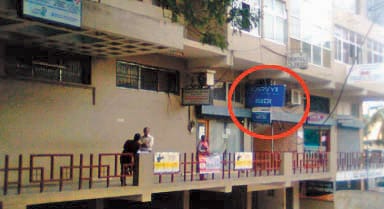
Karvy technologies at Sampige Road. Pic: Author
Venkatesan has been trying to get an Aadhar card for his physically challenged wife. He said: “I have been in touch with the department for the past six months but I cannot find a way to bring my wife to the technology centre.”
Karvy Technologies told Venkatesan that he was supposed to bring his wife to the office. When asked for an alternative registration location, he was asked to approach the Aadhar head office.
Fingerprints of all ten fingers and an iris scan is conducted for every citizen and the biometric details are collected at Aadhar registration centres in the city. Karvy Technologies’ offices are located in different parts of the city and amongst them the centre at Baswangudi is the only one located on the ground floor.
Similar circumstances prevail at the Panchayat office in Kumbalgodu. The centre responsible for biometric information collection is located on the first floor and is accessible only through a narrow staircase.
Emailing the UIDAI help-desk gets a very negative response. According to them, UIDAI has no facility at the centres for physically challenged people to give their biometrics.
Ashok Lenin, Deputy Director at UIDAI says, “People with physical disabilities come under the Marginalized Scheme. This scheme is aimed at taking biometrics of people who have physical limitations.
The Marginalized Scheme also involves officials visiting old age homes to take their biometrics. Lenin adds that a physically challenged person is exempted from the fingerprint process. He says, “Omni-vans are allotted to facilitate the Marginalized Scheme to reach out to people who are unable to go to technology centres to give their biometrics.”
⊕