Chennai’s Metropolitan Transport Corporation (MTC) is no more the monopoly provider of shared rides in the city, with share autorickshaws eating into its ridership on arterial routes. Moreover, it is losing revenues after it raised the fares, without any improvement to bus services or their quality – it had no air-conditioned services to offer this summer. But surprise! MTC did not make any move to find out how much it is losing to these 8-seater share auto vehicles, most of which are operated without a proper permit.
Share autos are in the grey zone, since there is no way they can be legalised.
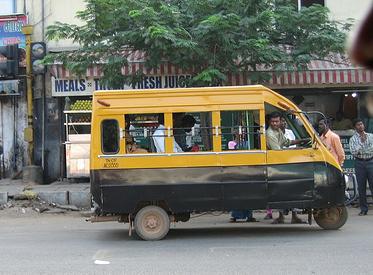
A share-auto in Chennai. Pic: Wikimedia Commons
Answering a Right to Information request, MTC said last week that it had no estimate of the number of trips it was losing to share autorickshaws. “No, however MTC is taking appropriate action against the illegal operation of private auto / share auto in Chennai,” it said.
The bus corporation also evaded answers to questions on whether it had held discussions with Chennai Metro Rail Limited, on running feeder buses from stations.
Asked for details of any meetings that it had held with CMRL on the topic, and the dates when these were held, MTC replied, “In the interest of public welfare, MTC is providing sufficient number of connecting services through Chennai Metro stations and MRTS/Southern Railway stations in and around Chennai.”
MTC also revealed that:
Of 200 small buses purchased as of May 1, 2018, 5% are not operational, that is 11 buses.
Only Ashok Nagar, Alandur, Nehru Park, Central, AG-DMS, Vadapalani, CMBT Koyambedu stations of Chennai Metro are connected via small buses.
Thus, the following Metro stations are not connected:
Teynampet, Nandanam, Saidapet, Little Mount, Guindy, Ekattuthangal, Arumbakkam, Thirumangalam. Shenoy Nagar, Pachaiyappa’s College, Kilpauk. All these are currently functional Metro stations.
MTC claimed to provide a bus link to the following suburban/MRTS of the Southern Railway:
Pallavaram, Chromepet, Tambaram, Velachery, Guindy, Thiruvanmiyur, Nungambakkam, Perungalathur, Madhya Kailash MRTS
In fact, in November 2017, as it was completing the underground line to Central, Chennai Metro was hosting an Ola cab kiosk and announcements about a small bus service from Nehru Park to Central. Metro services have not been extended up to Central.
MTC does not have a policy of providing open data on its services, preventing better utilisation of even the meagre available fleet through the creation of software applications for mobile phones.
This article in the News Minute quotes a government official to say MTC is working on GPS-based services. In reality, it has already trialled GPS-based services through multiple channels, but quietly withdrew all efforts for unexplained reasons.
[This has been reposted (with no changes except images) from the popular blog Straphangers United; the original post and photos can be viewed here.]