Webinar: Arkavathi and her sisters

Data-driven evidence can help people make informed decisions on protecting our Rivers. Listen to experts and citizens to know how.

Rivers, the lifeline of our economy, are drying up and/or becoming too polluted. Drought and floods are becoming frequent and more intense. Addressing these challenges involves making sound data-driven and evidence based decisions in the context of the river basin. In a mature democracy, data and evidence should be in the public domain, so citizens, including policy makers, can form informed opinions and take informed actions.

Once, it was the Arkavathi river that sustained Bengaluru. Running dry and polluted for almost half a century now, Arkavathi river is today biologically dead, a ghost river. It stands as living proof of what is in store for our other rivers and lakes.


Read more: Vrishabhavathi, Arkavathi, Cauvery, my mother


Citizen Matters is organising an online panel discussion: “The future of Bengaluru’s rivers, drains and lakes” in collaboration with BIC:

  • The current state of the rivers, kaluves and lakes of Bengaluru and their interlinkages.
  • Initiatives, non-starters and plans in the air.
  • The role of civic groups in the way forward.
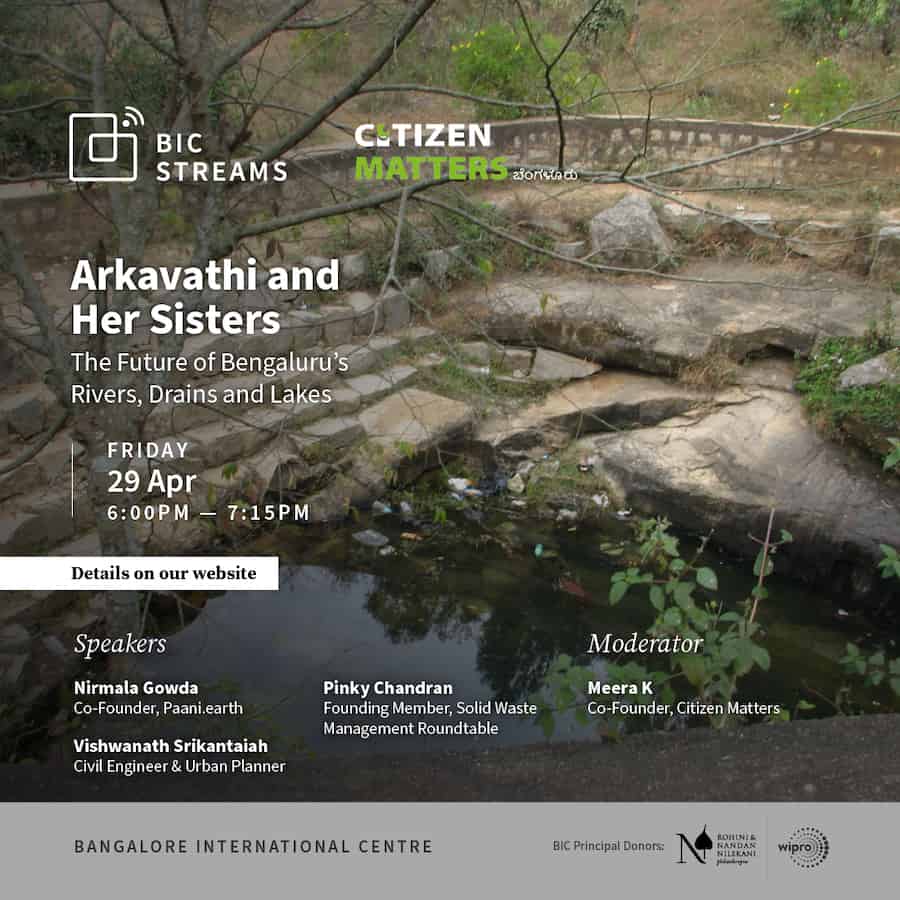
Arkavathi and her sisters webinar poster

Event details:

Event title: The future of Bengaluru’s rivers, drains and lakes
Date: April 29, 2022
Time: 6 pm (The webinar will be followed by a brief Q&A session open to participants.)
Register here: https://bit.ly/RiversofBengaluru


Read more : Why are Bengaluru lakes green in colour?


Speakers:

  • Nirmala Gowda – Co-founder, Paani.earth
  • S. Vishwanath, Civil Engineer & Urban Planner
  • Pinky Chandran – Founding Member, Solid Waste Management Roundtable
  • Meera K – Co-founder – Citizen matters (Moderator)

Also read:

Leave a Reply

Your email address will not be published. Required fields are marked *

Similar Story

Reviving the Cooum: Need for innovation, enforcement and shared responsibility

An analysis reveals how this Chennai river is affected by sewage dumping, encroachment of buffer zones and unchecked urban growth.

The Cooum River, once a sacred river that shaped the history of Madras, has now become a sad sign of urban degradation. For the millions of residents in Chennai, it has transformed into a malodorous, polluted, and stagnant channel, burdened with solid waste accumulation and extensive encroachments along its banks. During a recent datajam organised by Oorvani Foundation and OpenCity, we used Geographical Information System (GIS) datasets and population analytics to investigate the underlying causes contributing to this crisis. The results show that rapid urbanisation, inadequate provision of essential civic infrastructure, and the absence of coherent policy frameworks, along with…

Similar Story

Pallikaranai at a crossroads: Expert warns of irreversible damage to Chennai’s last great marshland

In an interview, naturalist Deepak V says the government must publish ecological maps marking wetlands and waterbodies to boost public awareness.

The Pallikaranai Marshland, one of Chennai’s last remaining natural wetlands, has long been a site of ecological tension. Its designation as a Ramsar site brought national and international recognition, along with renewed expectations for strong conservation measures. Yet the marshland continues to face intense pressure from urban development, infrastructure projects and real estate expansion.  Recently, Arappor Iyakkam, an anti-corruption organisation, alleged that state agencies illegally cleared environmental and construction approvals for a large high-value housing project within the Ramsar boundary. As the matter unfolds, it reveals how regulatory gaps and political inaction make the marsh vulnerable. Meanwhile, residents of Tansi…