Over the last few years, the city of Bengaluru has been growing beyond its potential. As a city with educated and active citizens, civic activism has been a significant decider in how the city develops.
One of the citizen activism initiatives has been developing the existing railway network to boost the suburban rail project.
A few years ago, the Government of Karnataka (Karnataka Rail Infrastructure Company (K-RIDE)) started developing a plan for the extension of these railway networks.
It recently announced that the 48-km Baiyappanahalli-Hosur railway line will be double tracked by 2022.
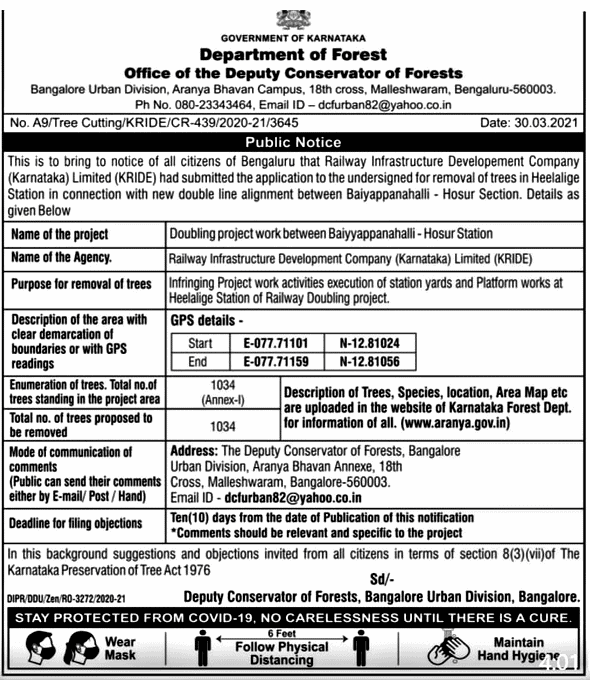
This alignment will be along the Yeshwantpur bypass, Hebbal, Banaswadi, Bellandur, Heelalige, Anekal Road and Maranayakanahalli.
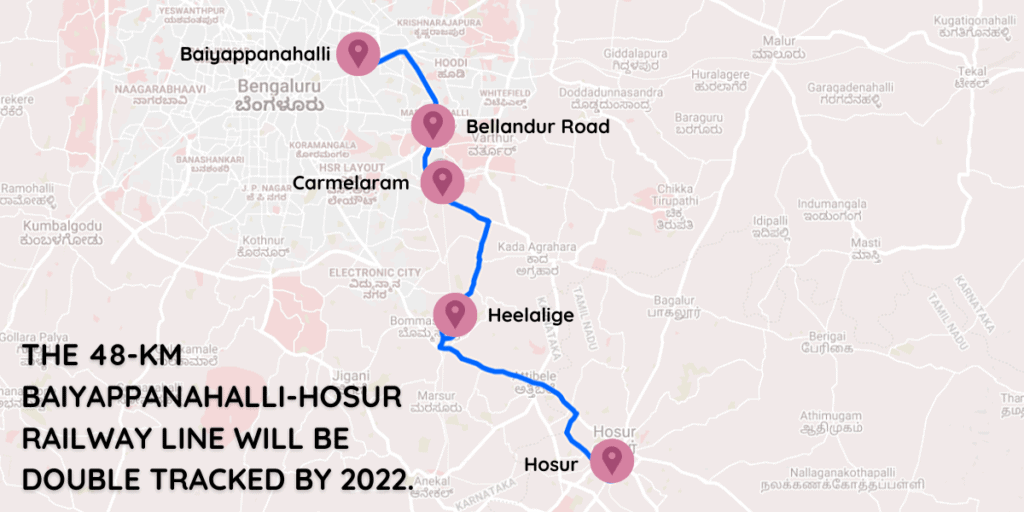
Last week, a news report stated that over 1,034 trees will be ‘removed’ for the track doubling work between Baiyappanahalli and Hosur.
The forest department issued a public notice requesting objections and suggestions according to the Karnataka Preservation of Tree Act. The deadline for filing objections is 10 days.
Given COVID and the spread of zoonotic diseases in humans due to the loss of habitat for animals, it is valid that the loss of 1,034 trees be questioned.
Is a 10-day objection period adequate? Also, is this a comprehensive participatory process? Yes, a few citizens’ groups that based their demand for this suburban rail project on traffic jams at Carmelaram and Sarjapur were powerful enough to advocate and push through their agenda.
Read more: If Bengaluru needs Commuter Rail, Commuter Rail needs Bengaluru
However, are the villagers that flank the alignment and the flora and fauna to be purely passive and accept this development with little to no input in the process?
Ideally, ward committees and village panchayats along the alignment would work with the State government and forest department to decide whether they want the project cutting through their villages and if it is acceptable to them, to exercise greater power over tree plantation and protection.
The process needs to be more democratic and representative of the local population.
Secondly, In Feb 2021, the Supreme Court, opining on a petition (regarding the felling of over 350 trees for the construction of railway over bridges (ROB) and widening of National Highway-112 from Barasat to Petrapole on the Indo-Bangladesh border in West Bengal), observed that a protocol is followed for projects to minimise damage to the environment.
Read more: Essential questions to ask when considering new transport projects in Bengaluru
A seven-member committee to develop scientific and policy guidelines for decision-making for cutting of trees for developmental projects has been set up.
The Court stated it was imperative to make a realistic assessment of the economic value of a tree. This had to consider “its value to the environment, longevity, production of oxygen, carbon sequestration, soil conservation, protection of flora/fauna and its role in habitat, ecosystem integrity and other ecologically relevant factors, distinct from timber/wood.”
It stated that “the right to a clean and healthy environment has been recognised as a fundamental right under Article 21 of the Constitution… Article 48-A imposes duty upon the State to endeavour to protect and improve the environment and safeguard the forests and wildlife of the country.”
How does this opinion then affect the double tracking of the Baiyappanahalli-Hosur track?
According to a 2017 study by the Indian Institute of Science, there has been an 88% decline in green spaces from 1973 to 2017 in Bengaluru. Much of the city has been concretised.
A recent RTI reply by the Bangalore Development Authority (BDA) shows that no saplings have been planted between 2017 and 2019.
India has a poor tree population per person ratio compared to other countries.
According to a research study published in the journal Nature in 2015, worldwide, there are 422 trees per person. Brazil has 1,494, Canada 8,953 and China 102 trees per person whereas India has only 28 trees per person.
With temperatures rising, groundwater table depleting and urban flooding becoming a common occurrence, this is disastrous for the city.
The State government and the forest department appear to have become immune to public sentiment or at least to the majority of the citizens.
Presently, it is the municipal corporation that orders the felling of a tree. By the time the forest department learns of the felling, the tree is already cut and there is little accountability left.
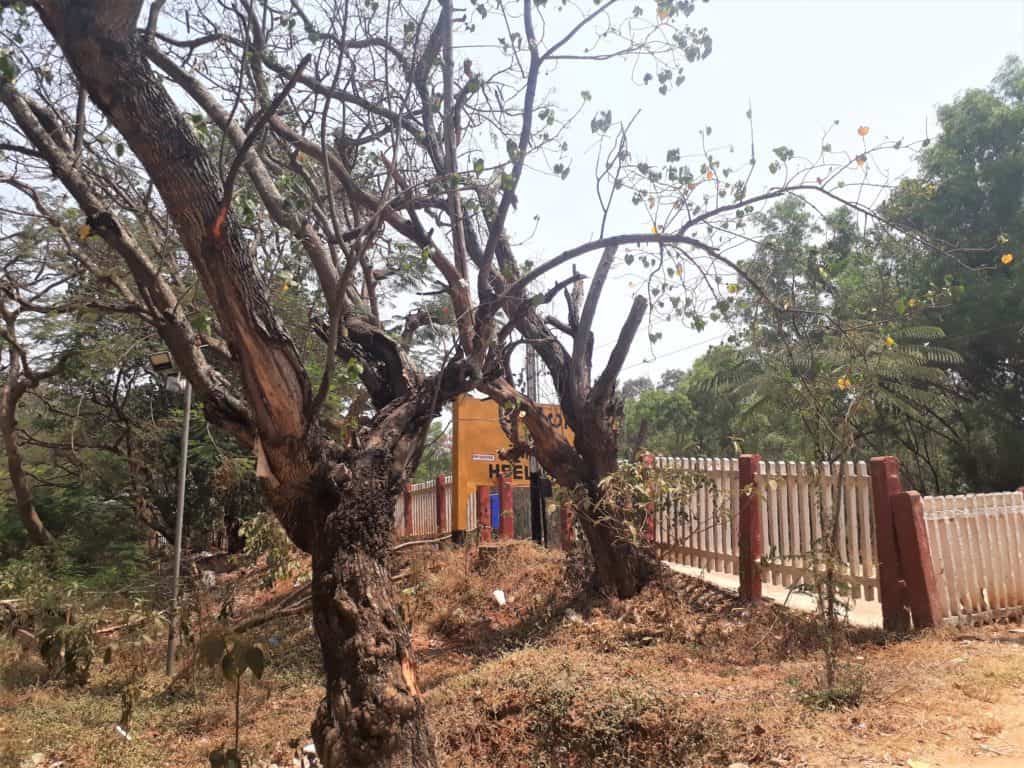
In this case, the felling appears to have begun even before the closure of objections. As of April 7, some trees at the Heelalige Railway station were cut. Today, April 8, is the last day for the public to submit any objections to the removal of trees.
The public notice regarding the tree felling brings up many questions.
One, who decides what is better for the city? Active citizen groups or local villagers? How democratic has the process been?
Two, was an EIA conducted before the project was announced? Where is the report? Were people adequately consulted for this report?
Three, why is the objection period for the felling of trees so short?
Will the objections make any difference or will K-Ride cut the trees before the forest department can intervene?
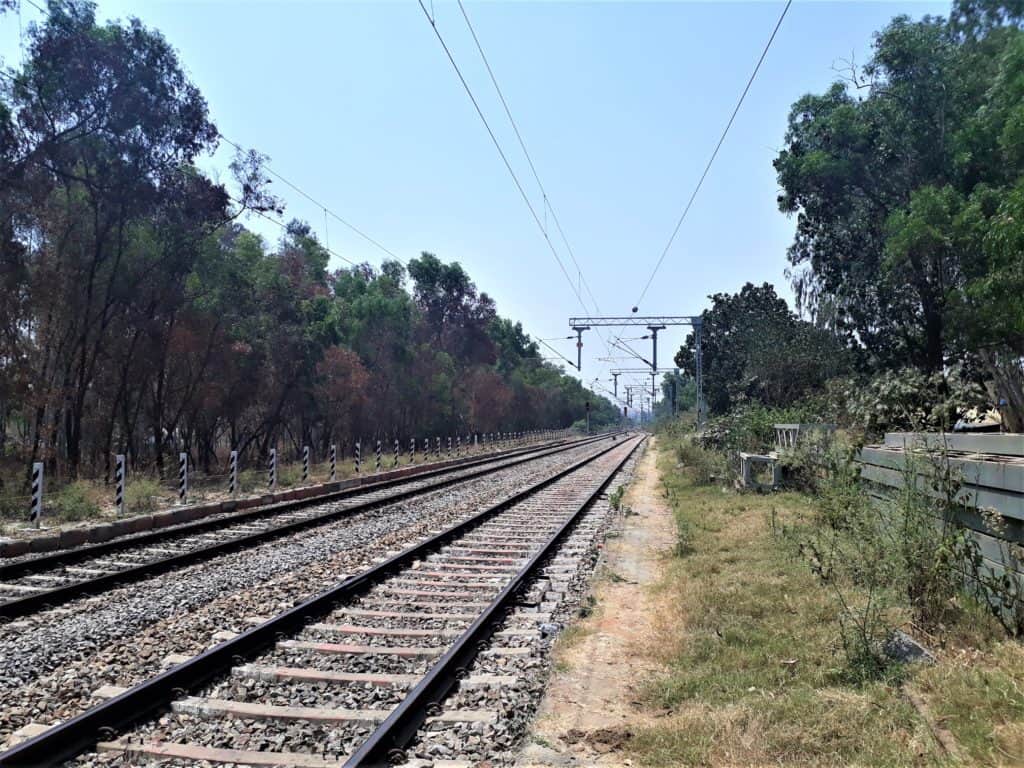
Most of the trees are Eucalyptus or Acacia. As per Forest Department guidelines, these two do not fall under the protected category. However, it is necessary that we carry out compensatory planning. Railways have used their lands to create Miyawaki Forests in Kengeri, Bidadi, and KR Puram. Something similar can be created along the Hosur Stretch. Doubling is the need of the hour. Investment in public transport is a must. It is a better idea than investing on elevated corridors for a few car owners.
Most of those trees are either eucalyptus or Acacia, that were planted as commercial trees in 1980’s along the tracks. We all know how bad those trees are. So much so that the planting of eucalyptus is banned!!
How many are eucalyptus and acacia, if u can provide that it will help us understand..
If any tree getting cut i don’t support this expansion1
we should encourage Railways to take up compensatory afforestation. Doubling of railway lines is key for a sound suburban network and also for easy passing of long distance trains.
Doubling of railway line from byappanahalli to hosur is must,all surrounding commuters need suburban train immediately from heelalige to rajanukunte……
If government listened to villagers all these days, then there would be no roads/railway tracks across the country. It’s common sense to understand that most villagers will oppose losing their land. We can’t blame them but we can’t be underdeveloped too.
Better allow tree axing on main roads/along railway tracks for expansion and plant trees on lakhs of small roads.
As rightly said by Mr Subramanium, most trees are Acacia and Eucalyptus which are not protected species. They were planted by Railways in vacant railway land. Now that doubling of track has to be done,compensatory plantation will be done immediately following all mandatory provisions. This is an important infra project which needs the support of all sections of the society.
As regarding to cutting of trees, I thought that in the dictionary of karnataka forest department, there no word of re-location of trees, I request forest department staff to make a visit at Kempa Gowda international airport, Bengaluru there you can see how they re- locate trees instead of cutting trees mercilessly. Cutting is very easy, but planting and preserving??. In another way, in road side forest department planting sapling in under the electric line, after one year Bescom will clear the trees, I will sent few images to FD very soon, please look in the matter and do needful.