Mandran and NCBS (National Centre for Biological Sciences) have put together Jigyasa event for 2018, themed on Traditional Knowledge meets Modern Science. The event starts at 9.30 am on December 15, 2018 at the Dasheri Hall in the NCBS campus in Kodigehalli, Bangalore.
This time the Jigyasa project features three languages, Kannada, Tamil and Hindi with eminent scientists participating to share their knowledge in their mother tongues. This event has been put together to benefit people whose primary language of communication is not English.
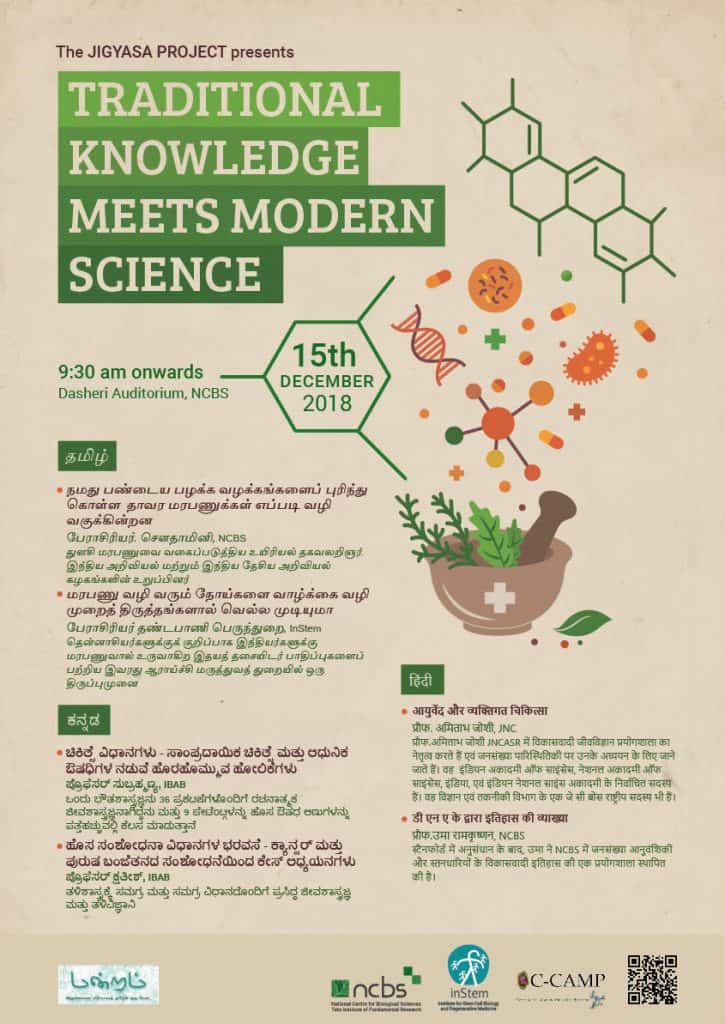
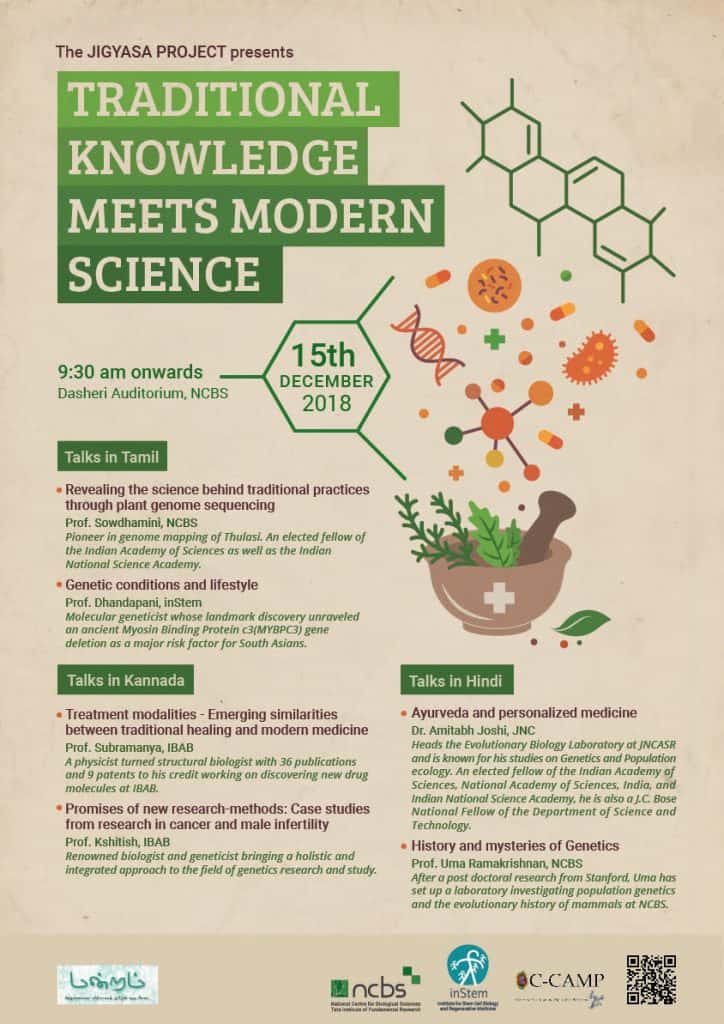
Tamil: Prof. Sowdhamini and Prof. Dhandapani, from 10 am to 11.30 am.
Prof Sowdhamini from NCBS is a pioneer in genome mapping of Thulasi. She is an elected fellow of the Indian Academy of Sciences as well as the Indian National Science Academy. She will speak about how plant genomes explain the reasoning behind some of our traditional practices.
Prof. Dhandapani, INSTEM, Molecular geneticist whose landmark discovery unraveled an ancient Myosin Binding Protein c3 (MYBPC3) gene deletion as a major risk factor for South Asians. He will share his knowledge on how some genetic orders are becoming major risk factors due to our lifestyle changes and how we can overcome them.
Kannada: Prof Subramanya and Prof Kshitish, from 11.45 am to 1.15 pm.
Prof Subramanya, IBAB is a physicist-turned-structural biologist with 36 publications and 9 patents to his credit working on discovering the new drug molecules at IBAB. Subramanya will talk on interesting similarities between emerging treatment modalities in modern medicine and how they have always been the central principles for ancient healing mechanisms.
Prof Ksitish, IBAB is a renowned biologist and geneticist bringing back a holistic and integrated approach to the field of genetics research and study. He will share how his unique approach has impacted his studies and work.
Hindi: Prof Amitab Joshi and Prof. Uma Ramakrishnan, from 2.45 pm – 4.15 pm
Prof. Amitabh Joshi, JNC, heads the Evolutionary Biology Laboratory at JNCASR and is known for his studies on Genetics and Population ecology. An elected fellow of the Indian Academy of Sciences, National Academy of Sciences, India, and Indian National Science Academy, he is also a J C Bose National Fellow of the Department of Science and Technology. He will focus on Ayurveda and personalised medicine.
Prof. Uma Ramakrishnan, NCBS, after a post doctoral research from Stanford, has set up a laboratory investigating population genetics and the evolutionary history of mammals at NCBS. Prof. Uma will speak on how genetics is shedding light on evolutionary patters of humans.
The event is free and is open to all. Lunch will be served at the venue. RSVP here.
Mandram, the organiser of this event, is a global platform for like-minded people with interests in Tamil language and literature, from different backgrounds, to share their perspectives, journey and success stories. The first-ever Mandram was organised in Chennai which had speakers from varied backgrounds like science, art and culture sharing their perspectives. Mandram was started in January 2018 by Maragathavalli Inbamuthiah (Director, AnitaB.org India) and Venkatarama Ramachandran (Digital Story Teller and Product Manager).
Note: This press note has been shared by the organisers and published here with minimal edits.
NCBS is calling people from outside NCBS for talks in Kannada. The institute is located in Karnataka and no one from NCBS can give a talk in Kannada!. You can find faculty from all over the country, but there are hardly any Kannadigas in the institute. This is the plight of all National Institutes in Karnataka. In the name of National Institutes, they somehow avoid Kannadigas entry into their institutes. IIT Dharwad which was set up recently has already started the same trend of hiring outsiders as if there are no faculty material in Karnataka.