Arvinda dreams of becoming a psychologist. But the 21-year-old transwoman from Hyderabad had to discontinue her education in 2023, after finishing her polytechnic diploma, so she could work and raise money for her sex reassignment surgery.
That’s the price she had to pay for living as her true self. Arvinda now earns ₹25,000 a month after taking a job at a BPO, of which around ₹12,000 goes towards repaying the loan she took to cover her medical expenses and afford other gender-affirming healthcare, including regular hormone treatments.
“I had to take a loan just to be who I am,” she says, lamenting the lack of government support to ease such a financial burden. She is not alone in this struggle. The transgender community continues to face challenges in accessing healthcare, especially procedures that would help affirm their gender identity.
In 2022, the Ministry of Social Justice and Empowerment (MoSJ&E) signed an MoU with the National Health Authority to launch a comprehensive health package for transgender persons under the Ayushman Bharat-Pradhan Mantri Jan Arogya Yojana (AB-PMJAY) scheme. The scheme promised health insurance coverage for transgender healthcare, including gender affirmation surgeries.
However, there’s no relief for the community due to a lack of implementation of the scheme. Three years on, many like Arvinda are waiting for help, struggling to pay lakhs of money for their gender affirming healthcare.
When Kalki Subramanian, Southern representative of the National Transgender Council, raised the issue of the delay, she received a positive response, but no action was taken. The council is an advisory body under the MoSJ&E, which evaluates and gives recommendations on existing policies. “The ministry has conducted a few meetings, where we demanded speeding up the process,” Kalki says.
What is gender-affirming care?
Gender-affirming care, as defined by the World Health Organization, encompasses a range of social, psychological, behavioural, and medical interventions designed to affirm an individual’s gender identity when it conflicts with the gender they were assigned at birth.
It includes medical and psychological support, such as surgeries, hormone therapy, and counselling, that help transgender individuals align their bodies with their gender identity and improve overall mental and emotional well-being.
The cost of gender affirming surgeries could range anywhere from ₹2 lakh to ₹8 lakh, and the cost for hormone treatments and therapy could range between ₹48,000 and ₹72,000 a year.
What was promised
The Ayushman Bharat scheme, launched on September 23, 2018, aims to provide health insurance to underprivileged rural families and selected urban worker groups based on the Socio-Economic Caste Census (2011). As of now, the AB-PMJAY dashboard reports over nine crore hospital admissions under the scheme. More than 41 crore Ayushman cards have been issued, including 4.57 lakh cards for individuals identified under the gender category marked as ‘other’.
While this card could help transgender persons access general healthcare, it excludes gender-affirming services.
Meanwhile, the special package announced in 2022 introduced the Transgender Healthcare (TG Plus) card, which allows transgender individuals to access over 50 medical procedures and treatments free of cost. The ministry will fund ₹5 lakh worth of health insurance per person each year under this scheme. However, the revised list of health benefit packages, released in November 2021 (before the announcement to include transgender healthcare), does not include any gender-affirming procedures. Neither has a new list of services been released.
Delay in implementation
The community seems to have lost hope in the scheme. “There is no step-by-step plan on how this will be implemented,” says Koyel Ghosh, Managing Trustee at Sappho for Equality, a Kolkata-based organisation working for the rights and social justice of individuals with non-normative gender-sexual orientations. Detailed information about the implementation—how to get these cards, what medical procedures are covered, etc.—is missing, Koyel adds.
Obtaining the TG Plus card is essential to get gender-affirming healthcare benefits. Neither the AB-PMJAY website nor the National Portal for Transgender Persons has a provision to apply for the card. Instead, beneficiaries with a transgender certificate from the portal must visit any empanelled hospital to get a TG Plus card. This process makes the scheme inaccessible to many.
Read more: Ayushman Bharat: All you need to know about availing benefits under the scheme
“We have provided the ministry with a list of medical procedures and cost estimations last year, but there has been no progress,” said Dr Sanjay Sharma, CEO and Managing Director of the Association for Transgender Health in India (ATHI). Moreover, the requirement to possess a certificate and to visit an empanelled hospital gatekeeps many from accessing the benefits, experts suggest.
Gatekeeping access to welfare
Zainab Patel, a trans activist and one of the petitioners in the landmark NALSA case and the marriage equality case, says that the issue of entitlement should be separated from identity. “We have been rallying behind the government to ensure that access to welfare is not contingent on proving one’s identity. But they are making the transgender certificate/ID Card incumbent on getting the entitlement,” Zaineb says.
This also goes against the Transgender Persons (Protection of Rights) Act, 2019, which does not mandate a transgender certificate to get gender affirming healthcare.
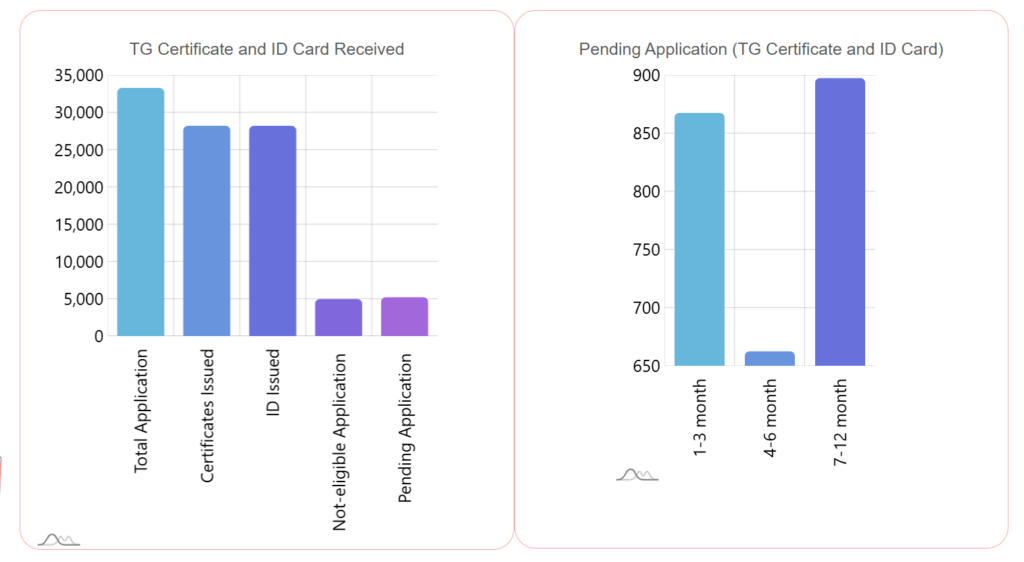
Transgender individuals can apply for a certificate online through the National Portal for Transgender Persons or at the nearest Social Welfare Department office, using an affidavit or medical certificate. However, the process is slow, and community awareness remains low. Arvinda, despite updating all her identity documents, including her Aadhaar card to reflect her transgender identity, is still unaware of how to obtain the certificate or ID card.
According to the 2011 Census, 4.8 lakh individuals identified as ‘other’ gender. But this number has grown considerably, as reported by Down to Earth. Despite this, only around 27,300 certificates have been issued so far, and more than 5,000 applications are pending approval.
Because of this, around 95% of the transgender population, who do not have the transgender certificate now, cannot avail the benefits of the scheme.

Lack of accessibility
Even with a transgender certificate, accessing the TG Plus card is difficult. Rakshitha Mallikarjuna, a trans-activist with Ondede, a Karnataka-based organisation led by transgender persons, says many from the community lack basic facilities and education, so the government can not expect them to understand the complex application process.
A dedicated online portal could make the process easier and would ensure transparency, say activists. Zainab recalls that when the scheme was being implemented two years ago, a portal existed, but it was riddled with glitches, so she could not apply for a card. Later, the portal was closed.
Zainab and Rakshitha reiterate that awareness campaigns and camps to issue cards are necessary to help the community avail the scheme.
When we tried contacting officials from the Ministry of Social Justice and Empowerment, we did not get a proper response.
Read more: Reservation in public employment for trans persons in Karnataka still a far cry: Akkai Padmashali
Empanelled hospitals
Another concern is the absence of a separate list of empanelled hospitals where beneficiaries can access gender-affirming healthcare. “Moreover, if the hospital staff are not sensitised enough to support transgender persons, that would become another obstacle,” Rakshitha says.
Zainab is concerned about whether hospitals will prioritise gender affirming healthcare, considering the recent reports on delays in the payment of dues of several crores to the hospitals by the government. “Gender affirming care is life-saving, considering that gender incongruence could lead to a lot of mental health issues, but many in the government or the healthcare sector lack this understanding,” she says. “Will these surgeries then be prioritised? People will always think of these as aesthetic or non-essential services.”
Moreover, only around 30 hospitals among the AB-PMJAY list of empanelled hospitals are specialised in gender affirming care. “With this capacity and the number of transgender persons, there is no clarity on the possibility or plan to put in place these services,” Zainab says.
Lack of uniformity across the country
The Transgender Persons Act, 2019, mandates the provision of medical facilities and coverage for gender-affirming procedures. However, only a few states have implemented free or subsidised services.
Tamil Nadu provides free sex reassignment surgeries in selected government hospitals. In Kerala, transmen and transwomen receive up to ₹5 lakh and ₹2.5 lakh respectively, reimbursed post surgery. Beneficiaries get ₹3,000 per month for a year of post-operative care.
A few government hospitals in Delhi provide gender-affirming surgeries free of cost. In 2022, Maharashtra announced that these procedures would be done free of cost, but there are no records of implementation. Similarly, in Karnataka, the transgender policy provides for financial assistance, but no budget allocation has been made.
The Ayushman Bharat scheme could have brought uniformity in financial assistance for transgender care in the country. “Given that many transgender and queer individuals are forced to migrate due to a lack of acceptance in their families, ensuring uniformity in access and support across regions becomes crucial,” says Dr Sanjay.
According to the National Portal, the scheme would only cover transgender persons who have not received such benefits from other central/state-sponsored schemes.
The demand for speeding up the process
An article titled Gender affirming care saves lives, published by the Department of Psychiatry, Columbia University, reveals that transgender and non-binary adolescents and young adults experience anxiety, depression and suicidal thoughts at a much higher rate than their cisgender peers.
“Gender affirming care is a critical need for many. Denying access to it is pushing people into depression, anxiety, and even suicide,” said Koyel. “A lot of people are not being able to live their lives on their own accord as the certificates that recognise them and the healthcare schemes are not provided to them at the right moment.”
Experts and activists demand that there should be a clear roadmap on how this scheme will be implemented:
- Simplify and speed up the application process for TG Plus card.
- Create an exclusive online portal and organise focus-based camps to roll out the TG Plus cards.
- Add gender-affirming healthcare treatments to the list of medical procedures covered under AB-PMJAY.
- Do not make TG certificate mandatory to obtain the TG Plus card.
- Announce a clear roadmap for implementation and the processes to avail benefits.
- Publish a separate list of empanelled hospitals where gender affirmation surgeries are available for beneficiaries.
The second part of this series will delve into the systemic issues and policy gaps that hinder inclusive healthcare.