In envisioning the ‘Good City of Chennai,’ North Chennai, including Manali and Ennore, were turned into industrial sacrifice zones. Successive governments have ignored the complaints and protests of local residents against industrial pollution and degradation of the Ennore wetlands.
After the 2015 floods spotlighted the critical role of wetlands in mitigating floods, the Government of Tamil Nadu announced a project for ‘Eco-restoration of Ennore Creek.’ However, the project — with its weak ambition and limited scope — was opposed by Ennore fishers, who decided to produce their own ‘People’s Plan’ for the restoration of their region.
In 2019, the fishing villages of Ennore, assisted by city-based solidarity activists from the Save Ennore Creek Campaign and Coastal Resource Centre, began the process of developing a People’s Plan for the restoration of the Ennore wetlands.
What began as an alternative spatial plan in response to CRRT’s proposed project, evolved into a deeper plan incorporating the need to respond to the multiple ways in which relationships between people and place, people and people, and people and non-human communities have evolved in the region.
Read more: Ennore power plants violate emission norms, pose serious health risks: Study
State and expert-led wetland restoration plans suffer from an inability to break free from disciplinary compartmentalism, anticipate and address imminent threats to the restored ecosystem or deal with unquantifiable relationships and values.
The People’s Plan for Eco-restoration of the Ennore Wetlands draws on local stories, and the emotions and aspirations of local communities to provide a framework for holistic restoration that straddles four interacting, overlapping spheres of relevance — namely, health (human health as part of ecosystem health), economy (jobs and livelihoods), culture and ecology.
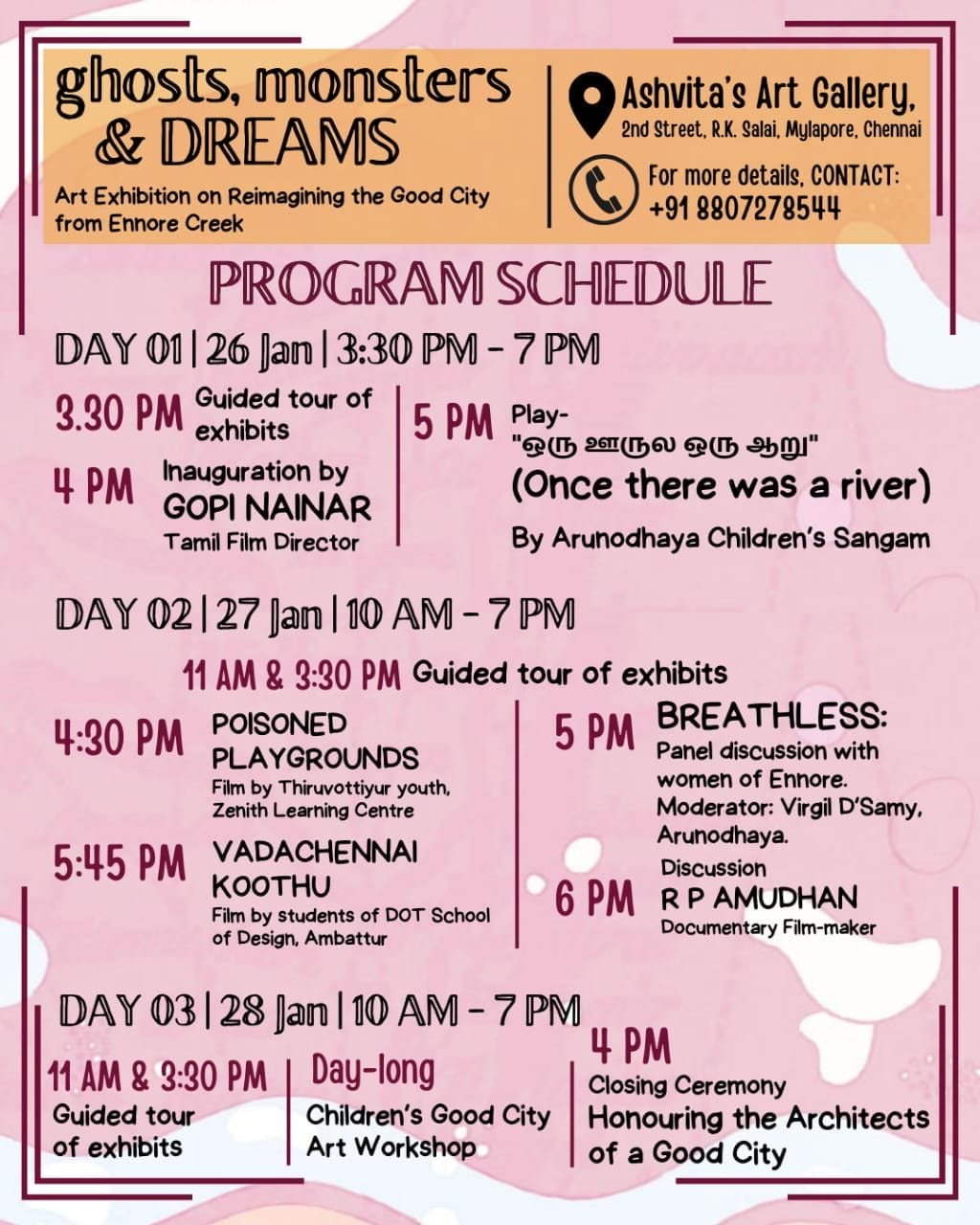
The People’s Plan will be launched at a formal event in Ennore on January 27th. A visual, artistic expression of the stories that inform the People’s Plan will be on display at an art exhibition at Ashvita’s Art Gallery, 2nd Street, RK Salai, Mylapore from January 26th–28. More than just an art exhibition, ‘Ghosts, Monsters and Dreams’ will also serve as a platform for voices from north Chennai through story-telling sessions, a play titled Once there was a River and a film by youngsters from north Chennai about sports, play and health.
Featuring art produced by eight young artists, including four students from the Government College of Fine Arts, the exhibition builds on Ennore residents’ memories of the place, their current anxieties and their aspirations for their futures.
[This article is based on a press release by the Save Ennore Creek Campaign and Coastal Resource Centre and has been published here with minimal edits.]