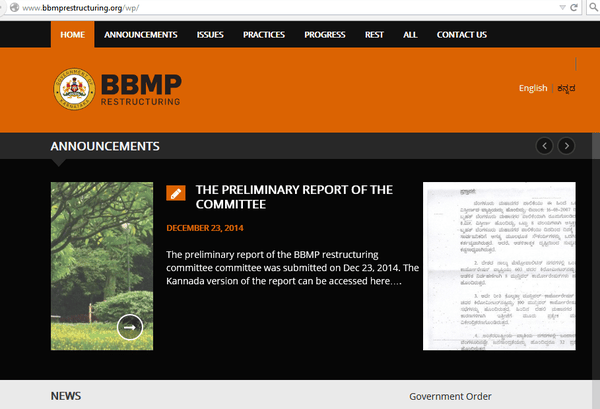
Website of the BBMP Restructuring Committee features the progress made by the Committee.
A three-member Government Committee formed in order to work out the modalities of dividing Bruhat Bengaluru Mahanagara Palike has been also entrusted the task of restructuring BBMP.
As Ravichandar, one of the members of the BBMP restructuring committee puts it, the Committee aims to structure it in such a way that:
- quality of life improves in Bengaluru for decades to come
- quality services are accessed by all citizens; accountability of elected representatives and service providers
- Bengaluru features among top 50 global cities on liveability
The Committee also aims to examine whether the city is better served by multiple City Corporations in place of the huge BBMP spread over 198 wards and 800 sq kms, by answering the questions:
- Can pure administrative decentralisation in the current set up do the job, or is political devolution and decentralised administration the way to go?
- If BBMP is going to be divided into multiple corporations, how many are appropriate? What is the basis?
- What are the key parameters to be reckoned while splitting the BBMP?
The Committee will also examine how to coordinate the regional arrangements across Corporations and the entities in the Bengaluru Metropolitan area, that is, the BDA area of 1219 sq kms. The role of Metropolitan Planning Committee, possibility of a directly elected mayor and responsibilities of running the city will also be analysed.
Plan to build accountability measures for elected representatives and service providers, starting at the ward level and working up the chain, possibility of municipalities providing services as opposed to centralised agencies such as BWSSB and BESCOM will also be discussed by the Committee.
The website features everything done by the Committee, progress reports and timelines for interactions with particular groups and so on.
The Committee requests public to:
- Visit www.bbmprestructuring.org
- Read the stuff that catches your fancy; Comment on the articles there; Send us your detailed inputs through the Contact Us section
- Point friends, relatives and anyone else to bbmprestructuring.org
- Share it on Twitter, Facebook
- Whatever you wish to say (positive, negative, indifferent, suggestions, criticisms, queries, whatever) do it publicly! Committee needs more public voices to build a consensus.