Bengaluru’s first-ever Climate Action and Resilience Plan (BCAP) was launched on November 27th, 2023. The main objectives of BCAP are to mitigate greenhouse gas emissions from the city and to build adaptation and resilience against climate change hazards collaboratively, leading to inclusive outcomes for Bengaluru’s citizens. To achieve these objectives, BCAP has formulated short-, medium- and long-term strategies and actions in seven key sectors in consultation with all relevant stakeholder agencies.
Here is a critical look at the progress of BCAP since its inception.
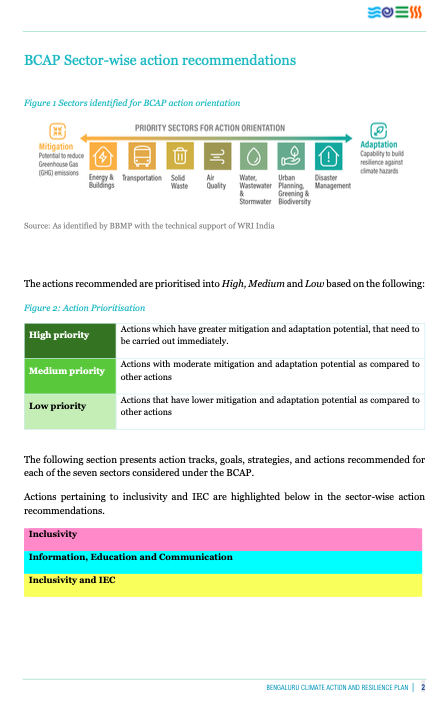
Undoubtedly, BCAP is a very well-conceived, comprehensive and ambitious initiative. It sets clear goals, targets, and actions across seven key sectors — energy and buildings, transportation, solid waste, air quality, water supply, wastewater and stormwater, urban planning, greening, and biodiversity and disaster management
The actions are classified into high, medium and low based on the following:
- High-priority actions, which have greater mitigation and adaptation potential, need to be carried out immediately.
- Medium-priority actions with moderate mitigation and adaptation potential as compared to other actions
- Low-priority actions that have lower mitigation and adaptation potential as compared to other actions.
As a concerned citizen tracking the progress of BCAP, I observed that while the plan identifies several high-priority actions with strong mitigation and adaptation potential, many of these remain under-discussed and unaddressed in implementation meetings so far.
For BBMP Climate Action Sector-Wise Action Recommendations, download this.
In this context, I have written an open letter highlighting these gaps and urging the Bengaluru Climate Action Cell to act on them with urgency.
Read more: BCAP: Bengaluru’s first step towards achieving net-zero by 2050
Excerpts from my letter to Preeti Gehlot, Special Commissioner of Forest, Environment and Climate Change, Bruhat Bengaluru Mahanagara Palike (BBMP):
Dear Madam,
This refers to the document Bengaluru Climate Action and Resilience Plan (BCAP) Sector-Wise Action Recommendations. At the outset, I wish to express my sincere appreciation for the quality and comprehensiveness of this document.
I have picked up the following eight green-coloured points, which are described as high-priority actions that have greater mitigation and adaptation potential, and need to be carried out immediately.
Track-wise actions:
- T 1.5 Implement the approved BMLTA Bill and establish the authority for coordinated action among different transport stakeholders.
- T 2.2 Create bus priority lanes as prescribed by CMP, and improve services by adding components such as safe and usable bus stops integrated with Passenger Information System (PIS) interface, clear signages to help commuters navigate, etc. to improve efficiency and user experience.
- T 2.6 Chalk out a detailed IPT plan for the city (along the lines of CMP) which includes regulatory provisions and operational mechanisms for all IPT modes (autorickshaws, e-rickshaws, app-based taxis, etc.)
- AQ 1.8 Develop low-emission zone (LEZ), ultra-low emission zone (ULEZ), or zero emission areas in the identified hotspots and restrict vehicle movement to limit tailpipe emissions, especially by heavy vehicles.
- UPGBD 1.1 Revise the city’s master plan based on compact development principles and incorporate provisions of the approved Bengaluru TOD Policy
- UPGB D 1.2 Prepare and adopt the ‘TOD Vision and Corridor Plan’ and TOD Zone Plans (TZPs) for all stations along metro Phases 2A and 2B by 2025. Prepare and adopt TZPs for all mass transit stations in the city by 2035 based on a TOD phasing strategy.
- UPGB D 3.2 Complete the ongoing Tree Census exercise in the city by 2025 and update periodically.
- UPGB D 3.3 Map the city’s blue-green cover, including natural drainage, water bodies, floodplains, trees outside forests (TOF), etc., to create a baseline and integrate into the city’s spatial database to facilitate regular updating.
I have gone through the proceedings of all 27 meetings held regarding the Implementation of Bengaluru Climate Action and Resilience Plan (BCAP) from February 12th, 2024, to January 9th, 2025.
On point No 4 – AQ 1.8, I found the following:
- 25 officials brainstormed on the Zero Emission Area which aims to improve air quality, reduce congestion, and GHG emissions.
- They co-created a zero emission area vision for the city.
- Meeting held on May 21st, 2024.
I request you to provide me with a copy of the zero-emission area vision for the city.
On point No. 8, UPGB D 3.3: It is mentioned in the proceedings of the meeting held on February 12th, 2024, that BBMP will create 100 blue-green spaces – I request you to provide the details of these 100 spaces.
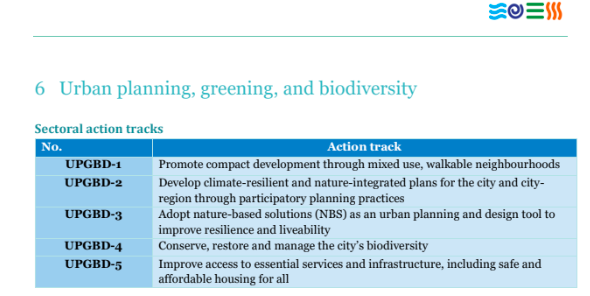
It appears that the remaining six actions have perhaps not been taken up for discussion. I did not notice any mention of these actions in the proceedings of 27 meetings. Please excuse me if I missed anything.
I am of the view that these six actions are big-ticket items, which can make a significant difference to the climate resilience of Bengaluru.
I request you to take these up as high priority for detailing and operationalisation. I would be grateful if I were given an opportunity to make a 10-minute presentation during your next meeting to explain my suggestions.
I look forward to hearing from you.
Thanks and Regards,
Yours faithfully
Dattatraya T Devare
Trustee-Bangalore Environment Trust.
[Writing assistance provided by Sandhya Bhat, Community Anchor at Oorvani.]
Mr. Devere is green revolutionary and his thoughts and views are towards nature, protecting the trees,and lakes of Bengaluru.
hope the commisioner responds to his letter, which has got very valid points.