Living near the waste processing unit in Lingadheeranahalli has turned daily life into a struggle for residents. Many have been grappling with health issues. “Asthma cases are rising among the elderly and young children. My mother, who has heart issues and stents, finds it hard to breathe when the stench intensifies. Even basic routines like eating have become unbearable,” shares Ravi N K, a resident whose home is less than a kilometre from the facility.
Located in Banashankari, in the southern part of Bengaluru, the waste processing facility is one of seven such units across the city. Over the years, several of these plants have drawn opposition from local communities. In 2022, residents rallied against the Chikkanamangala unit in Electronic City, while the Karnataka Compost Development Corporation (KCDC) plant in Bommanahalli has faced resistance since 2008.
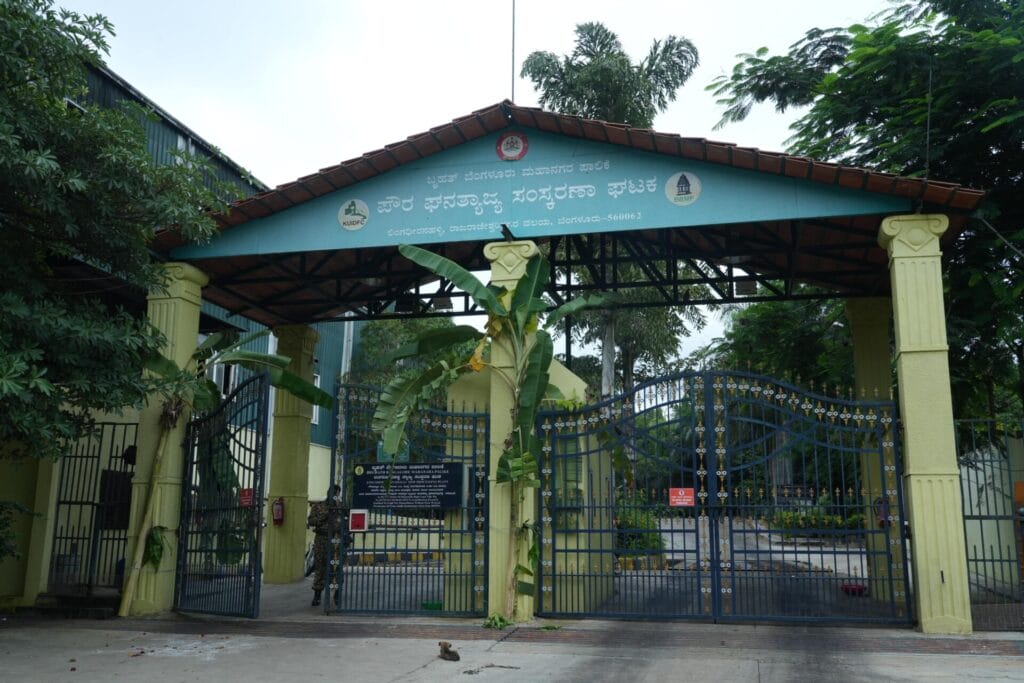
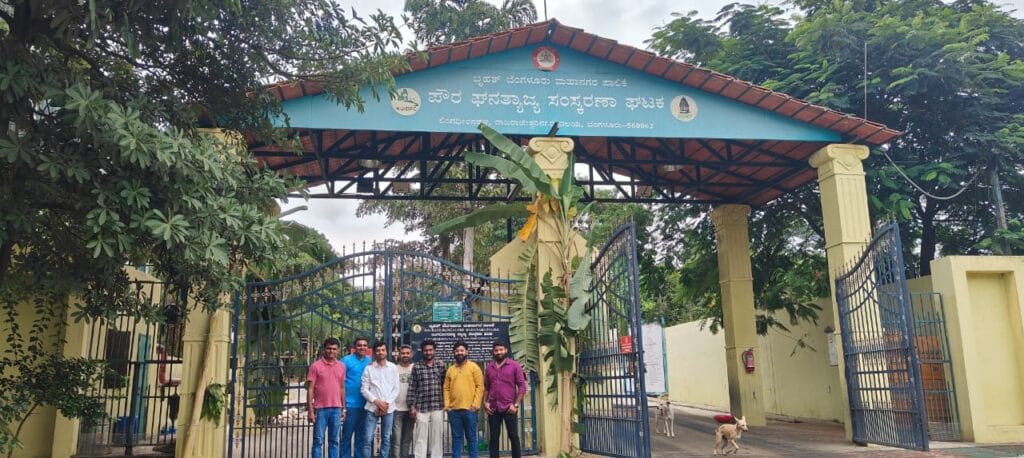
The Lingadheeranahalli plant, operated by the BBMP (now Greater Bengaluru Authority), includes both a waste segregation and composting unit. It was commissioned in 2015 with a capacity to process 200 tonnes of waste per day. Residents say the facility has emitted foul odours and leachate since then, affecting public health and the surrounding environment.
Legal battles and residents’ pleas
In 2021, the growing pollution prompted the National Green Tribunal (NGT) to intervene, and it ordered the plant’s closure. The move brought relief to the community, but not for long. Despite the NGT’s directive for BBMP to obtain fresh environmental clearance, the civic body challenged the order in the Supreme Court. In 2022, the plant was reopened after receiving provisional approval from the Karnataka State Pollution Control Board (KSPCB). Protests against the waste processing plant began as early as 2023 and have intensified now in 2025.
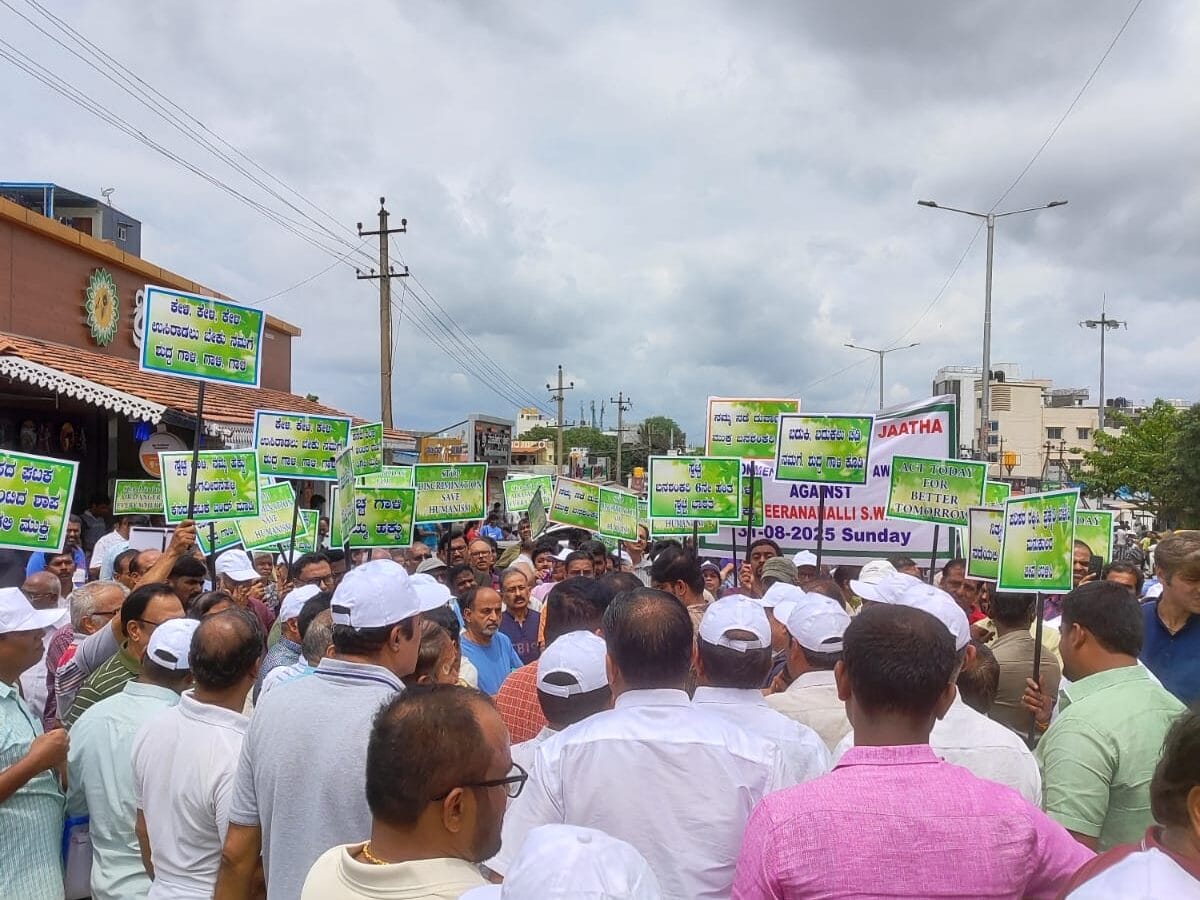
Residents of Banashankari 6th Stage and nearby areas held a rally on August 31st under the banner “Parisara Jagruti Jaatha” (Environment Awareness March), demanding its closure and drawing attention to prolonged health risks, environmental impact and government inaction. They demand either relocation of the plant or strict measures to prevent any harm to their health and the environment.
But is the plant’s closure really a solution?
Impact on public health
People here routinely report respiratory infections, skin allergies, recurring fevers, and headaches. Elders and children are particularly vulnerable. Families say their health has deteriorated since 2015, when the unit first began operating, and has progressively worsened after the plant was reopened.
“As per government approval, they can process 200 tonnes daily. But even now, at 100–150 tonnes capacity, the smell is so bad. If they run at full capacity, it will be much worse,” complains Natarajan, another Banashankari resident.
Kiran S M, who lives in a society 3.3 kilometres away from the plant, adds, “We have 1,500 flats here, and during the rainy season and evening hours, we cannot bear the stench.” Odour control, too, has been reduced to cosmetic fixes. The plant sprays lemongrass oil in an attempt to mask the stench, but residents say this only worsens headaches and nausea.
Prasanna Saligram, a public health expert associated with SOCHARA, a group of community health professionals, says, “An unmanaged waste processing plant becomes a breeding ground for rats and mosquitoes, which can lead to serious diseases. People living nearby don’t get proper rest at night because of the foul smell, flies, and mosquitoes.”
Prasanna also notes that the people working inside these plants are more vulnerable to infection risks due to poor protective gear, lack of masks, and exposure to heat and humidity.
How SWM plants can affect groundwater and living conditions
According to a 2021 study, leachate from municipal landfill sites has a significant impact on the surrounding environment due to the leakage of high amounts of heavy metals, organic compounds, and poisonous substances. The study suggests improper leachate management can contaminate groundwater, which is often a major source of water for urban and peri-urban residents.
Another study from Hue City, Vietnam, published in the journal Frontiers in Public Health, found residents living near solid waste facilities reported lower quality of life due to odour, flies, and “frequent health ailments such as respiratory problems, headaches, and skin irritation.” The study also emphasised that insufficient monitoring of emissions and health impacts, a lack of infrastructure to mitigate odours or vector (insect/rodent) breeding, worsened the issue.
Read more: Waste in Bengaluru: What’s creating all those garbage blackspots?
Who’s responsible
Of the seven solid waste processing units in Bengaluru set up by the erstwhile BBMP, different parties operate different plants, including urban local bodies and private companies. Also, a composting plant in Bommanahalli is operated by Karnataka Compost Development Corporation (KCDC).
The Karnataka State Pollution Control Board (KSPCB) is responsible for monitoring effective compliance with rules and regulations as per the Karnataka State Urban Solid Waste Management Policy, 2021.
Impact on the environment
Beyond health, the environmental consequences are stark. Residents say untreated leachate from the plant flows into nearby drains and lakes, seeping into groundwater, polluting the Sompura Lake and threatening the BM Kaval forest ecosystem. “The leachate treatment facility is not working. The liquid is simply discharged into drains, eventually reaching Sompura Lake, and then the Cauvery basin,” Ravi alleges.
The unit’s location itself violates basic safeguards. According to KSPCB guidelines, such plants must be situated away from habitations and ecological zones, with a buffer zone of at least 200–500 metres. But here, residents’ plots and homes stand right next to the plant.
Moreover, the state’s environmental laws mandate a buffer zone or no-construction zone of 100 metres from the boundaries of forest areas. But the plant lies adjoining BM Kaval forest, violating buffer zone regulations. In 2018, the NGT had directed the plant operator to maintain buffer zones, install odour control measures, and prevent groundwater contamination. Yet, none of these conditions have been followed.
“The hardness level of our groundwater is very high. We suspect it is because of the leachate from the plant,” Kiran says.
Shutting down of waste plants is not the solution
Experts reiterate that closing waste management units is not a solution. Instead, decentralisation at the ward level could be the way forward. “When limited waste is only composted, the odour can be reduced,” says Archana Tripathi, Chief Executive Officer at Saahas, a waste management non-profit organisation.
“If they have to operate, how do they do it without generating stench and by not causing significant damage to the residents? One, provide enough aeration. Two, limit the capacity,” adds Pushkara S V, Lead – Practice at the Indian Institute for Human Settlements (IIHS), who has experience in municipal solid waste management advisory and implementation.
“In cities, getting space for waste management is impossible these days, unlike any industry where there are special industrial economic zones,” adds Pushkara. “Closing this plant would mean having no space to process. That’s worse.” The plant should operate more efficiently. The compost produced can also be used for soil enrichment on forest land.
Another concern could be the loss of real estate value. “If there is a waste processing plant, the whole area’s value goes down drastically,” he says.
Read more: Bengaluru knows the solutions to waste problems, but looks the other way
How to manage waste units effectively
It is important to ensure that the vehicles transporting waste are kept clean and that the leachate management is done effectively. Monitoring of the plant’s operations should also be made stricter, experts add.
“Leachate management should be built into the design of waste processing plants, with proper infrastructure to collect, treat, and safely dispose of the leachate,” says Archana.
Decentralised composting at the home or ward level makes it easier to manage small quantities of wet waste. Large facilities are difficult to operate. They require strict adherence to processes, sufficient manpower, and proper monitoring. “Private operators are paid by the government, but poor financial viability and weak regulation lead them to cut corners—using fewer staff, neglecting equipment, and skipping proper monitoring,” she adds.
Bio-gas plants could be a better alternative. As the processing happens in sealed vessels, no odour will be released. “However, they require good wet waste segregation and infrastructure costs are high,” Archana says. Pushkara adds that in India, there is no real market for biogas, which needs to be improved. Still, they generate useful energy and are financially viable in the long run.
Solutions to be prioritised
- Ensure segregation of waste at source.
- Improve composting operations with better aeration and turning.
- Properly manage leachate and odours from plants.
- Monitor and regulate contractors handling waste.
- Decentralise waste processing with multiple smaller plants.
- Modernise transport vehicles to prevent leaks and odours.
- Explore biogas plants to convert waste into renewable energy.
The entire planet has now become an advertisement for GIGO. Furthermore, Bangalore, a “garden city” of yore is now one of the “garbage in, garbage overwhelmed” cities with its very literate but hardly educated denizens of the opinion that the entire City is One Big Dump.!! So throw and scoot is their modus operandi. Enforcement of rules is always selective and totally arbitrary..if at all. Sad and unfortunate.