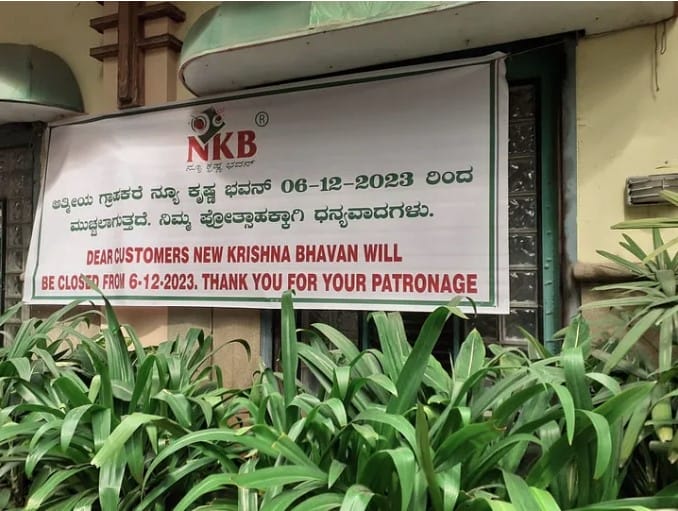
(New Krishna Bhavan on Sampige Road served its last order on December 6, 2023. The author of this article reminisces about the iconic ‘Udipi’ style darshini)
Someone said long back that Malleswaram is not a place, it’s an emotion. In the last days of its existence, it felt like New Krishna Bhavan (NKB) was not a place either, it was an emotion.
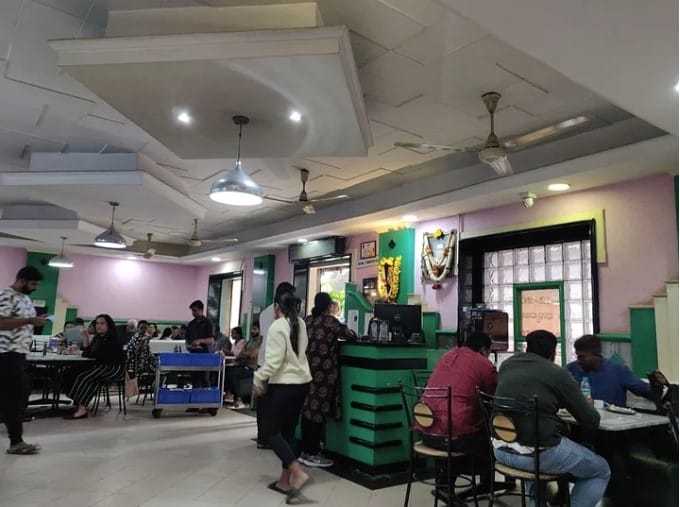
And what an emotion! Malleswaram was in mourning. Its residents were in shock. Numbing grief seemed to have descended over the neighbourhood, spread to all of Bengaluru and beyond, to places across the world. Anyone who had ever visited this venerable institution seemed to have been affected. Long lines wound round the block as people visited it from early morning till late at night, desperate to have one last meal there. To their credit, the staff hurried no one. No worried faces, no harried looks. They served everyone with the same efficiency and gentle courtesy that they had always displayed to their customers.
Yes, it was an institution. But did we know that when we casually sauntered in for breakfast after a walk in the park opposite? Did we know that when we ‘rounded off’ our dosais with fragrant cups of coffee? Did we know that when we took friends and family repeatedly to this beloved place? Did we know that when we dashed here after a long trip outside the city because eating here seemed to bring us back to Bengaluru (or Malleswaram) as nothing else ever could?
Read more: A tale of three parks
New Krishna Bhavan’s ‘unusual everyday specials’
NKB was not like any other place – and it was like every other place. In its ordinariness it was yet another restaurant in the Udipi style of ‘darshinis’. Maybe the fact that it had seating made it slightly different, though no one sat for long. There were almost always people waiting to occupy the table you vacated. Even in a place like Malleswaram with its umpteen (and very well-known) restaurants, the food here was a notch above most others, and some items were many notches above. The prices were so reasonable that you could eat a hearty meal without burning a hole in your pocket. It was clean and spare, but charming in its own way. The gaudy pink and green décor had definitely not emerged from the drawing board of a designer, but who cared? What mattered lay elsewhere.
Where else could we get those Unusual Everyday Specials? We knew the list by heart. Neer dosa (only available after 9 am), green masala idly (always reminded me of green eggs and ham), Soup idly, Salem sambar vada, and so on. We all had our favourites.
I swore by the neer dosai with the sweet chutney. No one else could make it the way NKB did. And what even was the green masala in the green masala idly ? We spent many occasions trying to figure out what soppu went into it, but never bothered to find out – because what the heck – it tasted good, and that’s all that mattered. And if someone were so curious, they could come back another time to find out.
Did we know then that there would be a time when there wouldn’t be ‘another time’? We took it for granted that NKB would stand there forever because it seemed like the one beloved institution that had resisted change and the forces of modernity.
Losing the essence of the city to development
And now that is no longer true, it feels like a personal betrayal, so much so that people are vowing not to visit the jewellery shop that is going to replace it. This is likely a passing emotion and soon enough, the memories of NKB will fade into a distant, if fond, memory. Sampige Road will be ‘adorned’ by yet another glittering showroom. Soon, there will be no older buildings left in Malleswaram as every physical vestige makes way for a flashy newcomer.
Yes sure, this is development, and you may ask – why should old, derelict structures continue to stand after they have outlived their utility?
Let me explain my personal viewpoint. I came to Bengaluru thirty years ago. I came from a city of migrants, a city where every wave of new citizens was more interested in establishing their identities than in being subsumed in the culture of their adoptive city. I thought Bengaluru was different because Bengaluruans seemed infinitely proud of their city – and rightly so. What a lovely city it was, with its salubrious climate, greenery and parks, and a gentleness that pervaded the atmosphere, and was visible in the faces of every resident! I thought these people would fight for their beautiful city. But I was wrong.
Over the years, I have seen with great sadness how they sold it down the river. Bit by bit, chunks of flesh were pulled out from the body of this city. Today it is an inglorious travesty of the wondrous place that it used to be.
This is development, true, and sometimes a new use can rejuvenate and bring life to a structure or precinct that has lost its purpose. But more often than not, we find that the replacement has taken AWAY from the city and given nothing to it – in fact, they are designed to be only extractive. It is the rare exception that has given back.
Older structures were planned at a time when it was important to interact with the neighbourhood. Think verandahs and colonnades and courtyards! That culture has long been vanquished by vandalising forces of capitalism.
So – this is a question we must ask ourselves. Are we okay with losing everything that connected us to our past, our heritage, tangible and intangible? Are we okay with replacing every old bottle with a new one? And if that sounds like something that does not concern you – just imagine the taste of the neer dosai at NKB, and then wonder where that disappeared.
Comment below or write to us at bengaluru@citizenmatters.in to share your memories of New Krishna Bhavan.
(This article has been republished with permission from the author’s Medium post)