Slight spike in COVID-19 cases
On April 12th, Mumbai reported 52 new COVID-19 cases, a 50% spike in the recorded cases in a day. On April 11th, 26 cases were reported.
A general trend still suggests a decline in daily cases. On April 12th, there were 309 active cases in the city with the recovery rate at 98%. The positivity rate was at 0.005%, with a doubling rate of cases is 16,537 days.
Since the emergence of the new XE variant some concern has risen but there is no evidence right now to prove that it is significantly different from other variants of Omicron.
Source: Live Mint, NDTV, The Indian Express
Goregaon Mulund Link road work begins in Goregaon
On April 15th, the Brihanmumbai Municipal Corporation (BMC) started work on the Goregaon end of the Goregaon Mulund Link road (GMLR) flyover. Work began on the the Mulund end of the link road in March with the inauguration by Cabinet Minister Aaditya Thackeray in Bhandup.
A big stretch of the GMLR will run under Sanjay Gandhi National Park in the form of a 4.75km long tunnel. BMC officials stated the construction of the tunnel is complex, and will only commence in 2023. 2 six lane flyovers will be built as part of the project.
The ambitious GMLR project has a budget of Rs 6000 crore, with the aim to improve East-West connectivity in the city, and spans 12.2km.
Source: Mid-Day, The Times of India
Study finds key infrastructure is at risk of submergence
An analysis by Risk Management Solutions, Inc. (RMSI), a company that engineers solutions for climate change, has found that some of the key infrastructure in Mumbai is at a risk of submergence by 2050. Queen’s Necklace on Marine drive, Haji Ali dargah, Bandra-Worli Sea-link, Jawahar Lal Nehru Port Trust, and the Western Express Highway are all placed in high risk areas.
This has been attributed to rising sea levels around India. “While we talk about sea-level rise, that is not the only factor that can inundate coastal cities. At 1°C global change, coastal regions are already facing the brunt of climate change with increasing intense cyclones, storm surges, and heavy rainfall events that lead to coastal flooding. While cyclones on the west coast have increased by 52% over the last four decades, extreme rains causing floods have seen a threefold rise since the 1950s. By 2050, the global temperature change will be close to 2°C, and these cyclones and heavy rains are projected to intensify further, putting the coastal cities in danger,” said Roxy Mathew Koll, climate scientist, Indian Institute of Tropical Meteorology.
Some road networks and important properties Mumbai, Kochi, Mangalore, Chennai, Vishakhapatnam, and Thiruvananthapuram may be under water by 2050.
Source: Hindustan Times
Read more: Mumbai’s Coastal Road Project will potentially cause damages: IPCC report
‘Sunday Streets’ Initiative to take place in 11 spots this weekend
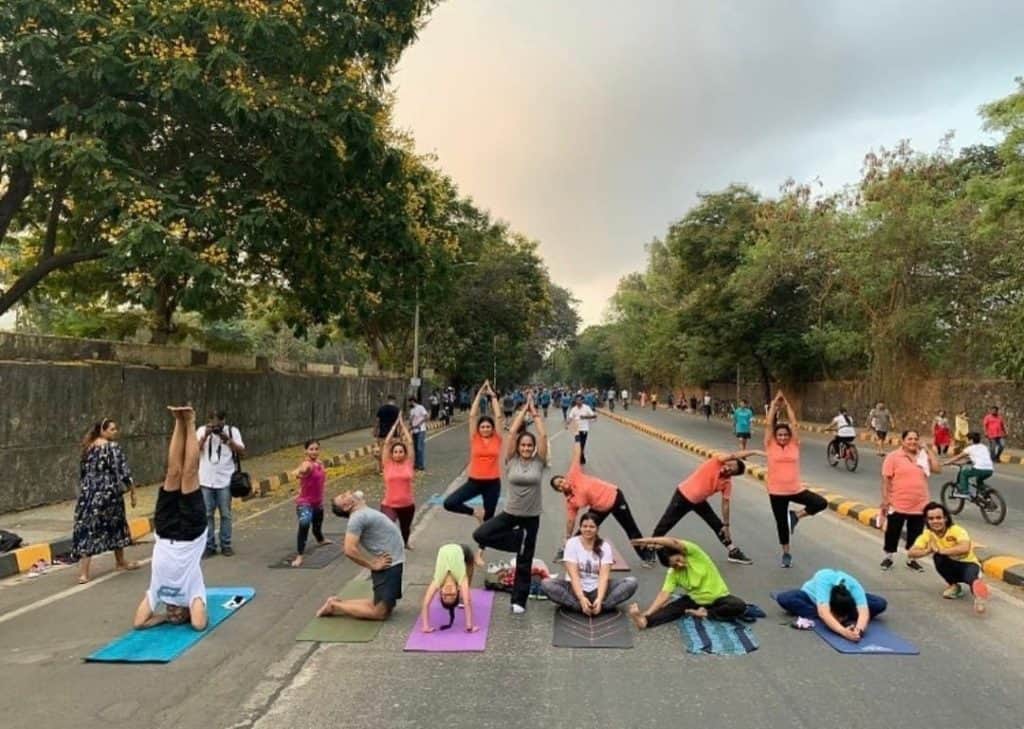
An official of the Mumbai Police said that the Sunday Streets initiative will take place in 11 parts of the city on April 17th.
The initiative was kickstarted by the current Police Commissioner Sanjay Pandey, as an effort to create a stress-free urban environment, where stretches of some roads will be made pedestrian-only and will be opened up to recreational activities like Yoga, jogging, skating and other community sports. Sunday Streets take place between 6am and 10am.
Spots in the western line –
- Nariman Point (Marine Drive) in south Mumbai
- Carter Road in Bandra
- Mindspace backroad in Goregaon
- Lokhandwala Road (DN Nagar)
- IC Colony Dahisar (MHB Colony)
- Thakur Village EMP Circle (Samta Nagar)
- Charkop Police Station Turzon Point (Kandivali )
Spots in the Eastern suburbs –
- Tansa Pipeline road (Mulund)
- Eastern Express Highway
- Vikhroli bridge (Vikhroli )
- Chimni Garden Road (Trombay )
Source: The Print
Mumbai’s Traffic police starts initiative for ‘Noise-free roads’
“Noise pollution is Mumbai has mental and physical repercussions” said Deputy Commissioner of Police, Traffic, Raj Tilak Roushan on April 14th. In a video on twitter, he introduced a special drive in Mumbai that aims to control noise-levels on roads. The drive aims to mitigate the noise pollution that happens on roads daily due to unnecessary honking.
Traffic cops will take strict action against those honking without reason, and fines will be levied by them. The drive will also enforce a ban on using modified silencers in two-wheelers, by asking the owner to get it removed and replaced with the original silencer.
The police authorities have taken action against 200 vehicles in the city until now, including two-wheelers, four-wheelers and buses.
Source: Mumbai Live
[Compiled by Radha Puranik]