Missing: Public participation in lake development in Bengaluru

The event will focus on discussions on the opaque process in lake development and how citizens are being vigilant in protecting neighbourhood lakes

Across Bengaluru, lakes are being dug up, drained and desilted for development. BBMP is in the process of developing 67 lakes at the cost of Rs 200 crore. But the civic agency and the government have kept citizens out of the process.

Citizen groups, residents and environmentalists across the city have expressed concern. They fear their neighbourhood lakes are being encroached upon or turned into soup bowl- shaped lakes that are not as biodiverse. There are fears that limited public funds are being wasted on unnecessary works.

Lack of public consultation

Lakes in Bengaluru are essentially commons, meant to be shared and used by the community. But the public is never fully consulted and they also do not have complete access to plans and financial information before lake development happens.


Read more: Govt claims 47 lakes developed and 17 underway, but this is not quite true


Citizen Matters, Bengaluru, has organised a panel discussion, Missing: Public participation in lake development in Bengaluru, we will discuss how lake development became such an opaque process and how this impacts the lakes and the well-being of citizens. We will also talk about the best practices for lake development, and how citizens are trying to stay informed and vigilant about their neighbourhood lakes.
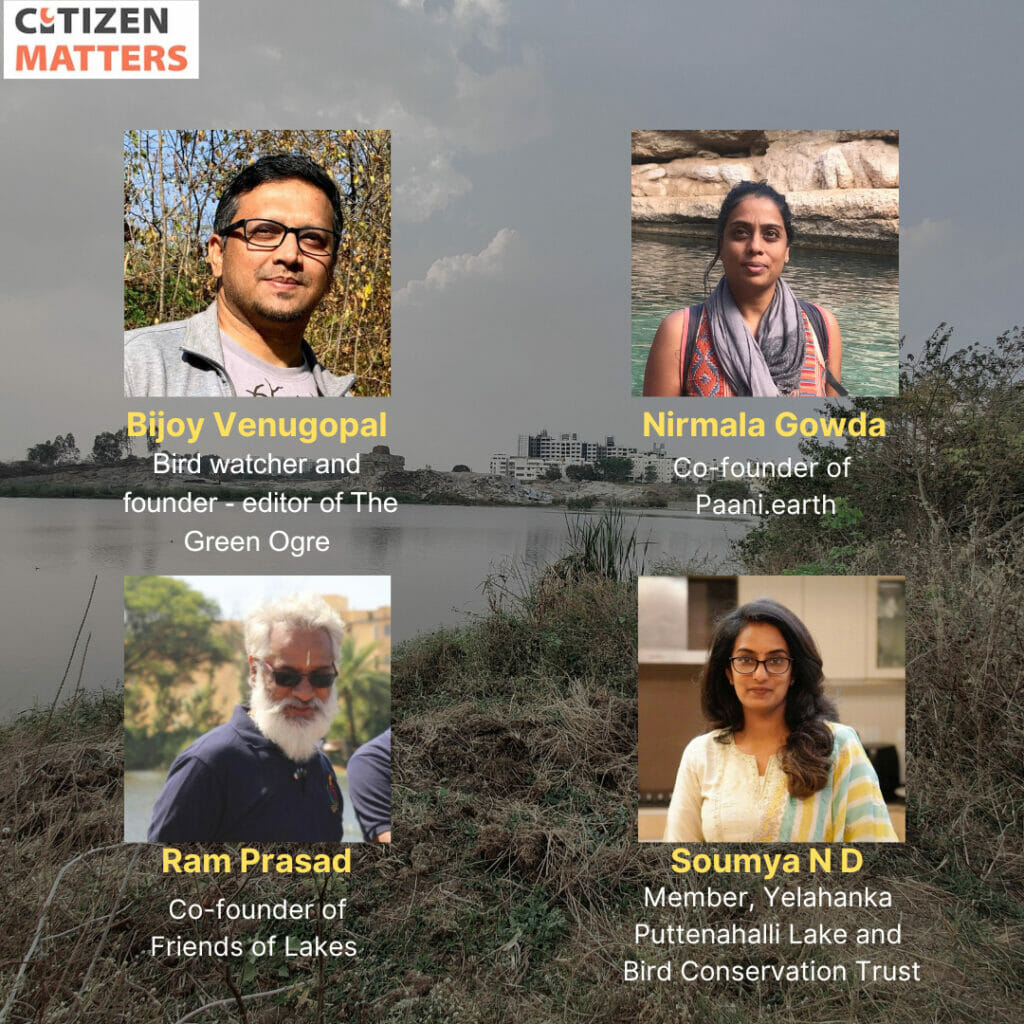
poster for webinar on lake development with panelists' information.
Event poster with panelists. Poster: Citizen Matters

Panelists

The panelists for the webinar include: Bijoy Venugopal, bird watcher and founder-editor of The Green Ogre. He is part of a group of active birdwatchers pushing for Saul Kere development to be biodiversity friendly.

Nirmala Gowda, co-founder of Paani.earth, a citizen lead research initiative that is building up a detailed database on the river-basins and wetlands of our country.

Ram Prasad, co-founder of Friends of Lakes and leading advocate for transparent and scientific lake management

Soumya ND, Member, Yelahanka Puttenahalli Lake Bird Conservation Trust, a citizen group monitoring the above mentioned lake.

The webinar will be moderated by Bhanu Sridharan, senior reporter, Citizen Matters, Bengaluru.

Event details

Date: May 26th, Friday

Time: 6 pm onwards

Register to join us on the webinar

The event will be livestreamed on YouTube

Also read:

Leave a Reply

Your email address will not be published. Required fields are marked *

Similar Story

The wild in the city: What citizen scientists tell us about Bengaluru’s biodiversity

Spatial and temporal biodiversity patterns, as observed by citizen scientists in the city during 2016-2025, were studied at a datajam in December 2025.

Imagine you’re out on a morning walk, phone in hand, when you spot a butterfly you’ve never seen before. You snap a photo, log it into a citizen science app, and voila! You’ve just contributed to crucial biodiversity monitoring. This isn’t just a hobby; it’s part of a global movement where ordinary people collect, record, and sometimes analyse data about plants, animals, and ecosystems. Citizen science stretches the reach of ecological research. Every observation adds to unique longitudinal datasets that reveal phenology — periodic events in the life cycle of a species — along with species distribution shifts and population…

Similar Story

Air quality management is a governance problem, not just an environmental one

Despite massive funding, Indian cities face weak governance, poor data, and limited capacity, as air pollution continues to worsen.

Indian cities are struggling to breathe. Air pollution is a year-round governance challenge. In 2024, 35 of the 50 most polluted cities globally were in India, with PM2.5 concentrations above 66.4 μg/m3. This is at least 13 times the World Health Organization (WHO) guidelines and at least 1.6 times the National Ambient Air Quality Standards (NAAQS) in India. Citizens continue to bear the brunt of worsening air quality, and urban local governments (ULGs) are at the forefront of the problem, being primarily accountable for their citizens' first mile. While they do have a role to play in addressing this threat,…