Missing: Public participation in lake development in Bengaluru

The event will focus on discussions on the opaque process in lake development and how citizens are being vigilant in protecting neighbourhood lakes

Across Bengaluru, lakes are being dug up, drained and desilted for development. BBMP is in the process of developing 67 lakes at the cost of Rs 200 crore. But the civic agency and the government have kept citizens out of the process.

Citizen groups, residents and environmentalists across the city have expressed concern. They fear their neighbourhood lakes are being encroached upon or turned into soup bowl- shaped lakes that are not as biodiverse. There are fears that limited public funds are being wasted on unnecessary works.

Lack of public consultation

Lakes in Bengaluru are essentially commons, meant to be shared and used by the community. But the public is never fully consulted and they also do not have complete access to plans and financial information before lake development happens.


Read more: Govt claims 47 lakes developed and 17 underway, but this is not quite true


Citizen Matters, Bengaluru, has organised a panel discussion, Missing: Public participation in lake development in Bengaluru, we will discuss how lake development became such an opaque process and how this impacts the lakes and the well-being of citizens. We will also talk about the best practices for lake development, and how citizens are trying to stay informed and vigilant about their neighbourhood lakes.
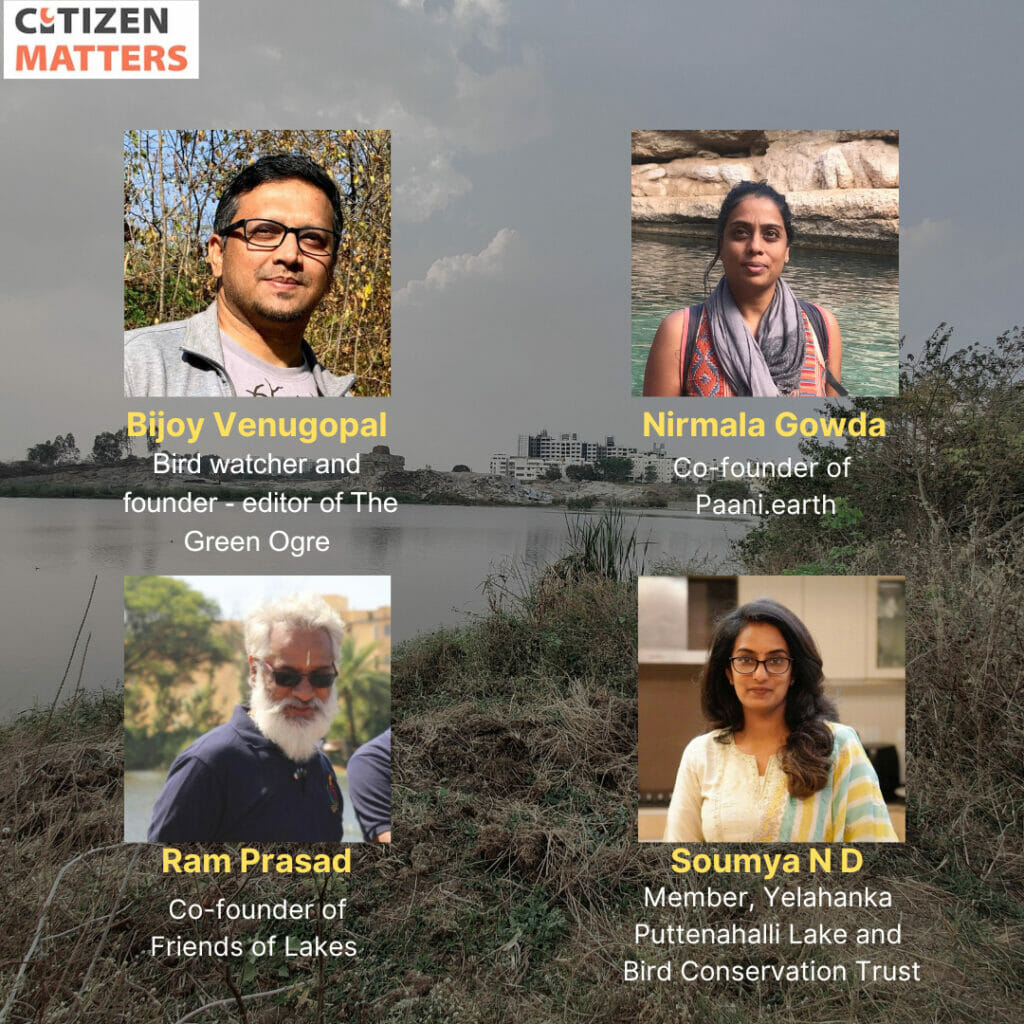
poster for webinar on lake development with panelists' information.
Event poster with panelists. Poster: Citizen Matters

Panelists

The panelists for the webinar include: Bijoy Venugopal, bird watcher and founder-editor of The Green Ogre. He is part of a group of active birdwatchers pushing for Saul Kere development to be biodiversity friendly.

Nirmala Gowda, co-founder of Paani.earth, a citizen lead research initiative that is building up a detailed database on the river-basins and wetlands of our country.

Ram Prasad, co-founder of Friends of Lakes and leading advocate for transparent and scientific lake management

Soumya ND, Member, Yelahanka Puttenahalli Lake Bird Conservation Trust, a citizen group monitoring the above mentioned lake.

The webinar will be moderated by Bhanu Sridharan, senior reporter, Citizen Matters, Bengaluru.

Event details

Date: May 26th, Friday

Time: 6 pm onwards

Register to join us on the webinar

The event will be livestreamed on YouTube

Also read:

Leave a Reply

Your email address will not be published. Required fields are marked *

Similar Story

The trees we forget: What a city loses when the canopy disappears

Bengaluru's trees are more than shade; they are memory, identity, and resistance. Their loss leaves the city harsher and emptier.

Summer in India has been merciless this year, with many states recording temperatures above 42 degrees Celsius and rising reports of fatalities. Despite these harsh conditions, urban support continues for development projects that clear trees, wetlands, mangroves, and forests near cities. A recent Article 14 report provides data on thousands of trees that will soon be sacrificed nationally for infrastructure projects. Those opposing such unscientific large-scale tree felling are often labelled 'tree-huggers', 'anti-development' and 'anti-nationals'. While capitalism accelerates environmental degradation and the world faces a growing climate crisis, societal divisions deepen.  Yet, we give trees too little credit: Beings necessary…

Similar Story

Bengaluru’s flowering Tabebuia Rosea trees: Think green, not just pink

Cities must not confuse beauty with ecology; Bengaluru’s pink weeks are lovely, but unchecked ornamental planting could make the city prettier but less alive.

Late each winter, Bengaluru briefly transforms into an Indian Kyoto, as roads blush pink, office parks turn photogenic, and social media buzzes with claims of a local “cherry blossom” season. But the star of this spectacle is not cherry at all. It is Tabebuia rosea, the pink trumpet tree, a neotropical ornamental whose native range runs from Mexico to Ecuador. What seems like a harmless aesthetic win is, ecologically, far more complex. The history Bengaluru’s pink canopy is not new. Much of it can be traced back to the 1980s under forester S G Neginhal, who drove a major greening…