76-year-old Bela Nag, a retired school teacher in Kolkata, finds urban life increasingly isolating. “Young people have no patience with the elderly,” she says, “Availing basic services has become a challenge due to technological advancements and wide scale adoption.” Bela’s sentiments only reflect what is reality for many seniors across urban India who are constantly grappling with the pressure of adapting to exploding cities, migration and rapid digital change. Their predicament brings to the fore larger questions around the effect of city living on the mental health of seniors, especially those who live alone. What affordable, stigma-free, accessible solutions can support them?
Dr Ramani Sundaram, executive director, Dementia India Alliance, says that one of the disadvantages of urban life today is isolation resulting from living in high-rise buildings. “Mobility issues such as difficulty walking, dependency on children for everyday tasks, and chronic illnesses make the elderly feel less empowered,” she says.
Bela agrees. Despite living in a gated community with her children, she is determined to be independent. She maintains a circle of friends and is active on social media. “When you grow older, you have to be impervious to irritation, so I try to get along with everyone in my building,” she says. But then some problems cannot be ignored so easily. For example, her health insurance and pension are not enough to cover her medical expenses. “I have asthma, hypertension, and diabetes, so I tire easily,” she says.
Can assisted living help?
After her husband passed away, Rajashree Bose, a retired teacher, had to make a choice between staying in her centrally-located flat, where she had lived for decades, and shifting to a senior retirement home. She eventually sold her flat and moved to Rabindra Niketan in Garia, further towards the southern fringes of Kolkata. It was a decision that took time but she has not regretted it.
“It has been 10 years, and I am very satisfied,” she says. “The manager is attentive: when I asked him ‘What if I fall sick when I am here? Will you look after me?’ he assured me, and kept his promise.” In 2019, when Rajashree was admitted to the hospital’s ICU, the manager visited her twice daily, providing reassurance and support.
Read more: Walking in their shoes: How cities can include senior citizens in planning
There are homes in many cities, like Rabindra Niketan, that have basic facilities in place, offer healthcare assistance, and also arrange social activities, festive celebrations, and outings for residents. “We are encouraged to participate in activities, yet our independence is respected,” Rajashree says.
She urges the elderly who stay alone at home to consider shifting to a retirement home. “Ensure you have sufficient funds and be particular about the place you choose. You have to be adaptable and be prepared for different meals and routines.” She emphasises that saving for retirement is crucial. “I still teach because I love it, but you need to ensure financial security for your old age.”
The challenge of the less privileged
Rajashree’s advice rings true when one looks at the plight of people who do not have the means to access the kind of support alluded to above. Manju works as a domestic worker at 65; she lost her husband a couple of years ago and does not have a sturdy support system. She struggles with mobility, public transport challenges, and financial insecurity, all of which affect her overall well being.
Recognising this gap, the Nightingales Medical Trust runs two destitute homes in Bengaluru — one for women (100 beds, 95 occupied currently) and one for men (24 beds, 22 occupied currently). Since 2019, there have been 230 admissions at the women’s destitute home and 79 at the men’s (since 2020).
Swati Bhandary, Associate Director at Nightingales, explains that some of the seniors they have admitted had in fact been abandoned by their children at railway stations; some have travelled from other parts of the country to reach Bengaluru.
Some homeless elders are initially reluctant to enter these homes because they feel more free living on the streets. It takes time for them to adjust, but eventually, most settle into these care homes. “Many of the elders are admitted with physical and mental illnesses but slowly recover with the quality care provided at the home,” adds Swati.
She notes that many families are hesitant to seek mental health care for their loved ones due to the stigma associated with it. The Trust also works to create awareness in communities, helping people to overcome those barriers.
Given the reality of the times, urban India needs many more such inclusive spaces for senior citizens, which can be enabled by policy reforms, disabled-friendly infrastructure, community outreach and caregiver support.
Reflections on a changing cityscape
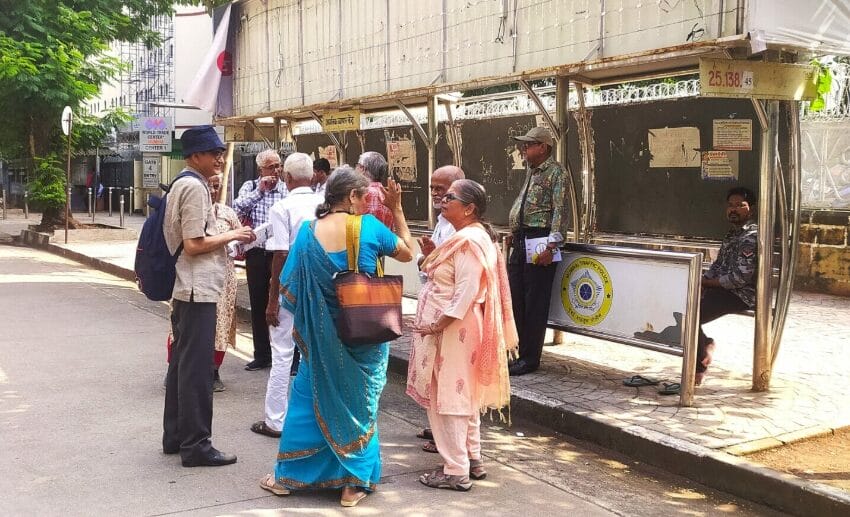
Cities that have been home for many senior citizens for as long as they can go back in memory are changing so rapidly and starkly, that these changes are in themselves a lot to cope with. For example, Aditi Raja, former Indian Audit and Accounts Service officer and former Finance Director of Karnataka Power Transmission Corporation Limited, rues the drastic urban changes Bengaluru has undergone.
“The city has transformed beyond recognition. New buildings are coming up everywhere: 30×40 sites are being filled with four-story buildings. Take Cox Town, for instance. What used to be a quiet neighbourhood with open spaces is now full of buildings with barely any proper roads, ” says Aditi. In Whitefield, where she lives, the Metro Station is just four km away, but it takes her an hour to reach. “It feels as if I am living inside a well, surrounded by buildings all around. There are no rules, no regulations. I feel frustrated and find myself constantly ranting and raving because nothing is done about it,” she adds. The loss of green and liveable spaces affects the well-being of the elderly sharply.
Shibani Basu, who has lived in Mumbai for 45 years, shares similar sentiments as she has seen the city of dreams undergo a major transformation over the years.
“In the early days, this city was still a bustling one where one came to fulfil their dreams… to either be the next Amitabh Bachchan or the next Dhirubhai Ambani. The city welcomed everyone with open arms and its wide open spaces, modern buildings and rich cultural heritage ” recalls Shibani. But people then were far fewer in number, traffic as she remembers it was not only manageable but also very disciplined. “In fact we ‘Bombayites’ would revel in that fact that we had the best traffic system in the country!” she says.
There was no real estate boom back then and housing was affordable to most people in almost every area or suburb of this metropolis, reminisces Shibani. As the decades passed, there came the era of liberalisation and satellite TV, heralding the modernisation of Indian society in the 90s.
“In 1995 the city was renamed Mumbai, and we became Mumbaikars from Bombayites. The decade brought sweeping physical and sentimental changes: foreign brands sparked a boom in malls and boutiques, real‑estate prices surged and split the city into north and south suburbs, and private banks made loans easy, which led to a car-buying surge that was once limited to the upper classes. More cars overloaded the roads, and the once‑disciplined traffic gradually deteriorated,” Shibani says sadly.
What also pains Shibani, and many elders like her, is the pace of life and the general changes in attitude that it has brought. “The average Mumbaikar has lost patience. We Mumbaikars always seem to be in a hurry, always chasing something, whether it be our dreams, careers or even the public bus or train for that matter! This fast paced city has eroded the serenity and sanctity of its soul that it once was proud to possess, as were its residents.”
She also finds it difficult to accept the overall cost of living today in this metropolis, which she says “is sky high when compared to all other metros.”
The advancement of technology and the advent of delivery, transport and other service apps have made life easier for the young who are always busy, but elders like Shibani miss the charm of shopping in their favourite markets or seeking suggestions for a good house help from neighbours. “While time ticks away and our journey nears its end, we remember the charm of old city ‘Bombay,’ which can never be replaced; it is now just a memory, a sweet unforgettable memory.”
Fighting ageism
One of the things that leads to dejection and mental illness among seniors is the feeling of redundancy. But senior citizens, contrary to popular opinion, are actually capable of earning and contributing to society.
Sujatha Balakrishnan, a Bengaluru-based senior citizen, theatre personality and psychologist, says there are several misconceptions about the elderly. “Society often treats the elderly as a burden, which is a harmful stereotype that denies their contributions,” she says, “the accumulated experience, wisdom, and knowledge of seniors are actually beneficial to their communities, workplaces, and families. If provided with fair opportunities, physically and mentally, they could give youngsters a run for their money! In short, ageism is a stereotype that needs to be addressed.”
Depression and dementia: A growing urban problem
Sujatha also talks of a very common yet under-recognised mental health condition among seniors — dementia. Being the primary caregiver for her aged mother, who slipped into dementia in her early eighties, has enabled a deep learning curve for her on age related issues.
“Interestingly, among dementia patients, some parts of the brain continue to respond to stimuli close to their hearts, even when they don’t recognise their loved ones, which is a nightmare!” she says, “My amma was a Carnatic vocalist. I made it a point to sing her favourite songs for her everyday, and she would sing along with me and correct me if I missed a line! As a psychologist, I have always felt the need for time, investment, communication and empathy from the immediate family to improve the quality of life of seniors.”
What studies say
- A BMC Public Health study review of 51 studies (56 datasets) across 16 states–between 1997 and 2016– found that 34.4% of the elderly adult population (60 years and above) suffer from depression.
- A BMC Psychiatry study observes that India is greying as the share of older adults (60+) population has increased from 7.7% of the total at the dawn of the millennium to 9.4% in 2017, and is expected to reach 19% (324 million) by 2050.
- The LASI nationwide study estimates that 7.4 % of Indians aged 60 + have dementia, with higher rates among women, in rural areas, and substantial variation across states.
Dr Ramani Sundaram notes that while the prevalence of dementia is high in India, there is little awareness. “That is why we founded Dementia India Alliance. We work on core areas: creating awareness, conducting screening, capacity building and supporting services for people with dementia and their family carers. We also collaborate with the state and central government to develop and advocate for policies.”
Lack of awareness, the fear of stigma, and limited accessibility often delay diagnosis. “Early screening enables timely intervention for treatable conditions such as depression and vitamin deficiencies, which improves the quality of life. Early diagnosis also gives families time to plan for advanced care,” the doctor says.
Help for caregivers
Retired Wing Commander, DP Sabharwal cared for his wife after she began showing early-onset Alzheimer’s symptoms in her 50s. “I moved from Chandigarh to Bengaluru in 2011, and sought treatment for my wife at Nightingales Medical Trust. She passed away in 2017,” he recalls.
Sabharwal now works to raise awareness about Alzheimer’s, especially for caregivers. “A caregiver feels empty and helpless, which can wear them down. It is essential to have an outlet,” he explains.
Sabharwal has authored three books that share his insights, beginning with Handling Alzheimer’s With Courage. He offers practical advice for caregivers: “Set aside at least one hour each day to rest and recharge. Every week, go out for three to four hours in a week, for a night out for dinner, a walk or meeting friends, to refresh your mind.”
Read more: Making Chennai safer for senior citizens
Addressing geriatric depression
There are various other factors that affect geriatric mental health. Apratim Chattopadhyay, Founder and Managing Director of Support Elders, which provides elder care services in Kolkata, Durgapur and Bengaluru, points out that during the transition from ‘young-old’ (ages 65-75) to ‘mid-old’ (ages 75-84), a common occurrence is the loss of a spouse.
“Suddenly, we see a huge challenge in the cognitive zone, brought on by the reality of living independently and alone. Loneliness becomes an impediment to cognitive wellness. At this stage, it is important to introduce them to a support mechanism.” Peer-to-peer bonding, delivered through online and offline events at Support Elders, helps them strengthen support systems for senior citizens.
Geriatric depression brought on by social isolation and urban stressors can be mitigated through a combination of interpersonal, community‑level, and health‑focused interventions, says Dr Ramani. These include:
- Maintain regular family contact: Daily video calls, messaging, or voice chats with children and other relatives help preserve emotional bonds and reduce loneliness
- Promote participation in local senior groups: Membership in neighbourhood seniors’ clubs, cultural or religious gatherings (e.g., satsangs, bhajan circles), and organised hobby groups provide peer support, shared purpose, and routine social interaction
- Encourage intergenerational engagement: Structured activities that involve grandchildren, adult children, or younger volunteers foster mutual understanding and sensitivity toward older adults, reinforcing their sense of belonging
- Share caregiving responsibilities: Older women who traditionally shoulder the bulk of household and caregiving duties should be helped with shared responsibilities, allowing time for self‑care
- Address comorbid medical conditions: Chronic diseases such as diabetes, hypertension, and cardiovascular disease, as well as untreated pain, insomnia, or sensory impairments (vision/hearing loss), amplify depressive risk. Optimising medical treatment, correcting sensory impairments, and ensuring adequate sleep (7–9 hours/night) are essential components of prevention
- Encouraging work: Part‑time employment, volunteer roles, consulting work, or cognitively stimulating hobbies can make seniors feel useful and foster overall positivity
- Improve digital inclusion: Training in basic smartphone or computer use enables older adults to access telehealth, online support groups, and virtual social networks, thus reducing isolation
- Monitor for early warning signs: Persistent low mood, loss of appetite, excessive sleepiness, withdrawal from previously enjoyed activities, and marked functional decline require prompt evaluation by a primary‑care clinician or mental‑health specialist