Making public spaces safe for women, in particular, is not rocket science. Nor is it an expensive high tech exercise. Yet with little action being taken, collecting ground data can help raise awareness of the issue and convince authorities to act.
With this in mind, Bangalore Political Action Committee (B.PAC) in collaboration with CGI, conducted a safety audit of public places in Malleshwaram and Mahadevapura Assembly Constituencies as a pilot project. The areas were chosen based on preset criteria – Malleshwaram being one of the oldest constituencies and Mahadevapura – one of the newer ones.
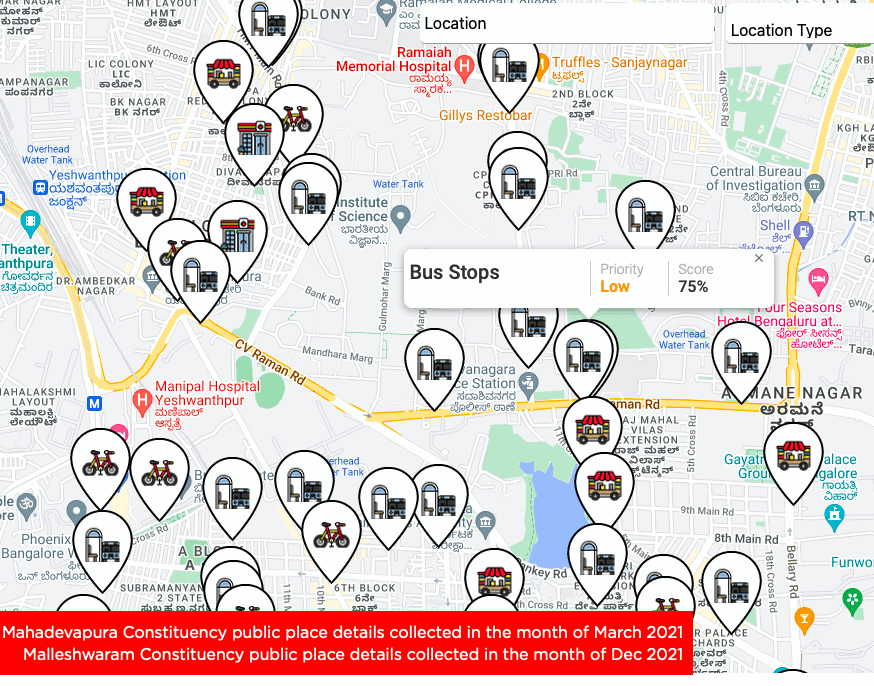
The audit was conducted with the help of citizen volunteers or “B.SAFE Ambassadors” from both zones. The purpose was to identify infrastructure gaps and work with the local community, ward committees, civic bodies and elected representatives to make it safer and secure. The audit report was released on March 19.
“A safe city is always a prosperous city.” – Kiran Mazumdar Shaw, President, B.PAC
Read more: If only cameras could ensure women’s safety…
Audit findings
Some of the points brought out during this exercise were – in some areas while good quality bus stops have been provided but are being under-utilised/unused, as the buses do not stop there, which leads to its misuse. As one of the B.Safe Ambassadors pointed out, in certain locations bus stops are situated under flyovers at busy junctions, navigating them is a daily nightmare for users.
Malleshwaram
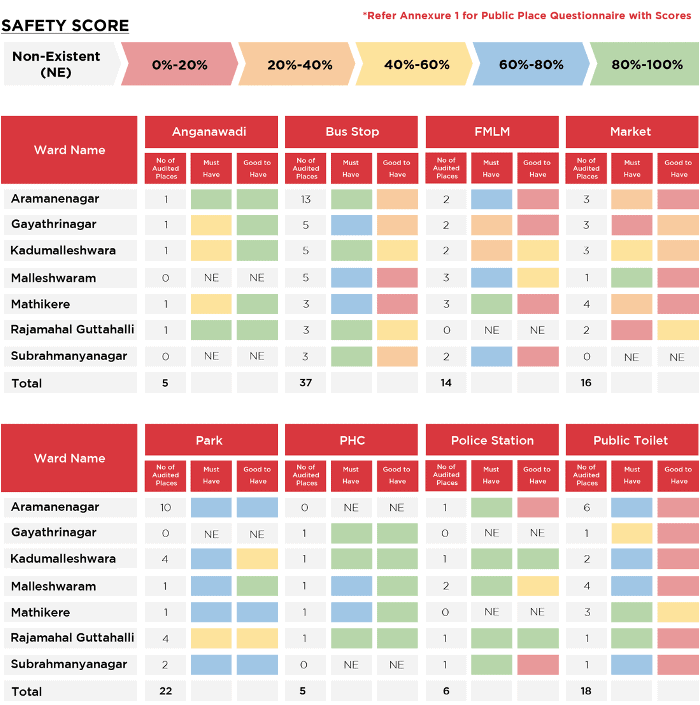
Malleshwaram Assembly constituency is divided into seven municipal wards. Across the eight types of public places identified, an audit was conducted in 73 streets and 123 public spaces.
Key findings:
- Street lights at 73 streets were audited, of which 23% were found to have a deficit in lighting. These included 9 streets, 4 bus stops, 11parks and 2 First Mile-Last Mile – auto stands, etc.
- 5 Anganwadis – showed a potential to expand into a full daycare centre, as 43% of the students had working mothers.
- Bus stops, a total of 37 stops were audited, out of which 8 bus stops had dead spaces which needed to be cleared and
- First Mile-Last Mile – around 5 of the 14 auto stands did not have any walkable footpaths.
- Parks – crimes such as chain snatching, etc were reported at 10 of the 22 parks audited. Installation of CCTV/security guards can help address this issue.
- Police stations – 4 of the 6 stations did not have wheelchair access.
- PHC – Of the 5 audited at least 2 PHCs lacked Jan Aushadhi Kendra.
- Public toilets – 15 of the 18 audited need to be free toilets.
Read more: Guess why women avoid cycling in our city
Mahadevapura
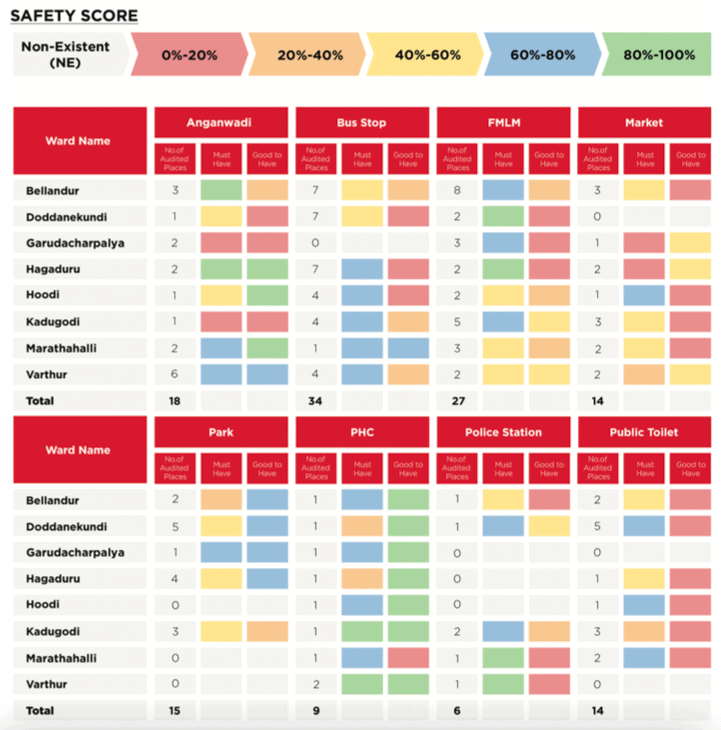
Mahadevapura Assembly Constituency is divided into eight municipal wards. Across public places identified, an audit was conducted at 35 major streets and 137 public spaces.
Key findings:
- Street lights – 50% of the 35 audited streets were in need of proper lighting.
- 18 Anganwadis – 11 of these kendras showed the potential to expand into a full daycare centre.
- 34 Bus stops – all of them lack PIS/Route maps.
- 14 Markets – 50% of them lacked separate clean toilets.
- 15 Parks were audited, 8 of them lacked CCTV/security guards for safety.
- 6 Police stations – 2 of them lacked dedicated women’s desks, and separate waiting areas for women.
- 9 PHC – at least 50% lacked Jan Aushadhi Kendras.
- 14 public toilets – 7 of them need to be open full time.
So what is required to make our public spaces safe? The audit report points to the two priorities for immediate action in both constituencies:
- Improve the infrastructure of street lights and bus stops making them passenger-friendly through map/information systems, better lighting, footpaths, and quality seating.
- Significant opportunities in improving park infrastructure, first mile and last mile connectivity and facilities at anganwadis.
Response to the audit reports
The report was released at a public programme attended by Dr B R Ravi Kanthegowda, IPS (Joint Commissioner of Police), Radhika G, IPS (Director, Security & Vigilance, Bangalore Metropolitan Transport Corporation), M Srinivas, (Joint Commissioner, West, Bruhat Bengaluru Mahanagara Palike) and Sapna Karim (Head, Civic Participation, Janaagraha).
At the function, Aravind Limbavali, MLA of Mahadevapura promised, “In the coming days, our team will ensure implementation of the feedback and recommendations from the audit report in the next one year.”
In a video-recorded message, Dr C N Ashwath Narayan, Malleshwaram MLA and state minister said, “B.SAFE constituency program has emphasised in bringing safety for women and empowerment as a priority subject to the attention of the government, elected representatives, civic bodies and citizens.”
Revathy Ashok, CEO and Managing trustee, B.PAC said, “The B.SAFE initiative started after the Nirbhaya incident. We felt that we should not do something only when such an incident happens, instead, we should continuously work towards making our public spaces safe,” says Revathy Ashok. “Everybody needs to come together if we want a better environment around us.”
How B.PAC organised the safety audit
Around 45 B.SAFE Ambassadors, 22 from Mahadevapura and 23 from Malleshwaram, were chosen for the programme, and underwent capacity building sessions conducted by domain experts on concepts focusing on women’s safety, government schemes for women’s empowerment, financial literacy, diagnostics of safety in public places, working with police, etc.
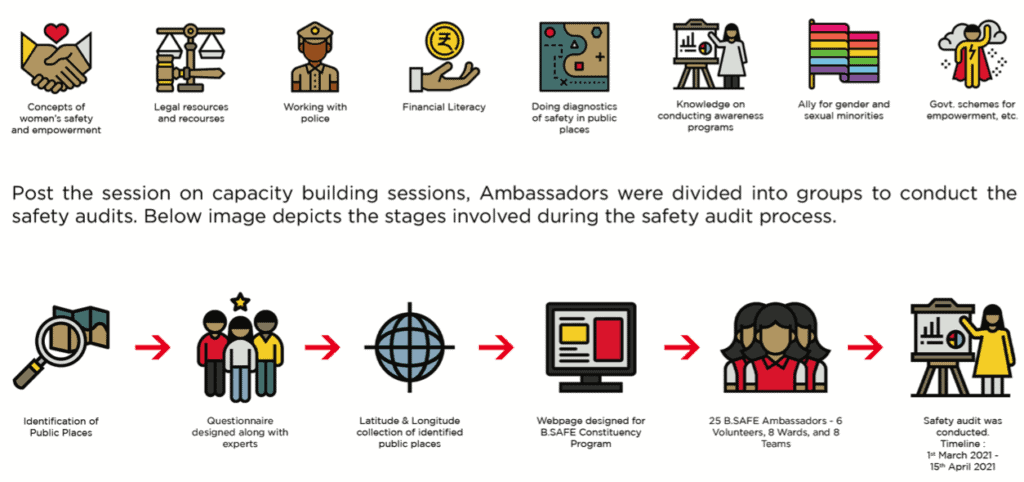
The Ambassadors audited 260 public places and 108 streets between March and April 2021. The safety audit focused on eight types of public places in the two constituencies that women access on a regular basis. This includes 23 Anganwadi Kendras, 71 Bus Stops, 41 First Mile-Last Mile connectivity to metro stations, bus stops, auto stands and Yulu stations, 30 Markets, 37 Parks, 14 PHCs, 12 Police stations and 32 Public Toilets. The audit included around 108 street lights.
The B.SAFE Ambassadors were split into teams of three and were provided with the latitude and longitude of each of these public spaces. The purpose of the exercise was to understand how to get the community engaged. The target was to achieve 1000 community outreaches, including local colleges, 100 auto drivers, etc., in each assembly constituency. The outreach was to talk about the safety of women and their empowerment so that they can begin to understand what is involved.
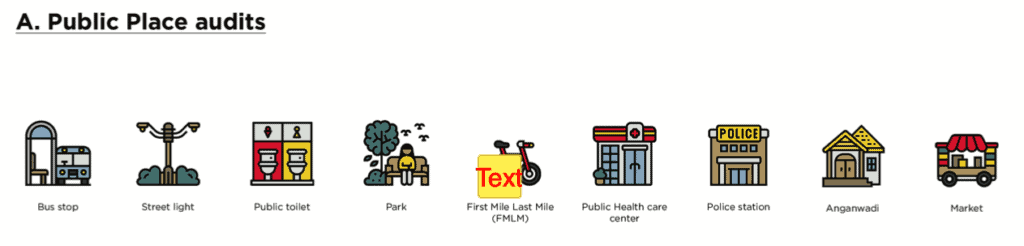
The safety audit of streets focused on light, openness, visibility, security, footpaths, gender usage and sense of safety. Data was segregated into Must-Have and Good-to-Have.
- Must-Have – focused on the absolute basics such as seating, accessibility to clean toilets, proper lighting, maps/signages, etc.
- Good-to-Have – included waiting rooms, free toilets, children’s room, sanitary pads, etc.
The executive summary of the audit report and action plan can be viewed here:
B.SAFE Constituency Public Place Safety Audit Mahadevapura and Malleshwaram