It’s time to let go of your favourite horn that you chose to fit your vehicle with. Wonder why?
The Supreme Court of India, in its judgment dated December 10, 2013, on the petition SLP (Civil) 25237/2010, has banned the multi-tone horns in vehicles. The last date for removal of this is January 10, 2014.
Bangalore Traffic Police, in accordance with the obeyance of law, has issued a notice regarding this. A pamphlet that is issued by the Police Inspector of Indiranagar Traffic Police station says that all kinds of air pressure horns, musical horns, reverse horns, hooters, trumpets and other devices that are fitted on vehicles, that produce an unduly harsh, loud or shrill or alarming noise, and the horns that are not fitted by the manufacturers should be removed with immediate effect.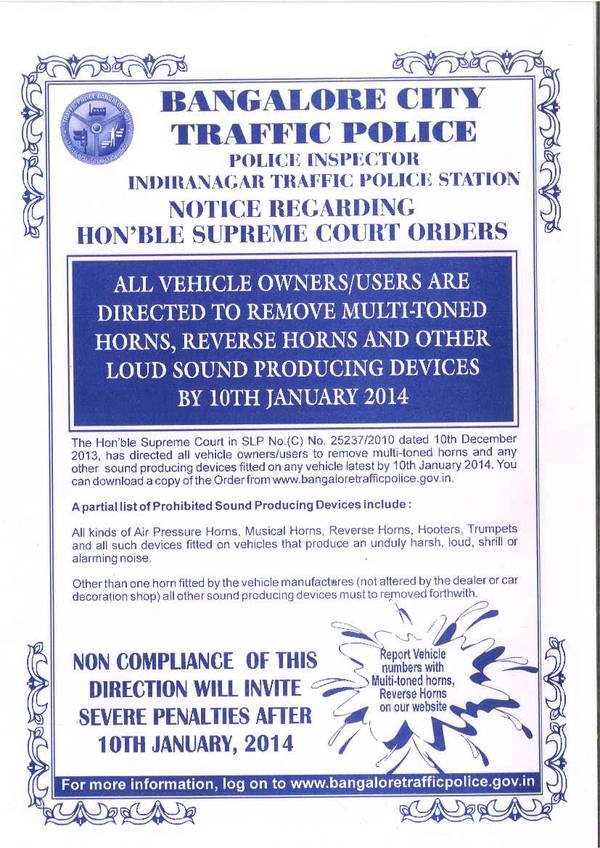
Bangalore traffic police notification on multi-toned horns
Non-compliance with this rule will attract penalties after January 10, 2014, says the brochure. A call to the Assistant Commissioner of Police Traffic South East (Adugodi) Division (9480801805) confirmed the same. However, the notification isn’t available on Bangalore Traffic Police website. The police official who spoke to Citizen Matters said that the pamphlet is being circulated through emails and facebook.
Related Articles
Bangalore Traffic Police wins Golden Peacock Award
Traffic police answers key question on Facebook
Fun thing called cycling can solve traffic problems. Here’s how!
Mobile app to report traffic violations, ambulances with GPRS on the anvil
Whattay NY gift. Super happy that the menace of reverse horns is going to be dealt with. Annoying to be woken up at 1 AM by douche-bag neighbors who reverse into their garages with their reverse-horns waking every household in a 100m radius. Sad that civic sense needs to be enforced with laws.
Air pollution is already affecting the lungs and the horns will made deaf every one.There is no strict follow of rules and police are reason they don’t book cases, they will go by corruption,the RTO is use less, only people are suffering
How will police know whose car reverse horn is disturbing the people next door & how & who will penaslise such offender?