The Climate Change cell of the Karnataka State Pollution Control Board (KSPCB) has launched a series of public consultations to solicit opinions, suggestions and feedback from environmentalists, civil society, and other informed individuals and groups, to prepare a report on recommendations that can be made to the state government.
The first of the public consultations took place in Mysore and Madikeri on January 28th and 29th respectively. February and March will see consultations at 10 other cities and towns in Karnataka, including Bengaluru.
In 2007, the Intergovernmental Panel for Climate Change (IPCC) had prepared an assessment report and had warned agrarian‐dominated countries like India of the adverse impacts of climate change. The report also pegged a rise in temperature by 3.3℃ for India by the end of the 21st century. The Prime Minister’s Council of Climate Change then prepared the National Action Plan on Climate Change (NAPCC) in 2008.
Along with action plan, the Ministry of Environment and Forests directed states to prepare corresponding State Action Plans. In 2011, the Karnataka State Action Plan on Climate Change (KSAPCC) was prepared by reviewing previous studies and with consultations with various government departments.
KSPCB’s public consultations will focus on eliciting public opinion on the actions required to mitigate and adapt to climate change, with relevance to pollution impact. The focus areas will be Water and sanitation, Land use and planning, Waste management, Air quality, Transportation, Industries, Energy, Agriculture and horticulture, Forestry and biodiversity, and Urbanisation.
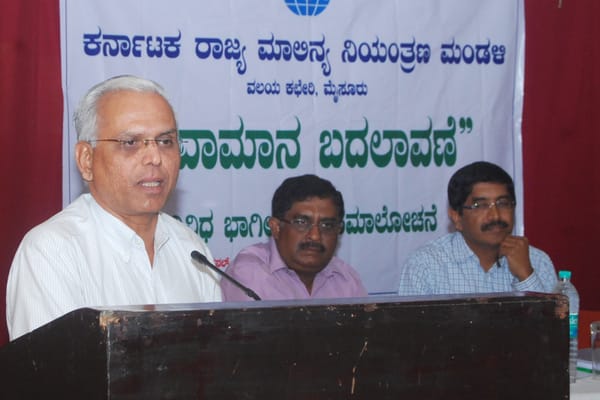
Shankar Sharma addresses the gathering at the public consultation held in Madikeri on Jan 29th. Pic: KSPCB blog
Shankar Sharma, a Power Policy Consultant, will be working with KSPCB to coordinate the consultations and prepare a detailed report with recommendations that come from the consultations. This will be shared with the state government to ensure that the subsequent State Action Plan on Climate Change will be inclusive and incorporate people’s recommendations.
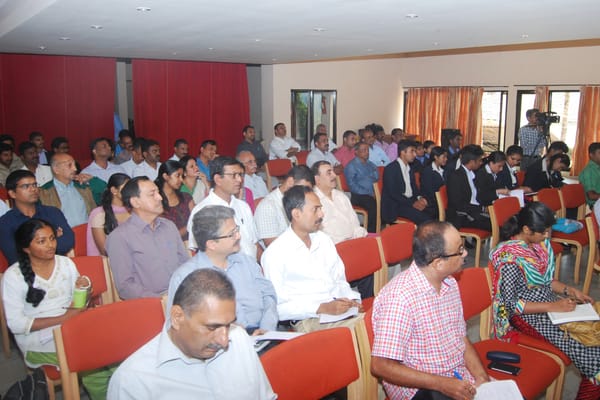
Participants at the public consultation held at Madikeri on Jan 29th. Pic: KSPCB blog
To participate in the public consultations, interested parties can drop a mail to ceo@kspcb.gov.in and corpcell@kspcb.gov.in, marking a copy to shankar.sharma2005@gmail.com with details of their preferred city/town to attend the consultation.
KSPCB will send out a formal invite to registrants closer to the date of the consultation. Citizens can also send in their written feedback prior to the consultation to the aforementioned email ids. Once KSPCB reviews what is shared, individuals will be invited to present their ideas at the public consultation. KSPCB has a blog that could serve as a good resource for those preparing their feedback.
For more details on the consultations, click here.
Tentative dates for public consultations:
- Mangalore: February 6th
- Karwar: February 7th
- Bellary: February 20th
- Gulbarga: February 21st
- Bijapur: February 22nd
- Shimoga: February 27th
- Tumkur : February 28th
- Dharwad : March 12th
- Belgaum: March 13th
- Bengaluru : March 17th, 26th, 27th, 28th
KSPCB on its blog stated: “We hope to see participation by a good number of environmentalists/ concerned citizens, and an effective consultation process leading to a better environment not only in the state but in the entire country.”
Related Articles
KSPCB acts tough on stone cutting units
As citizens challenge steep STP fees, KSPCB may relent
KSPCB asks BWSSB not to pollute water bodies
KSPCB releases STP guidelines, relaxes treated water norms