“What is the budget allocated to my ward?
How many roads will get relaid this year in my area?
This waterbody in my ward needs to be desilted, can we add it to the works”
I could rightfully ask these questions and give my suggestions for my area said Charu, Raji, Meera, Sakthi and Jothi, the members of Voice of People. But how?
As we celebrated this August 15th, our 73rd Independence day, maybe it is time we got into the spirit of what independence truly is. We are continuing in this journey as passive bystanders, appalled at the quality of governance by successive governments, literally enslaved by what they dole out.
Where are the rules?
All of India is talking about the Constitution of India, in the past few days, attempts are being made to understand article 370. While we are in that mode, for a moment I want my friends here to look at the 73rd and 74th Amendment Act (1992) of the Constitution, speci74fically section 243S.
This amendment truly paves way for representative democracy to become a participative democracy. It provides a constitutional mandate for decentralization of Governance and creating local self Government units at the rural and urban settlement levels. This is the idea of gram sabha in villages, where every voter is a constituent member in the decision-making process, which has gained some traction once again. But what we are actually not aware of is that, we who live in cities and towns could have ward committees and area sabhas which allows each one of us to represent a point of view. We could actually sit in a meeting once every few months to discuss the questions I raise in the beginning.
Tamil Nadu Government incorporated this into its Corporation act in 2010, making ward committees mandatory. But this was done as mere compliance for a Central Government scheme, and till date, no rules have been framed and Ward committees and Area sabhas are still unheard of in the State.
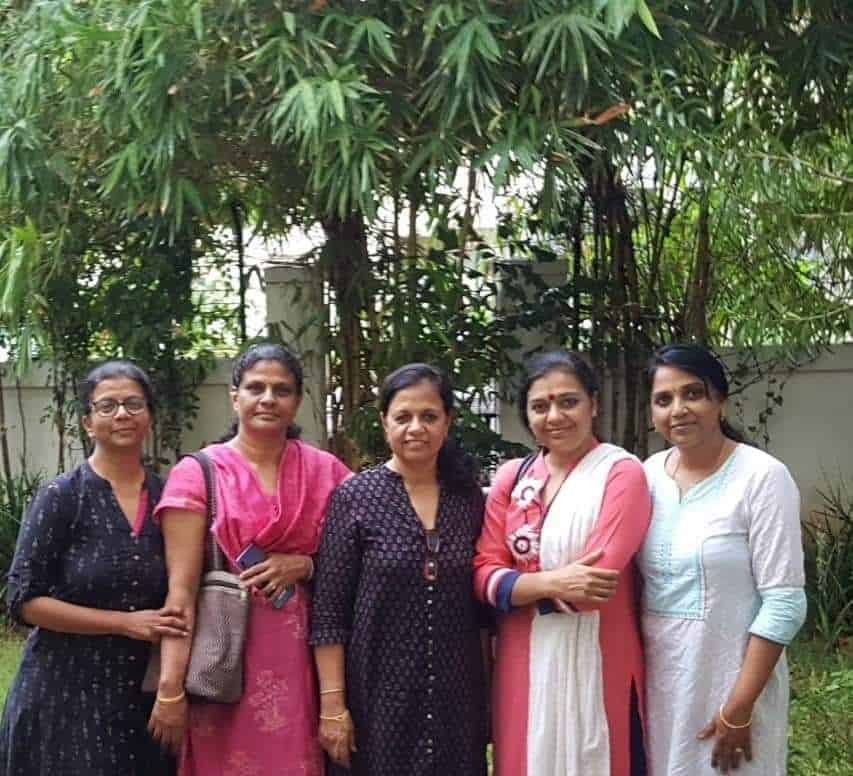
Members of ‘Voice of People’ with the author (third from left)
A collective voice
I was truly delighted to have been enlightened on this by my extraordinary group of friends: Charu, an IT engineer; Raji, an entrepreneur; Sakthi, an academician and Meera, a civic issue enthusiast. We missed Jothi, a lawyer, who could not join us.
I met Charu, Raji and Meera, in March 2017, at Besant Nagar in a gathering of a large group of young women. These women stepped out on the road singing songs, set to popular tunes on the deplorable act of MLA’s in the State of Tamilnadu, that was going through the mess of MLA’s in a resort and an ugly and dirty fight for power. Literally on these streets was born this civic group who go by the name ‘Voice of People’.
These women came together driven by the conviction that consistent participation of informed and active citizens would make a significant difference in the way we are being governed. Charu quotes Barathiyar at the drop of a hat in defense of participative democracy, Meera raises her voice against every issue she spots on social media, Raji an ardent supporter of groups that raises civic issues and Shakthi the soft-spoken academician who believes that knowledge is empowerment, all of them in one voice tell me that we have to take responsibility beyond our family. It is our State, our Country, and let’s make a beginning they say with optimism. They have vowed to introduce the concept of Ward committees and Area Sabhas to Chennai.
They have met every political party and the concerned Government departments in the State, to hand over petitions demanding the constitution of Area sabha and ward committees. They are on a mission to educate people on what this means for them.
It is easy to keep condemning but very difficult to step out and do something about it. Not really, you will if it bothers you enough, they say. They are courageous and smile at barbs thrown at them, they are even referred to as tools of some political parties.
And so I had a delightful and meaningful time sipping coffee with these Bharathi’s ‘pudhumai penngal’.
You might want to understand this more, give them a call and they will come and talk to your group or association. If you do think that this makes sense and we need a say in governance beyond voting please do sign the petition here: bit.ly/2XkNZXx
You can read the petitions here: bit.ly/329QfEy (English), bit.ly/2XQj1uI (Tamil)
[This article first was first posted by the author on Facebook.]