Two days ago, Bengaluru Police Commissioner Bhaskar Rao tweeted that the number of traffic wardens in the city would be increased from 390 to 2500. He requested citizens to get in touch with their nearest traffic police stations to apply to be a warden.
Traffic wardens are volunteers from diverse backgrounds who support the police in traffic management, especially as the city’s increasing vehicle numbers have put pressure on the latter. The wardens are part of the Traffic Warden Organisation (TWO) of Bengaluru City Police.
Traffic wardens need to be on duty only 16 hours a month, but can do more if they prefer to. In addition to managing routine traffic, they also take part in special duties during cricket matches, aero shows, protests, elections, VIP visits, religious events etc.
Manju Mehra, 45, is a Senior Traffic Warden in Whitefield. A homemaker, Manju started managing traffic informally about 10 years ago. Back then, as a resident of Hulimavu, she had witnessed school students – some 7500 of them from three government schools nearby – struggling to cross roads and even meeting with accidents.
Manju decided to help these children by managing traffic for them. Over time she realised that she enjoyed the activity, and joined the Traffic Warden Organisation formally.
Manju says, “When a traffic warden treats everyone equally and genuinely cares about their welfare, we all become one big family. And we care for our families, don’t we? The sense of duty, selflessness and love for them drives me to arise each day to make a difference.”
When asked about standing in traffic for long hours amidst pollution and honking, Manju enthusiastically says that the smiles of people and her satisfaction in helping them reach their destination safely, motivates her.
Mixed responses to Rao’s suggestion on Twitter
Rao’s tweet received a mixed response, but more importantly, it stirred discussions around voluntary citizen participation in traffic management. While some suggested nominating volunteers from Resident Welfare Associations for handling local traffic, others suggested giving comprehensive training to wardens and officers on traffic management.
If you want to be a traffic warden in your locality, the application process is pretty simple.
What you need to know before applying:
- The Commissioner of Police is the chief patron of TWO. At present, Dr Mohana Nambiar is the Chief Traffic Warden
- Citizens from varied backgrounds are encouraged to join as traffic wardens. If you are a doctor, engineer, lawyer, teacher, government employee, businessman, industrialist, homemaker, or simply someone with a desire to help, this is for you
- You should join TWO voluntarily with the interest of serving the organisation and the public
- Traffic wardens can perform their duty four hours a week or more. In a month, minimum 16 hours of duty in uniform is expected from them
- They can work with the traffic police either in the day or at night
- Since the wardens are offering voluntary service, they don’t have statutory powers and are not remunerated
- Parades for traffic wardens are conducted on the third Saturday of every month, between 8:15 am and 10 am at CAR Grounds near Sirsi Circle, Mysore Road. Attendance is compulsory.
Qualification to be a traffic warden:
- Completion of grade 12 education from HSLC or similar boards
- Aged between 18 and 55 years
Application process:
- Obtain an application form from the nearest Traffic Police Station and fill it
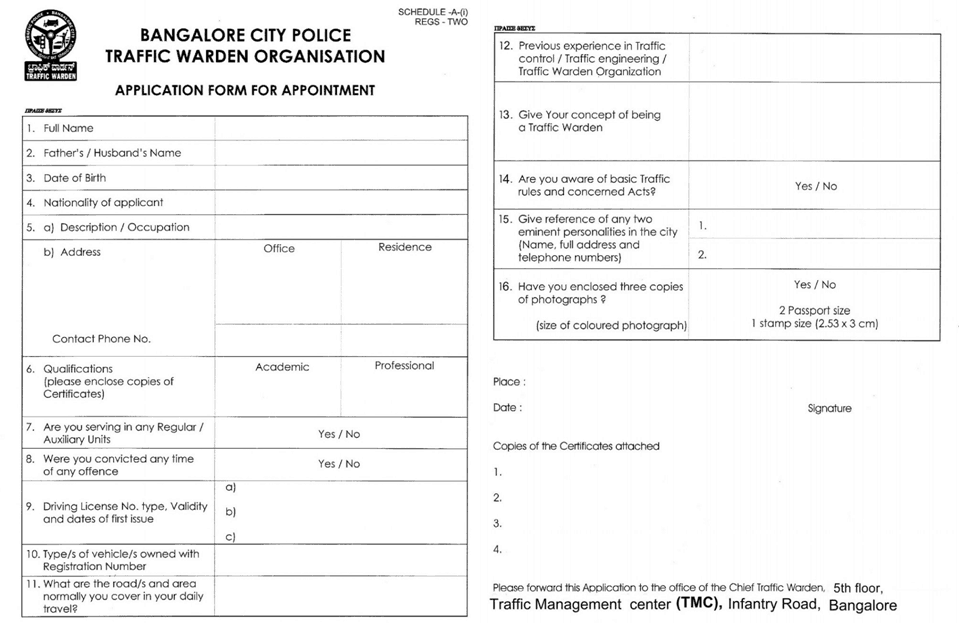
A copy of the application form
- Submit the form along with:
- 2 passport-size photos
- 1 stamp-size photo
- Photocopy of educational qualification certificate
- Photocopy of valid identity proof such as Aadhaar, Voter’s ID, PAN Card etc
- Once you submit the application form with the required documents, you will be invited for an interview conducted by Chief Traffic Warden and senior traffic officials
- Interviews are generally held between 5-7 pm on working days
- You will be required to undergo one-day training on a Saturday or Sunday
- Once you’re selected, you will be informed about it
- Post training and selection, you need to participate in an oath-taking ceremony in the presence of the City Police Commissioner
- Obtain uniform and other items that are required on duty
- You will be in touch with the Chief Traffic Warden, Area Division Traffic Police and fellow traffic wardens by call and WhatsApp
- You can communicate your preference to manage traffic at a particular spot, and start your journey as a samaritan
For more details, check this press note of TWO.
Find the contacts of Bengaluru traffic police officers and stations here.
Since they have no statutory powers, why should the unruly traffic even obey them? Bangalore is full of rowdism and rash drivers who don’t care a fig about the lives of others. They drive like crazy endangering the lives of others motorists/pedestrians. BTP should make strict vigilance first instead of these feel good measures.