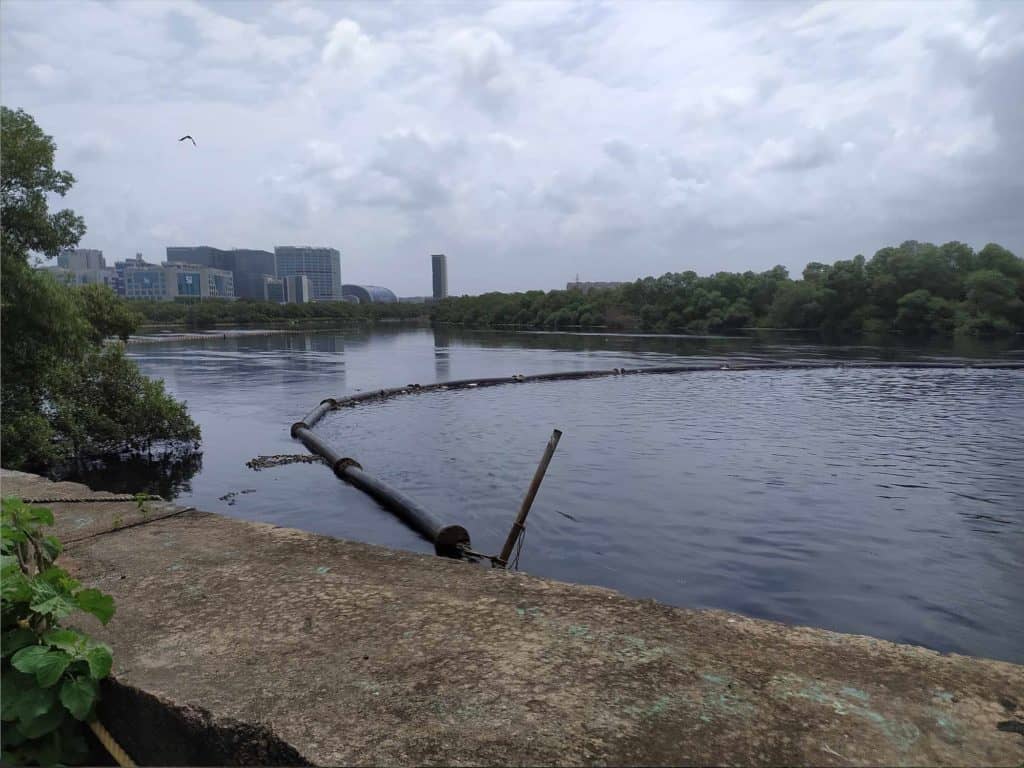
As of 6 August, the Mithi river in Mumbai became the first to have booms or ‘thrash traps’ installed across it. This machinery imported from Finland transfers garbage collected from the river, via a conveyor belt, to another conveyor belt that segregates the waste which is eventually recycled.
Booms are temporary floating barriers made up of light materials like plastic chained across water bodies to prevent and collect floating garbage from flowing into the sea. Booms obstruct floating debris without affecting marine life in any way.
How will Mithi be cleaned up?
Booms placed near Bandra Kurla Complex on the Mithi river near its confluence with the Vakola nalla, will halt and collect the floating garbage right before they can enter the sea, and then segregate the waste. The entire operation at Mithi will be done through solar power in an attempt to stay energy neutral. The plastic waste will be sent for recycling, to develop plastic waste into Pyrolysis oil, a bio-crude substitute for diesel fuel, at a later stage, said Yashwant Deval, country director of RiverRecycle, the Finnish company behind the operation. The company hopes to generate about 50 tonnes of plastic waste daily once it is fully functional.
Environmentalists like Stalin Dayanand have been fighting the government in court for cleaner rivers, claiming that the government ignores lasting and cost-effective solutions, favouring expensive alternatives instead. “Wouldn’t it be much simpler and cheaper to just put up nets along the river mouths to stop flow of garbage into the sea? But the government seems interested only in costly projects. Booms will just take care of the floating garbage; what happens to the garbage just beneath the surface of water?” asked Stalin, director of Vanashakti. “Our entire coastline, be it the beaches, mangroves or mudflats are riddled with garbage, thus affecting not just our marine life but also our fishing communities whose livelihoods are dependent on it. These days fishermen in Mumbai get more plastic than fish in their nets,” he added.
But the project is underway.
Who is responsible for the project?
The Mumbai Metropolitan Regional Development Authority (MMRDA) is facilitating the project ‘Marine Debris partnership’. It is an 18-month long project with four different organisations. Initiated in September 2020, the project includes a year-long operation at the river, with the machinery. RiverRecycle plans to install about 500 such pieces of machinery in eight countries including India. Another Finnish consumer packaging company, Huhtamaki has funded the project with rupees five crores.
Read more: A leak here, a leak there. No way to quantify water wastage in Mumbai
Why was Mithi chosen?
Mithi river was chosen as ideal for the project based on its depth, flow and location (Mithi journeys through areas of Bail Bazar, Kurla, Bandra-Kurla Complex and then connects with the Mahim creek to enter the Arabian sea), said Saurabh Gupta, founder-director of Earth5R. It also passes through one of the densest localities of Mumbai like Dharavi, Kurla and Sion, and infamously collects large amounts of waste.
Which government body governs Mithi ?
Of the 17.84 kms stretch of Mithi, about 11.84 kms is under the jurisdiction of the Brihanmumbai Municipal Corporation (BMC) while the rest of 6 kms is governed by the MMRDA.
If this pilot project records a positive response, this model could potentially be replicated across other rivers in Mumbai like Oshiwara, Poisar and Dahisar, state environment minister Aaditya Thackeray has announced.
Why is Mithi so dirty?
Mithi carries the most waste across all water bodies in Mumbai, according to a water quality analysis done by the Maharashtra Pollution Control Board. With a Water Quality Index (WQI) of 28, the lowest in the city, it has become a benchmark for deeply polluted water in the city.
Of the total 29 marine outfalls in the western suburbs of Mumbai, about 14 of them discharge a combination of sewage and plastic waste into the Mithi river.
The river is also treated as an open dump for sludge oil and disposals of unauthorised and hazardous industrial waste generated by a myriad of activities alongside the river, like washing of oil/chemical drums or barrel cleaners, and a line of many cattle sheds contributing to waste.
What is the BMC doing about it?
BMC is now proposing to set up a 6.7 km tunnel to divert 168 million litres of sewage and industrial effluents generated along the Mithi river to the Dharavi Sewage Treatment Plan. The project is estimated to cost about Rs 603.40 crores and is expected to take about 48 months to complete. https://indianexpress.com/article/cities/mumbai/bmc-to-construct-tunnel-to-stop-discharge-of-sewage-in-mithi-7451260/
What prompted the BMC to do this?
In October 2020, the National Green Tribunal (NGT) had ordered for booms to be installed across water bodies to prevent the journey of waste into the sea and eventually the coasts.
It had also penalised the BMC, citing environmental concerns, for a compensation of Rs 29.75 crores for discharging untreated sewage waste into the city’s water bodies till October 2020. This was calculated at the rate of a monthly fine of Rs 5 lakh for each of the 85 outfalls in the city that were discharging untreated water directly into the Arabian Sea.
How does waste disposal in water bodies affect the city?
Creeks, rivers and the sea along Mumbai’s 437.71 sq km coastal stretch are under threat from continuous discharge of toxic, untreated waste that is thrown directly into nullahs by the general public and those residing in informal settlements, an National Green Tribunal order observed. It also noted that solid waste consisting of plastic carry bags, thermocol plates, styrofoam cups etc find their way into the mangroves, hindering the natural process of water bodies and dirtying the city’s beaches.
Apart from clean ups, the Mumbai Debris Partnership will also work with communities along the rivers to sensitise them and encourage awareness towards organic waste processing, compost making and garbage segregation. Local community members will also be motivated to work for this project,thereby generating employment opportunities and meeting sustainable development goals.