Hope In Many Forms

The fire that raged through the lake on the 16th of March almost killed our spirit. By burning several of our trees, it had made a mockery of our effort to increase the green cover in the area. The sun’s heat, rapidly evaporating the water in the lake, sapped our enthusiasm as well. Whatever little water was present was getting covered with the Salvinia Molesta. Our many efforts to mobilize skilled labour to remove the Salvinia were making no headway. Attempts to get more residents to strengthen our effort drew a blank as well and only our regular volunteers attended our recent assessment meeting. Despite all these, we couldn’t throw up our hands in despair. Not yet at least. Not while our trees and shrubs are growing so well. Not while our resident birds are, well, still resident. 
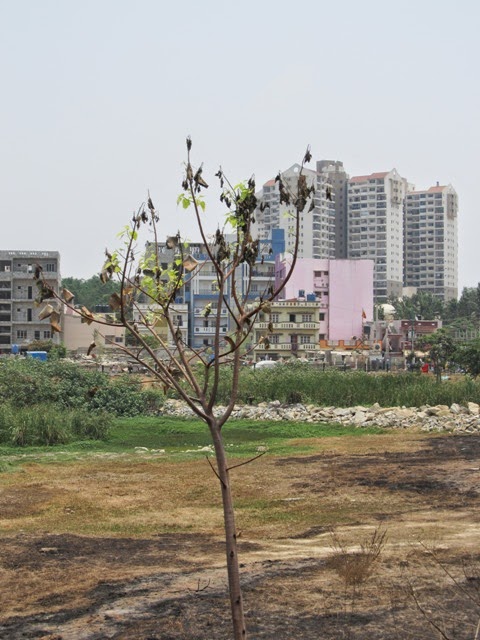
 
We got our gardeners to water the plants every day buying a tanker load of water every three or four days (we still do not have a reliable water source at the lake) in the hope of reviving them and they did! The ground around the trees may be black and the few dried leaves cling obstinately to the branches but new leaves are sprouting!! Fresh, green and tiny but spelling hope and promise of a new beginning. 
 
Peepal sprouting new leaves 
 
Flame of the Forest sprouting new leaves
 
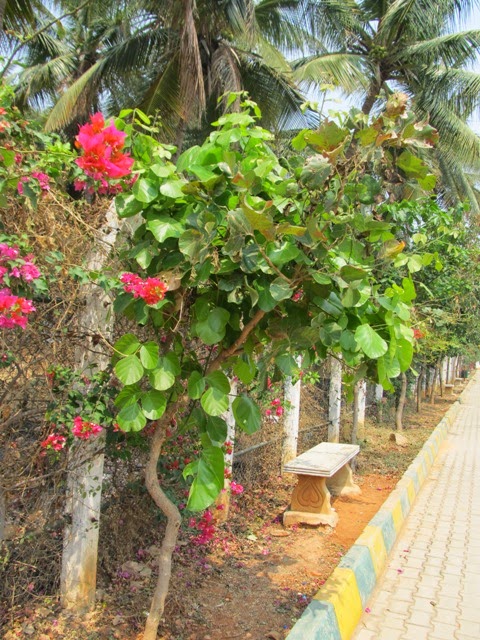
Two trees, the identity of which had puzzled us resolved the issue once and for all by flowering for the first time. The trumpet shaped yellow coloured flower tinged with honey brown is unmistakably Gmelina arborea (Shivani in Kannada, Gamhar in Hindi). The other is the Tabebuia rosea (Pink Trumpet Tree), and there are two of them growing tall in the corner near the encroachment, adjacent the main road from Brigade Millennium. 
Gmelina arborea (yellow flowers on tree) and Bougainvillea (pink flowers)  
 
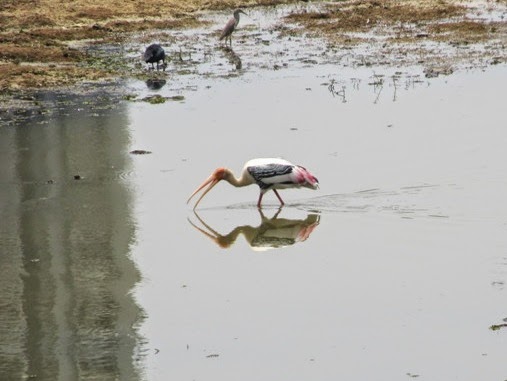
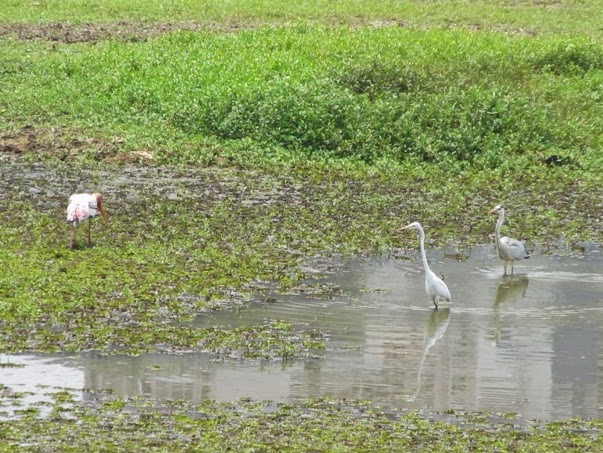
Today morning, birder Srinivas called excitedly to say that while passing by he’d spotted a Painted Stork in the lake. What? Despite the little water and the salvinia? This had to be seen to be believed. We rushed to the lake and what do you know? There was indeed one big Painted Stork foraging for fish! Giving him/her stiff competition were a large sized Egret (Intermediate?) and a Grey Heron
 
Painted Stork foraging for fish
 
Three large birds – Painted Stork, Intermediate Egret, Grey Heron
 
The things that give us such great pleasure may seem trivial and small to others but may the lake continue to surprise and enthuse us all!


Leave a Reply

Your email address will not be published. Required fields are marked *

Similar Story

Bengaluru’s Peripheral Ring Road: Traffic relief or ecological disaster?

Even as landowners contest unfair compensation, other issues persist: emissions, large-scale tree felling, and the project's alignment through lake ecosystems.

Two decades after the Peripheral Ring Road (PRR) was announced, the project is far from completion. For farmers, it has meant years of uncertainty and mounting financial losses, while residents remain unsure about the usefulness of the long-pending road development. In an earlier article, we explored how the PRR project could lead to forced migration and threaten the livelihoods of farmers. In Part 2 of the series, we did a deep dive into the manipulation of compensation options that landowners strictly oppose. However, farmers and environmentalists raise different concerns: even if the road is built, will it truly ease traffic…

Similar Story

From Kuruvimedu to Besant Avenue, how Chennai breathes unequally

Ahead of the art exhibition ‘Pugai Padam’, this photo essay captures the contrasting realities of air and the lived experiences of air pollution in Chennai.

The chimneys of the NTECL Vallur Thermal Power Station, billowing smoke, loom over Kuruvimedu in Ponneri, Thiruvallur near Chennai. Wedged between the plant and its sprawling 300-acre ash pond, the hamlet lies under a blanket of kari (coal) and sambal (ash), coating its narrow streets, colourful homes, and trees. Kuruvimedu is hard to find on Google maps, just as its namesake bird. The main road leading to this place is flanked by factories and industrial complexes, its surface riddled with potholes that make every journey dangerous for motorists.  Home to mangroves, networks of canals, and fields, Kuruvimedu once buzzed with…