Hope In Many Forms

The fire that raged through the lake on the 16th of March almost killed our spirit. By burning several of our trees, it had made a mockery of our effort to increase the green cover in the area. The sun’s heat, rapidly evaporating the water in the lake, sapped our enthusiasm as well. Whatever little water was present was getting covered with the Salvinia Molesta. Our many efforts to mobilize skilled labour to remove the Salvinia were making no headway. Attempts to get more residents to strengthen our effort drew a blank as well and only our regular volunteers attended our recent assessment meeting. Despite all these, we couldn’t throw up our hands in despair. Not yet at least. Not while our trees and shrubs are growing so well. Not while our resident birds are, well, still resident. 
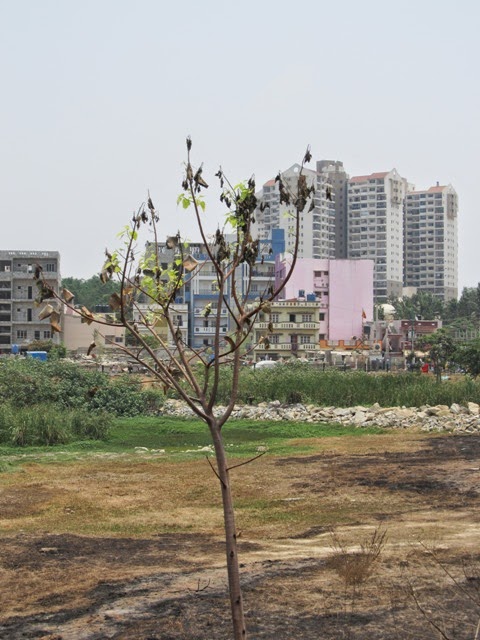
 
We got our gardeners to water the plants every day buying a tanker load of water every three or four days (we still do not have a reliable water source at the lake) in the hope of reviving them and they did! The ground around the trees may be black and the few dried leaves cling obstinately to the branches but new leaves are sprouting!! Fresh, green and tiny but spelling hope and promise of a new beginning. 
 
Peepal sprouting new leaves 
 
Flame of the Forest sprouting new leaves
 
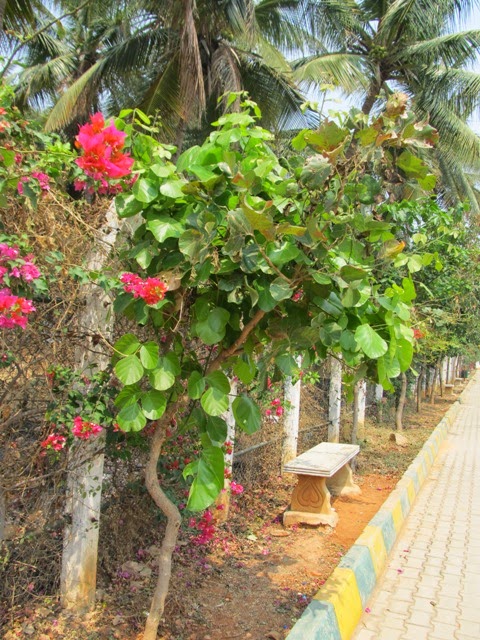
Two trees, the identity of which had puzzled us resolved the issue once and for all by flowering for the first time. The trumpet shaped yellow coloured flower tinged with honey brown is unmistakably Gmelina arborea (Shivani in Kannada, Gamhar in Hindi). The other is the Tabebuia rosea (Pink Trumpet Tree), and there are two of them growing tall in the corner near the encroachment, adjacent the main road from Brigade Millennium. 
Gmelina arborea (yellow flowers on tree) and Bougainvillea (pink flowers)  
 
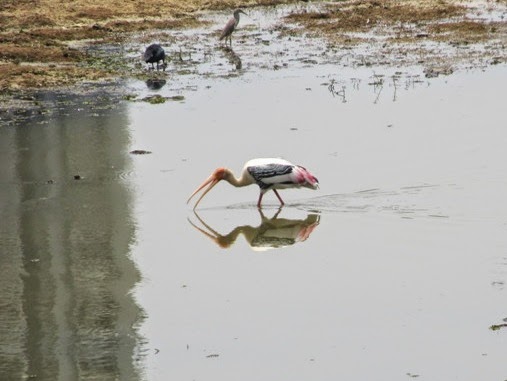
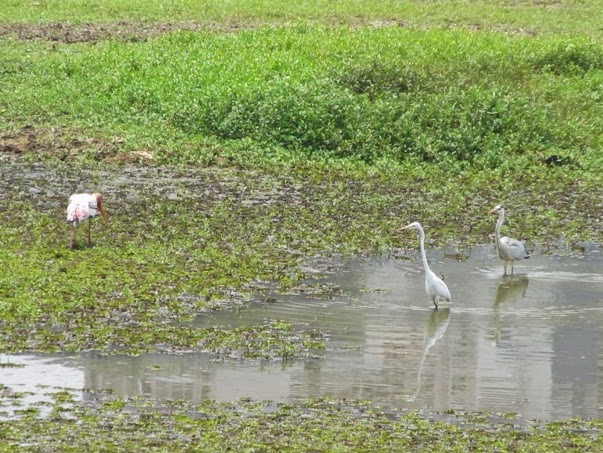
Today morning, birder Srinivas called excitedly to say that while passing by he’d spotted a Painted Stork in the lake. What? Despite the little water and the salvinia? This had to be seen to be believed. We rushed to the lake and what do you know? There was indeed one big Painted Stork foraging for fish! Giving him/her stiff competition were a large sized Egret (Intermediate?) and a Grey Heron
 
Painted Stork foraging for fish
 
Three large birds – Painted Stork, Intermediate Egret, Grey Heron
 
The things that give us such great pleasure may seem trivial and small to others but may the lake continue to surprise and enthuse us all!


Leave a Reply

Your email address will not be published. Required fields are marked *

Similar Story

Mumbaikars are fighting for their mangroves. Here’s how you can join them

Mumbai is about to face a monumental loss—its mangroves are being cut to build the coastal road. Citizens, however, have not given up the fight to save them.

​“What happens when we remove this natural infrastructure of the city? What happens if it floods? What happens if the air quality (index) goes really high?” asks Pooja Domadia, a member of the Save Mumbai Mangroves campaign. These are questions that many Mumbaikars have as work begins on the Versova-Bhayandar Coastal Road, which is set to affect 45,000 mangrove trees. In March this year, the Supreme Court dismissed a petition challenging the Bombay High Court order to greenlight the cutting of mangroves for the project. Is the SC decision a fatal blow to the movement? The BMC has already begun…

Similar Story

Where are the pollinators in Bengaluru?

Despite the volumes of citizen-generated data on the city's biodiversity, pollinators who sustain the urban ecosystem do not seem to be getting their due attention.

Urban biodiversity is often discussed in terms of tree cover, lakes, or flagship species, but far less attention is paid to pollinators—the insects and birds that quietly sustain urban ecosystems. In Bengaluru, a rapidly urbanising city with a strong culture of citizen science, large volumes of biodiversity data are now being generated by the public. But what does this data tell us about pollinators in the city? This article draws from a data jam hosted by OpenCity in Bengaluru that explored pollinator observations using publicly available, citizen-generated datasets. By analysing long-term observation records and spatial data on land use and…