Just a few metres away from the congested traffic bottleneck on Mount Poonamallee Road, near Sri Ramachandra University in Porur, lies Chennai’s first wetland sponge park, named Dr MS Swaminathan Wetland Eco Park. Unlike most parks in Chennai, this one stands out for striking a balance between ecological restoration and community use.
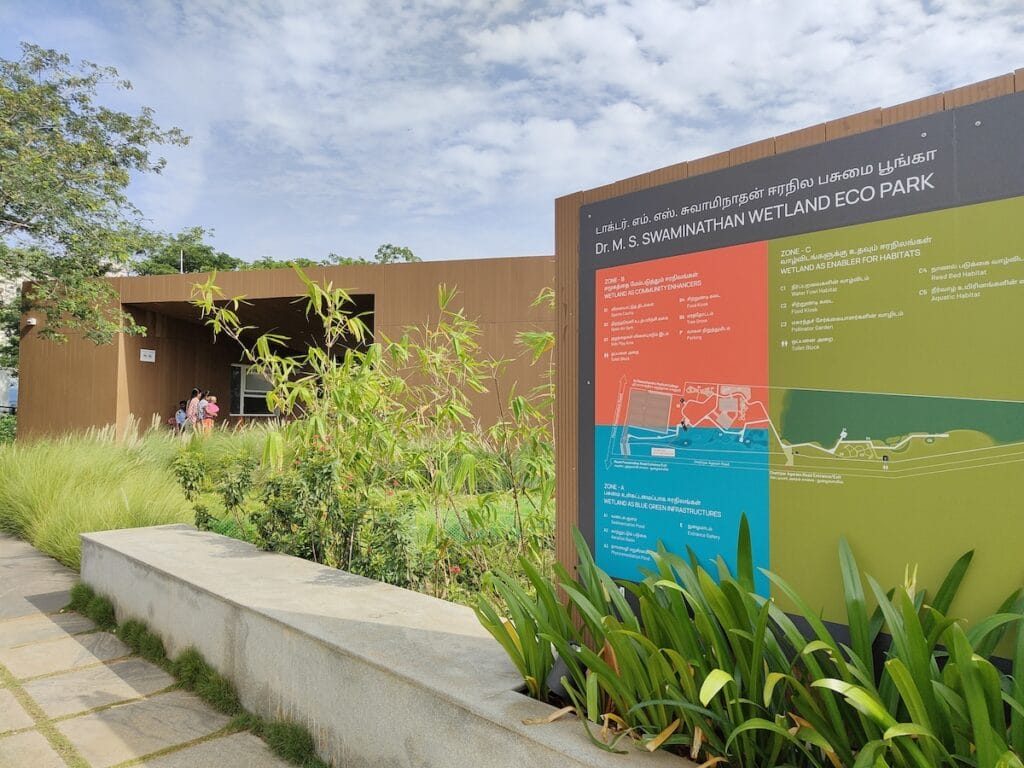
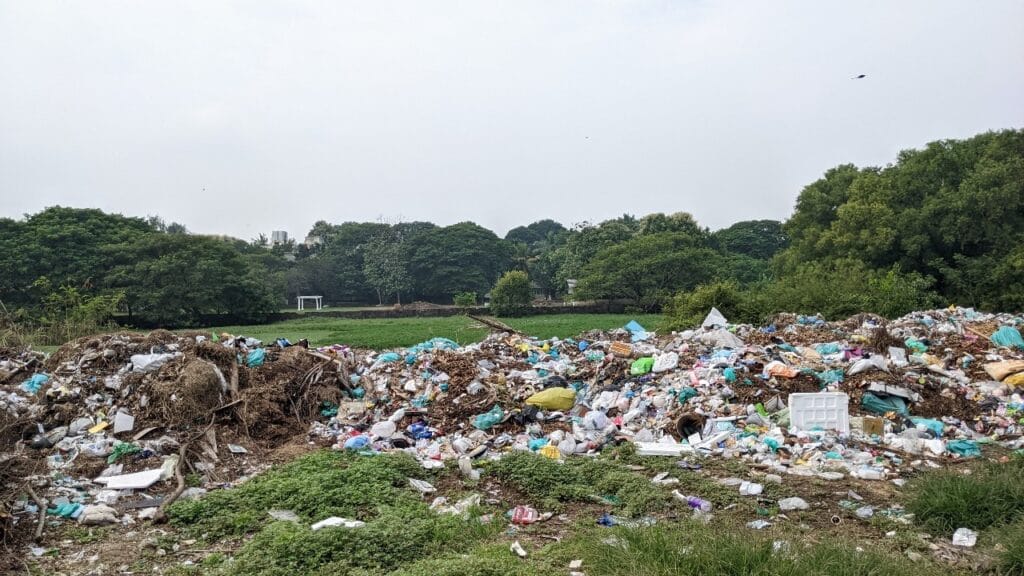
What was once a marshy plot of land became a dumping ground and parking lot over the years. The Chennai Metropolitan Development Authority (CMDA), along with the Sponge Collaborative, has converted this 16.63-acre site, part of Sri Ramachandra University’s Open Space Reservation land, into a sponge park. It offers an alternative approach to managing water in cities.
Traditional flood-control systems aim to remove water as quickly as possible. This park takes the opposite approach. It slows down water, stores it, filters it, and allows it to percolate into the ground. At the same time, it provides a public green space in a dense urban area.
“When we first arrived at the site, it was covered in asphalt and used as a parking lot, while the existing water body was degraded and being used as a garbage dumping ground. The land had been heavily altered from its original wetland state, and our goal for the project was to restore its ecological functions and rejuvenate the water body,” says Manushi Ashok Jain, Co-Founder and Director of Sponge Collaborative.
Community response to the sponge park
The park was opened to the public in February. “While we will continue to monitor its impact, the initial response from the community has been overwhelmingly positive. Over 1,000 people visit the park on weekends,” says Niveda Ramesh, Associate Urban Designer with Sponge Collaborative.
Read more: Understanding sponge parks: Why are Indian cities opting for it?
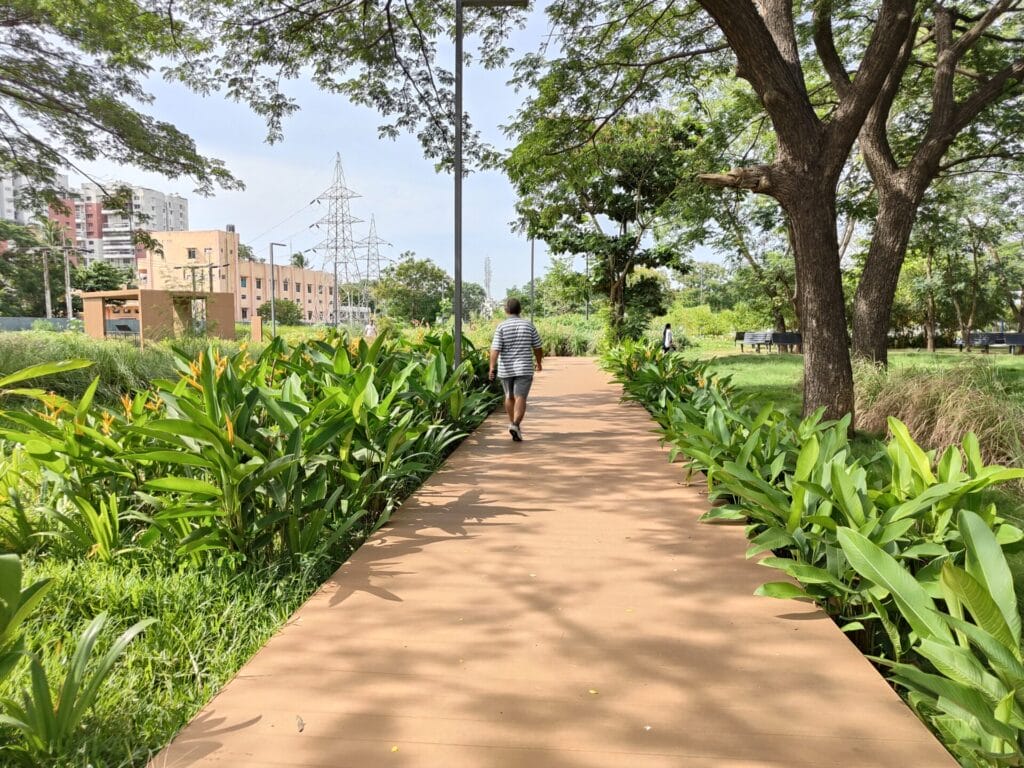
I have been visiting the park for evening walks regularly since its opening. There are smaller parks in the area. But having such a big park in the locality is very refreshing. It has more greenery and provides a much better breathing space. Boards are placed explaining the design behind the sponge park, and these are very informative,” says Senthamarai, a resident, adding that the park provides a welcome escape from the traffic noise.
“I saw an empty ticket counter. Entry is free now, but charging a fee would limit access,” she adds, raising her concerns.
KP Subramanian, former Professor of Urban Engineering at Anna University, agrees. “Ticketing would reduce the public’s sense of ownership,” he says.
Read more: Do we need a reimagination of Bengaluru’s stormwater drains?
Understanding the sponge park’s design
Nearly 50% of the stormwater generated within Sri Ramachandra University is diverted into the sponge park.
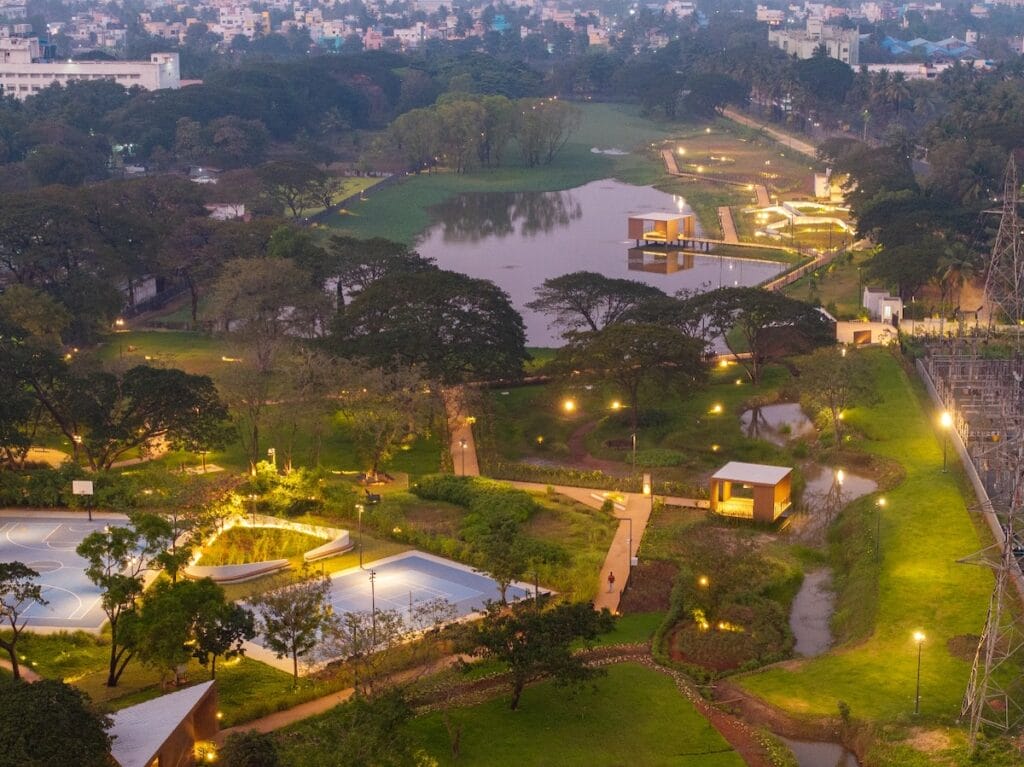
A channel leads this stormwater into a bioswale, a gently sloping, vegetated trench, which slows the water and starts the filtration process.
From there, the water passes through three treatment zones: a sedimentation pond, an aeration basin, and a phytoremediation pond. Each plays a vital role in cleaning the water before it enters the retention pond.
The sedimentation pond is the first stop. It slows down the flow, allowing silt, sand, and debris to settle. “Sedimentation ponds are cost-effective and are lined with vegetation to stabilise the banks and enhance filtration. This process effectively reduces the turbidity. The accumulated sludge is removed through periodic desilting,” explains Niveda.
Next comes the aeration basin, where the water flows over gravel beds and gently sloped mounds. It is designed to maximise the water’s exposure to air and promote the circulation of oxygen. Aeration provides several benefits, including reducing pond muck, improving water quality, eliminating the thermocline and decreasing the risk of fish kills.
The final stage is the phytoremediation pond, where native plants such as Typha and Myriophyllum absorb remaining pollutants. “We sourced native species from the wetlands on the outskirts of Chennai,” Niveda says. The water from this tertiary treatment is discharged into a larger retention pond that supports wetland habitats and recharges the aquifer.
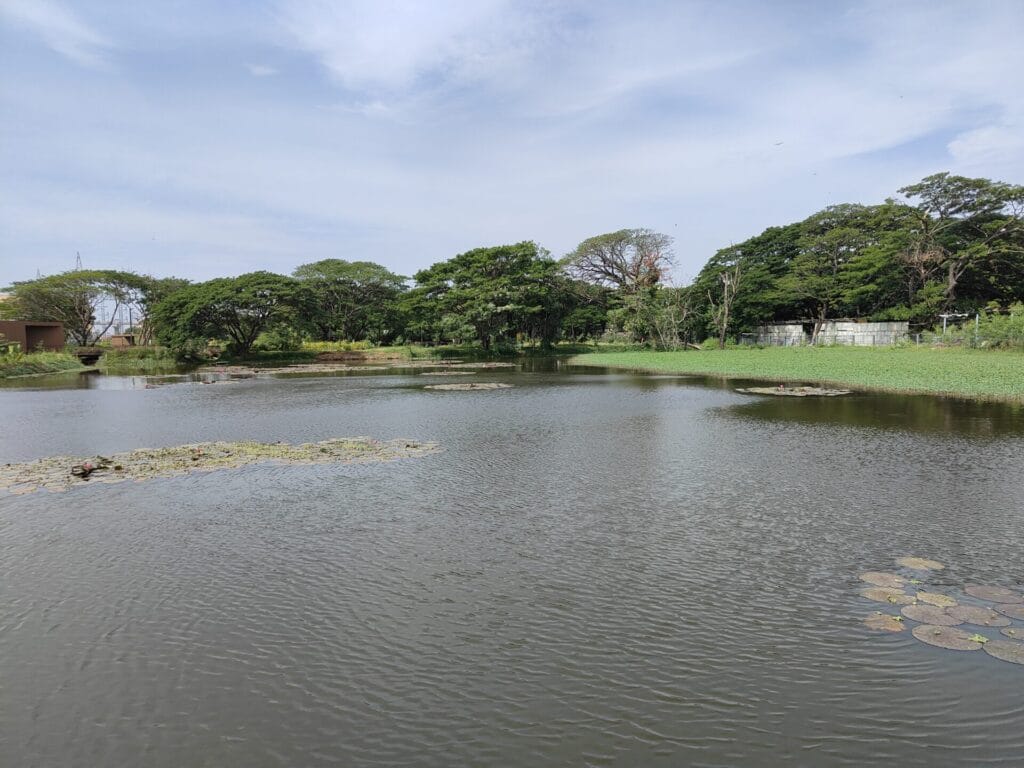
“We deepened the existing water body by about five feet. Now, during the monsoon, it can hold up to 30 million litres of water,” adds Niveda.
A public space rooted in ecology
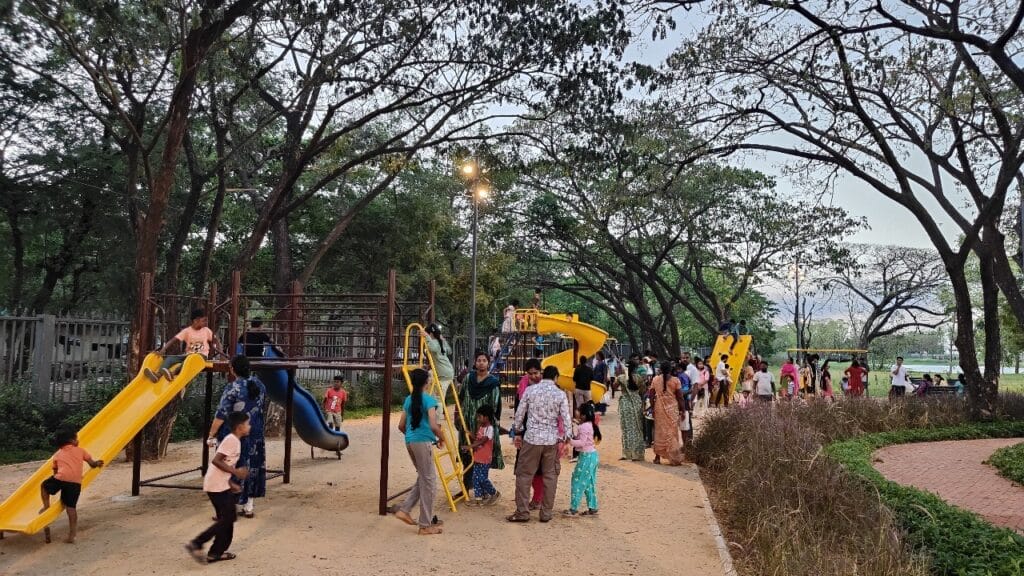
While most sponge parks are designed purely as infrastructure, the Porur sponge park not only manages water but also functions as a community space for recreation and gathering. The park has a basketball court, a multi-use sports area, a children’s play space, and elevated boardwalks that allow residents to traverse the park.
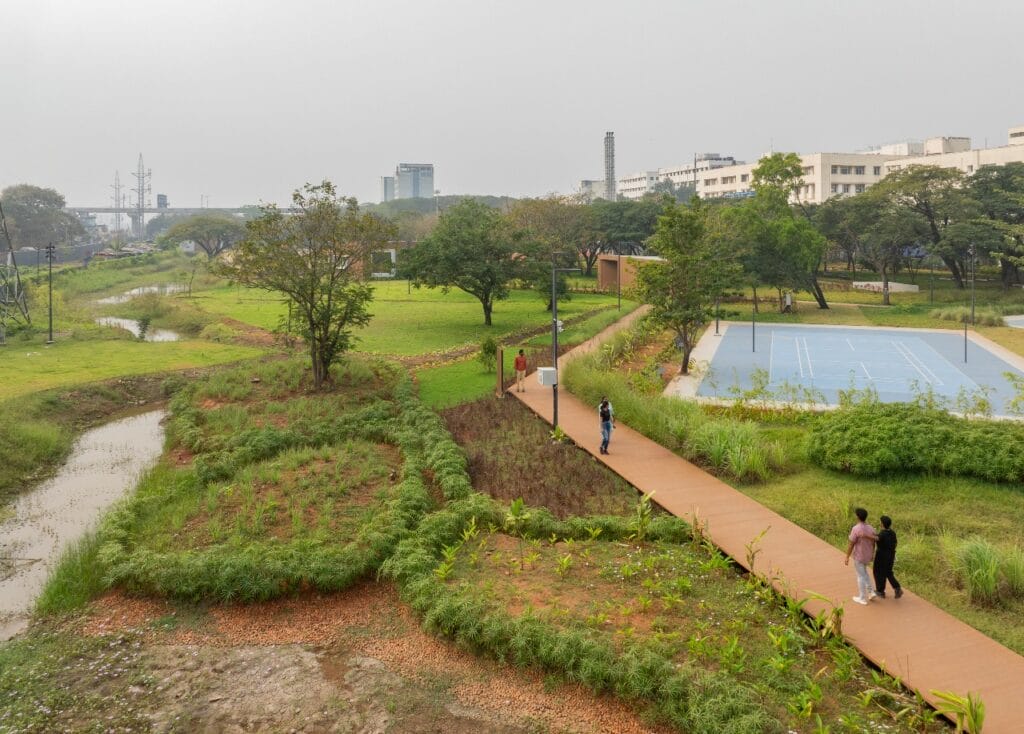
“These boardwalks are carefully constructed to allow water to flow freely underneath, ensuring that the hydro-ecological movement is uninterrupted,” says Niveda. The steel frames supporting the boards are treated to prevent rust and corrosion, even during prolonged exposure to water. The maximum water level during peak monsoon remains at least one foot below the boardwalks.
The entire park is designed to flood safely during the monsoon. The public can use the park for recreational purposes on other days. During heavy rains, it acts as a temporary holding tank. A controlled outlet slowly releases water into the public drainage system. This protects public infrastructure from being overwhelmed. “The park helps to delay the stormwater runoff before entering the stormwater drain and supports groundwater recharge,” she adds.
Read more: Can blue-green infrastructure fix Mumbai’s floods and heat waves?
The challenge in the upkeep of the sponge park
Despite the success of its design, the sponge park faces practical challenges, particularly in the area of long-term maintenance.
Community-led upkeep is not feasible at this scale. According to a CMDA official, the CMDA and the original contractor currently manage the sponge park. A new tender has been floated to appoint a long-term maintenance agency. Sponge Collaborative will also provide technical guidance.
Equally important is the quality of incoming water. The sponge park is not designed to treat raw sewage. The park only receives stormwater and treated water from the STP within the campus. “If sewage mixes with stormwater, it will compromise the filtration system and pollute the groundwater. However, since the park currently receives only stormwater and treated water from the STP within the campus, we are able to maintain water quality and monitor conditions effectively,” says Niveda.
A starting point, not a solution
The Porur wetland sponge park is a pilot project that presents a thoughtful and forward-looking response to Chennai’s flood and water management issues.
“However, one sponge park cannot solve the problem alone. What Chennai needs is a network of similar interventions, sponge parks, wetlands, and holding ponds, strategically placed throughout the city to work in tandem,” says Dr S Janakarajan, President of the South Asia Consortium for Interdisciplinary Water Resources Studies, Hyderabad, and former Professor at the Madras Institute of Development Studies.
A master plan for open spaces in the city is essential to bring about a larger transformation. “We recently completed a study on open spaces for the Chennai Metropolitan Area region, to help plan and include more green spaces in the city’s urban planning,” notes Manushi.
To go beyond one-off projects, Sponge Collaborative created a framework to identify important locations and help expand sponge parks across the city. “We also hold workshops and train municipal engineers, because successful scaling needs strong local skills,” she adds.
The Porur project may be the first, but it must not be the last.
good initiative. many more to come. all the best.