Whitefield.
I know the very mention of that name is starting to remind people about all the things that are going wrong in that part of town. In my recent visits to that side too, I have been surprised by the degree to which the city has collapsed over there, and wondering what can be done to retrieve the situation. Rather than continue the litany of complaints, I thought I would put together the things that can be done to tackle the problem, initially focusing on roads and transport.
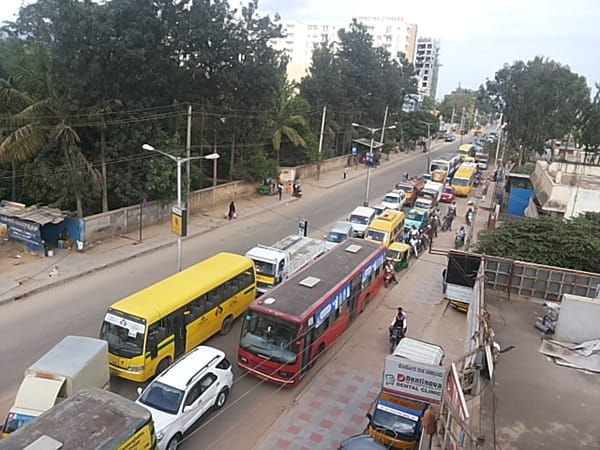
A beeline of vehicles waiting on Varthur Main Road, near Kundalahalli Gate. Pic: Shree D N
The following things can be done WITHIN 2 MONTHS – stabilising the patient, in a manner of speaking.
-
Identify the major arterials and tar them to be continuously motorable, and allocate money to keep them in such condition. Concrete the major intersections, so that the additional wear and tear from braking movements will not damage the roads there, and that signals can actually clear when they turn green.
-
Double the fleet of circulator buses, adding more routes in necessary. Double the Big10 fleet on Old Airport Road and Old Madras Road, and introduce connector services between the two in three orthogonal segments – along Suranjan Das Road, on the Ring road itself, and from Kadugodi to Dommasandra.
-
Build crosswalks at intervals of 500 m to help people get across the street on the high-volume streets.
-
Create pre-emptive U turns at all points where the U turn movements are needlessly brought into the junction area.
I will myself admit that these things will not be SUFFICIENT, but they are NECESSARY in any long-term solution, and can be done right away. The more long-term thing to do is to:
-
Create more access points to the area from the ring road, which is the core cause of the bottleneck in movements, and
-
Widen the existing access points to allow better movement through these intersections.
We are trying to solve the problem without spending money, and that will never work. We have to commit 300-500 crores for junction improvements, and recover those from betterment fees if necessary, but counting on TDR to pave the way for change is NEVER going to work. In fact, almost certainly the ‘cheap’ approach to development is now working against it.
Related Articles
Whitefield Shining – breaking global records!
Ruminations en route from Whitefield to the heart of Bengaluru
Please don’t fool residents of Whitefield into thinking that there are viable solutions for their problems till there is an acknowledgement that it is severely overcrowded. And let’s not waste Rs 500 crores by pouring GOOD MONEY after BAD.
Despite having the highest per capita income, it is the most polluted area in Bengaluru with poorest air quality. Too many high rises, too many malls, too many vehicles, too many kindergarten schools and too many companies all clogged into a small area.
Offer MNC’s free land say in Chikkaballapur or near Kolar and tax holiday for about 20 years. Moving half the companies out of Whitefield is the only viable long term solution.
Commuter Rail from Yeshwantpur to Whitefield, Kengeri to Whitefield , Kengeri to Hosur would takeout many cars from the road. A station at Outer Ring Road / Airport Road on the Byappanahalli – Hosur track with feeder buses could ease the situtation.
Feeder Commuter Rail such as a Rail Bus from Byappnahalli Station which is next to Byappanahalli Metro Station to Whitefield with stops at KR Puram, Shanthinikethan Apartment and Whitefield could also be another option.