Panel discussion: The complicated technical and legal process of handover from builder to RWA

On June 25th, ADDA, Citizen Matters and BAF organised a collaborative event consisting of panel discussions and sessions. Catch the video here.

Given Bengaluru’s building boom, the city has a vast number of Residents Welfare Associations (RWA). But few RWA members are aware of the complex laws and rules that have to be complied with for transfer of ownership of the building complex from the builder to the RWA. The process of financial, legal, operational and other technical issues regarding the handover can be a long and tedious process. 

On June 25th, ADDA, an Apartment Society Management & Accounting Software, in collaboration with Citizen Matters and the Bangalore Apartment Federation (BAF), organised an event consisting of two panel discussions and sessions on the practical to-dos, how-tos and checklists of the handover process that residents should be aware of. 

The panellists and speakers included, Uday Simha Prakash (Founder, Nemmadi), Satish Mokhashi (VP, Prestige Property Management and Services), Rahul Raj (Director, RM Consultants), Ajith Alex George (Director, 42 Estates), Col. Narsimhan (Brigade Group) and Mithun Gerahalli (Lawyer). Apartment association representatives included Ishwar Dixena, Gautham Kamath and Hareesh Sivaraman.

Meera K and Arathi Manay were the moderators for the two sessions, titled, “Operational aspects during takeover: Inputs from customer service experts and MC members” and “Legal and regulatory considerations during handover: Inputs from developer representatives, RWAs and legal experts”.


Read More: What documents to check while buying a property in Bengaluru?
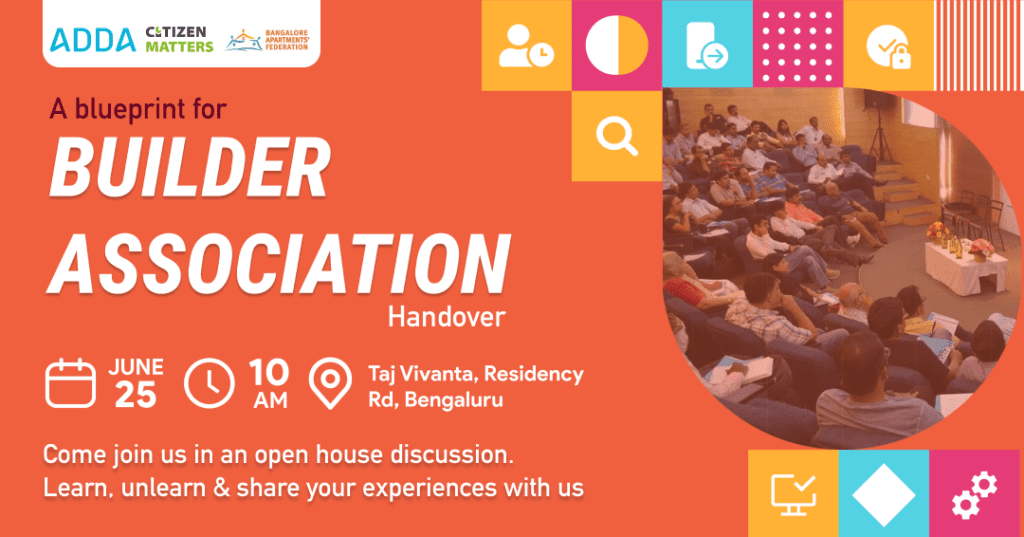

poster of the builder association handover event
A blueprint for builder-association handover. Graphic credit: ADDA

Between them, the two discussions touched upon the various steps to be followed during the process of handover, including the formation of the the residents’ welfare association, the handover of financial details and accounts, modalities and financing of common area maintenance, legal requirements related to documentation and statutory compliance, document checklists and several other important details.


Read More: Builders must get occupancy certificate before handing project over to buyers: Consumer Court


The discussion is available on ADDA’s YouTube channel and can be watched here as well.

Also read:

Leave a Reply

Your email address will not be published. Required fields are marked *

Similar Story

The right to leisure: Do Chennai parks provide respite from soaring temperatures?

Locked gates at noon and ₹75 entry fees limit access to Chennai's parks for the people who need them most during extreme heat.

For homemaker Rani, alternate evenings are dedicated to a few rounds at the 2,456 sq m Sharma Park in Chennai's T Nagar, playfully chasing her two granddaughters across the sanded area. But there are a few things she is worried about. “It’s hot throughout the year at the park. It has unwatered, withering plants, and this area is often prone to rowdyism,” Rani says, pointing to strewn water bottles and food packets behind some benches. However, as she spends all day sweating in her kitchen, these few hours in the open air are immensely valuable. ​In an earlier article, we…

Similar Story

Chennai has 835 parks, but overall green spaces have shrunk

Chennai's green spaces are shrinking with North Chennai having unequal access. Experts call for native planting, rainwater sponges and citizen action.

A flower-seller weaving mozhams of jasmine, men reading newspapers, and cackling children playing games — these are common sights across city parks. As Chennai saw temperatures cross 40°C this May, seekers of shade, couples stealing time together, and informal workers turned to parks for solace.​ Parks and open spaces are crucial for residents in congested areas, many of whom live without air conditioning. But open spaces in Chennai are shrinking. The Urban Regional Development Plans Formulation and Implementation (URDPFI) guidelines mandate 10 to 12 sq. m of open space per person, yet the Chennai Metropolitan Area has roughly just 0.65…