Earth Day Competiion

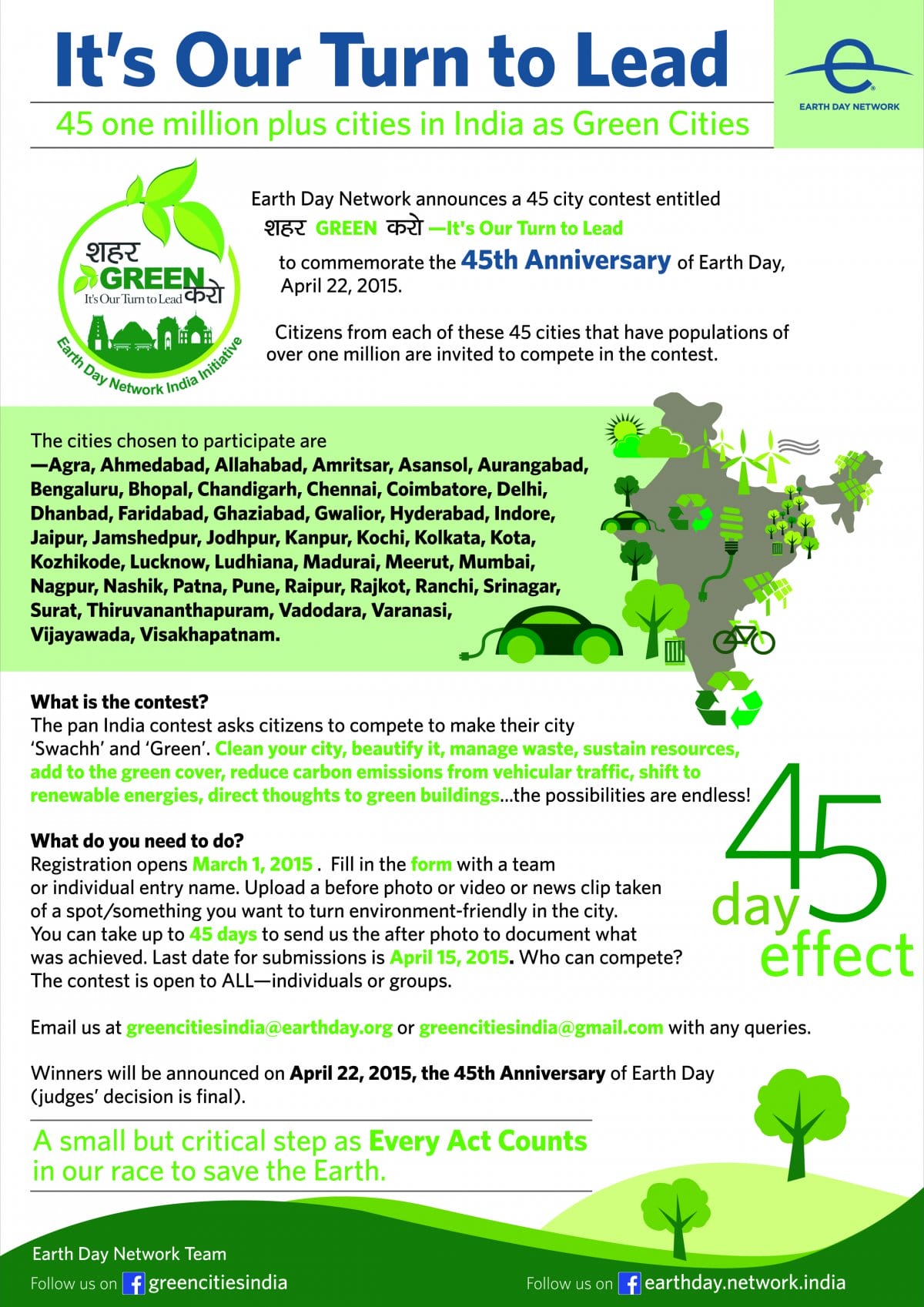
April 22, 2015 will mark the 45th Anniversary of Earth Day.  The international slogan to mark the Day is
‘It’s Our Turn to Lead.’
 

To commemorate this year’s Earth Day, Earth Day Network India announces a 45-city contest titled “Shehar Green Karo” – It’s Our Turn to Lead.

 
All the cities chosen (listed below) have populations of over one million.
 
Agra, Ahmedabad, Allahabad, Amritsar, Asansol, Aurangabad, Bengaluru, Bhopal, Chandigarh, Chennai, Coimbatore, Delhi, Dhanbad, Faridabad, Ghaziabad, Gwalior, Hyderabad, Indore, Jaipur, Jamshedpur, Jodhpur, Kanpur, Kochi, Kolkata, Kota, Kozhikode, Lucknow, Ludhiana, Madurai, Meerut, Mumbai, Nagpur, Nashik, Patna, Pune, Raipur, Rajkot, Ranchi, Srinagar, Surat, Thiruvananthapuram, Vadodara, Varanasi, Vijayawada, Visakhapatnam
 
Let’s make cities more liveable
 
 
What is the contest?  
The pan India contest asks citizens to compete to make their city ‘Swachh’ and ‘Green’.  Clean your city, beautify it, manage waste, sustain resources, add to the green cover, reduce carbon emissions from vehicular traffic, shift to renewable energies, direct thoughts to green buildings…the possibilities are endless!
 
What do you need to do?  
Choose a name for your team/individual entry and register with a photo/video/news clip taken of a spot/something you want to turn environment-friendly in the city.  Take up to 45 days to achieve this, and by April 15, 2015 send us a photo/video/news clip that documents what was achieved.
 
REGISTRATION OPENED March 1, 2015.
Last day to register is April 15, 2015.
​​ 
Who can compete?  
The contest is open to ALL – individuals or groups
 
Entries to be submitted by clicking on this Registration Form
  
For queries email
 
Winners will be announced on April 22, 2015, the 45th Anniversary of Earth Day. Judges decision final.


Leave a Reply

Your email address will not be published. Required fields are marked *

Similar Story

Mumbaikars are fighting for their mangroves. Here’s how you can join them

Mumbai is about to face a monumental loss—its mangroves are being cut to build the coastal road. Citizens, however, have not given up the fight to save them.

​“What happens when we remove this natural infrastructure of the city? What happens if it floods? What happens if the air quality (index) goes really high?” asks Pooja Domadia, a member of the Save Mumbai Mangroves campaign. These are questions that many Mumbaikars have as work begins on the Versova-Bhayandar Coastal Road, which is set to affect 45,000 mangrove trees. In March this year, the Supreme Court dismissed a petition challenging the Bombay High Court order to greenlight the cutting of mangroves for the project. Is the SC decision a fatal blow to the movement? The BMC has already begun…

Similar Story

Where are the pollinators in Bengaluru?

Despite the volumes of citizen-generated data on the city's biodiversity, pollinators who sustain the urban ecosystem do not seem to be getting their due attention.

Urban biodiversity is often discussed in terms of tree cover, lakes, or flagship species, but far less attention is paid to pollinators—the insects and birds that quietly sustain urban ecosystems. In Bengaluru, a rapidly urbanising city with a strong culture of citizen science, large volumes of biodiversity data are now being generated by the public. But what does this data tell us about pollinators in the city? This article draws from a data jam hosted by OpenCity in Bengaluru that explored pollinator observations using publicly available, citizen-generated datasets. By analysing long-term observation records and spatial data on land use and…