In the past, the making of urban form in an Indian city like Bangalore was an outcome of the spontaneous growth of a settlement. The city had winding streets that were primarily for people and not for the automobile. There has been a tremendous change in the economic life of the city and in the present times the experience of the city lies in its high-rise buildings, its flyovers and its high speed traffic. Every piece of architecture in the city strives for its own individuality and its own identity.
Today, a street is defined by high compound walls that demarcate one “private” property from another, road dividers that separate the direction of vehicular traffic and foot overbridges that delineate where the pedestrian must walk and where the car must move.
In our traditional habitats, it was the indigenous soil that made the material of construction for the house. So, for instance, in Jaisalmer in Rajasthan, the locally available yellow stone determined the colour and form of its architecture. It was the organic growth of the stone settlements that made the streets a golden yellow in this city. The colour of urban form was the same as the colour of architectural form.

In Jaisalmer, locally available stone is used for construction.
Similarly, the urban fabric in Jodhpur was also generated from its architecture as each building was a part of the integrated whole. When you walked through the city, you saw a beautiful urban form and experienced a different urban space with every corner you turned, enveloped by blue walls that changed hues as the sun changed its light. In the present-day city of Bangalore, we increasingly make buildings and infrastructure using concrete and urban form is not a cohesive construct.
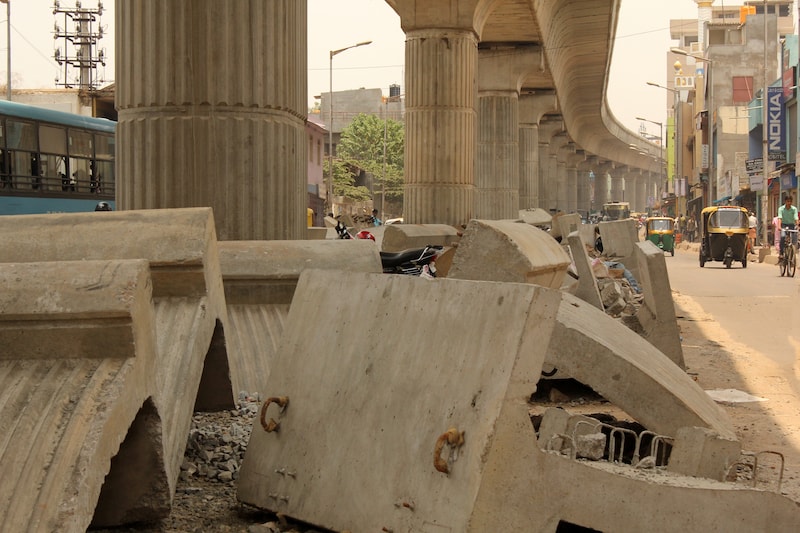
Metro lines and concrete buildings in Bangalore.
The streets of the city have begun to seek a new sense of aesthetic as we commission local artists to paint the compound walls to private and government land. Sometimes, these paintings narrate history, sometimes they are remembrances of nature. For instance, the high compound walls of the Bangalore Palace and the grounds surrounding it are painted on the outer side giving the street a visual stimulus that tries to overcome the monotony of a dull urban landscape.
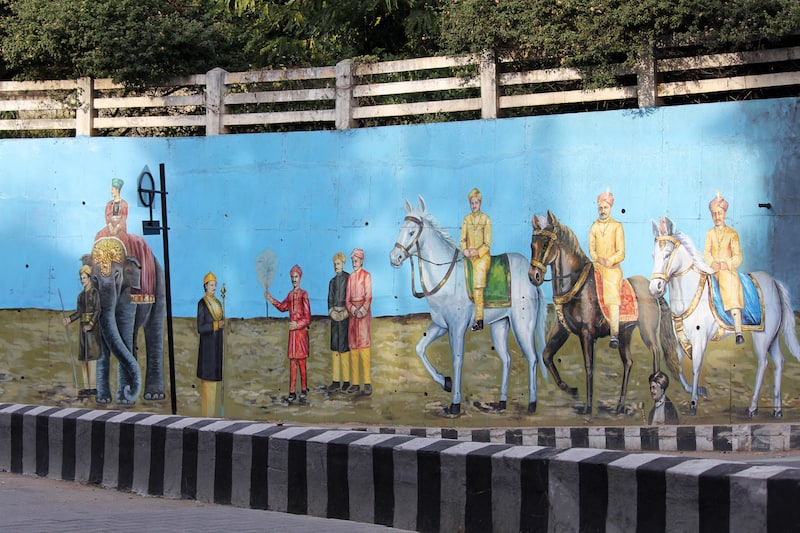
Walls painted by local artistes in Bangalore.
The concrete columns that hold the railway bridge at the Palace road junction become the elements that add colour and vibrancy to the city’s urban form and space.
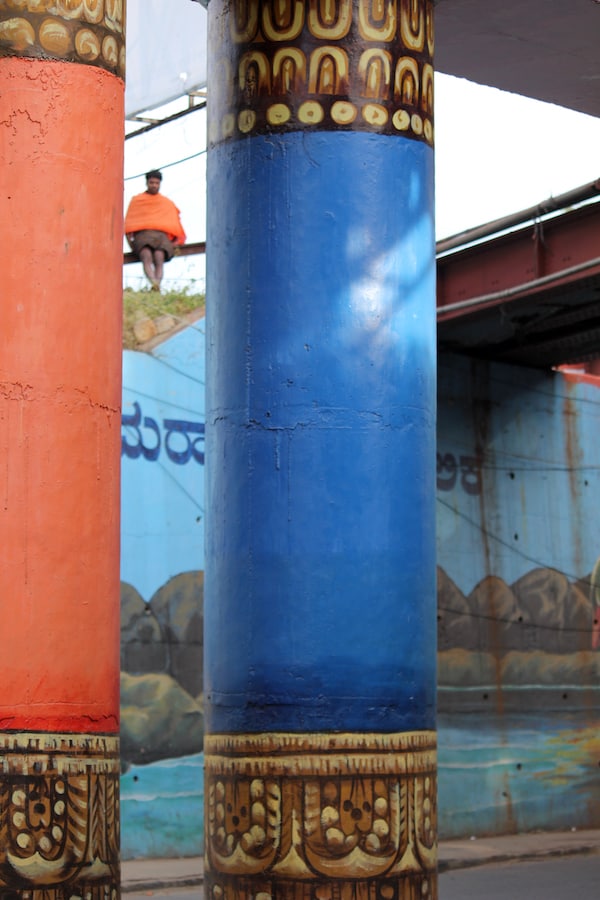
Painted concrete columns on Palace Road, Bangalore.
Street art has been a part of the Indian city before and it has worked as an aesthetic element. The difference was that earlier we did not perceive architecture as a singular entity by itself and we did not neglect urban form. If you walk the streets of Udaipur today, you still find walls with paintings on them. But, the city of Udaipur has an aesthetic that binds its streets and buildings into one harmonious whole. That is what Bangalore lacks, at least in most parts.
Today, Mumbai or Bangalore cannot boast of a harmonious urban fabric inspite of the progress made in construction technology. How can we think about the city as a whole and apply innovative technologies to the whole rather than to a part, to a sole building? If we were to analyse the system of building in Jaisalmer and devise thereon a system for use today, we will perhaps have an answer to a better city fabric.

In Fraser town, a modern building abutts a traditional house. Both have a different visual language.
Jaisalmer as a city, as urban fabric, was designed to be in total harmony with its soil, its terrain and the lifestyle of its people. A city in yellow stone, a sculpture that emerged out of the landscape. But, Jaisalmer was a man-made sculpture of small well-designed parts. It was a system of carved elements – stone slabs, beams, columns, pieces that were put together in a carefully pre-planned process. Stone carvers worked together to deliver the pieces as required, with every piece cut, carved, to make a railing, to turn it to make a junction or to break the monotony of a symmetrical façade. Today, can precast concrete elements take the place of stone slabs, beams, columns, brackets, railing to make a better contemporary Indian city?
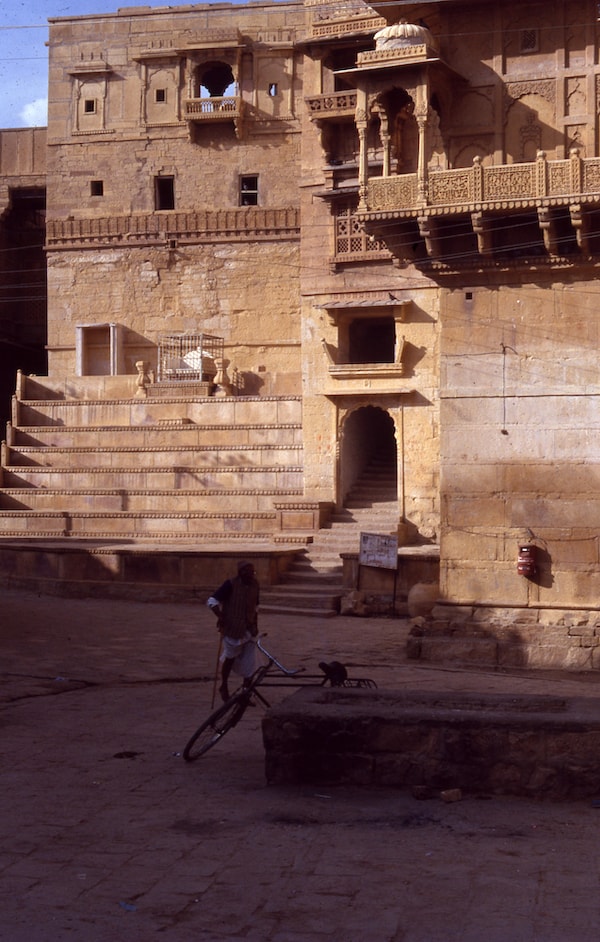
In Jaisalmer, streets and buildings are in harmony with each other.
Here, Jaisalmer is representative of a traditional Indian city just as Bangalore represents any modern Indian city. What we need to realise is how much our perception of the ideal city has changed. Today, we look to the west to emulate the “world-class city.”
Our cities of the past WERE world class cities in every sense. They had a continuous urban fabric, they had an architecture that used indigenous building material and local craftsmanship and they had street art that reflected a highly evolved sense of aesthetic. Today, we need to ask ourselves: What steps would take us to urban change where ‘world-class’ infrastructural efficiency and the ‘Indian everyday life’ work well together?
To put into effect what we learn from our traditional habitats, development control regulations can be an important tool to shape urban form. A study on ‘Builtform and Development Control for Ahmedabad’ conducted and published in 1996 by the Vastu-Shilpa Foundation recommended that a performance-based regulatory system should be instituted in Indian cities since it would give us more flexibility in responding to social and economic change.
Development control that comprises of zoning regulations, sub-division controls, building codes and byelaws can influence population density, open spaces, orientation based on sun movement and wind direction, adequacy of water suppy, drainage and transportation.
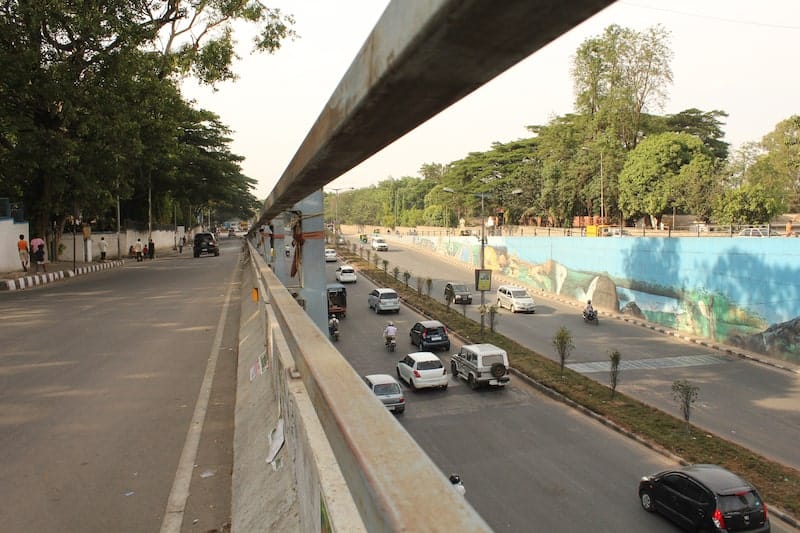
A scene from Mekhri circle, Bangalore.
In Bangalore, an in-depth study of how people use built space and unbuilt space can help regulate urban growth better through devising development control regulations. We need to prescribe appropriate road widths, parking requirements, floor space index, setbacks, plot coverage and building heights based on extensive documentation of existing conditions and needs of the people.
Finally, we may want to consider the implications of a high-density, low-rise development. This could lead to a continuous built fabric that generates a visually harmonious urban form and is more appropriate to the social life of the city.