More rains expected in Chennai
The India Meteorological Department (IMD) has predicted the formation of a new low-pressure area over the Bay of Bengal, bringing heavy rain to Tamil Nadu from December 9th to 12th. Just over a week ago, Cyclone Fengal ravaged Puducherry, northern Tamil Nadu, parts of Karnataka and Kerala causing extensive damage. The Centre has promised ₹944.80 crore relief as two instalments from the State Disaster Response Fund (SDRF), for the people affected by Cyclone Fengal in Tamil Nadu, against the state’s plea for ₹2,000 crore. The state government has announced ₹2,000 for every family affected in Villupuram, Cuddalore and Kallakurichi. It set up medical camps for speedy relief.
The heavy downpour has turned the Muttukadu backwaters in southern Chennai black, with the sudden influx of raw sewage. Greater Chennai Corporation drained water from most of the affected areas. Residents voiced the demand for a permanent solution to address water stagnation.
Source: Hindustan Times, News18, The Hindu, The New Indian Express
Read more: Cyclone Fengal in Chennai: Some areas badly impacted, others hold steady
Tree planting drive in Kochi
The ‘Pachathuruth Project’ saw more than 1,200 tree saplings planted across eight locations in Kochi. Initiated by the Kochi Corporation, in collaboration with the Haritha Kerala Mission, the ‘Green-islands’ project is creating small forests in waste-dumping sites, with mango, jackfruit and star apple trees, medicinal and flowering plants. The Pachuthuruth initiative is being implemented in 21 circles over 74 divisions falling under the corporation.
The corporation cleans up open spaces and grounds for a ‘Pachathuruth’ area and a nearby school or Resident Welfare Association (RWA) is asked to maintain it. About ₹2 lakh has been allocated by the local body to set up ‘green islands’. These have already been established at Lisie Hospital, Kaloor, Mundamveli, and Pullepady.
Source: The New Indian Express
Health scheme reaches one million in Bengaluru
About one million Bengalureans have benefited from the Arogya City scheme, launched in 2022 to combat non-communicable diseases. As these diseases are spreading rapidly across India, addressing the epidemic one city at a time is a smart approach, said Health Minister Dinesh Gundu Rao at the second Arogya City Summit 2024.
It is a collective effort to explore solutions for non-communicable diseases, foster mental well-being, and use technology for a healthier future. The scheme involves government institutions, corporate entities, social organisations, educational institutions and startups working together, said sources. More than 75% of the city’s adults are either diabetic or prediabetic, while one in four deaths are due to cardiovascular disease.
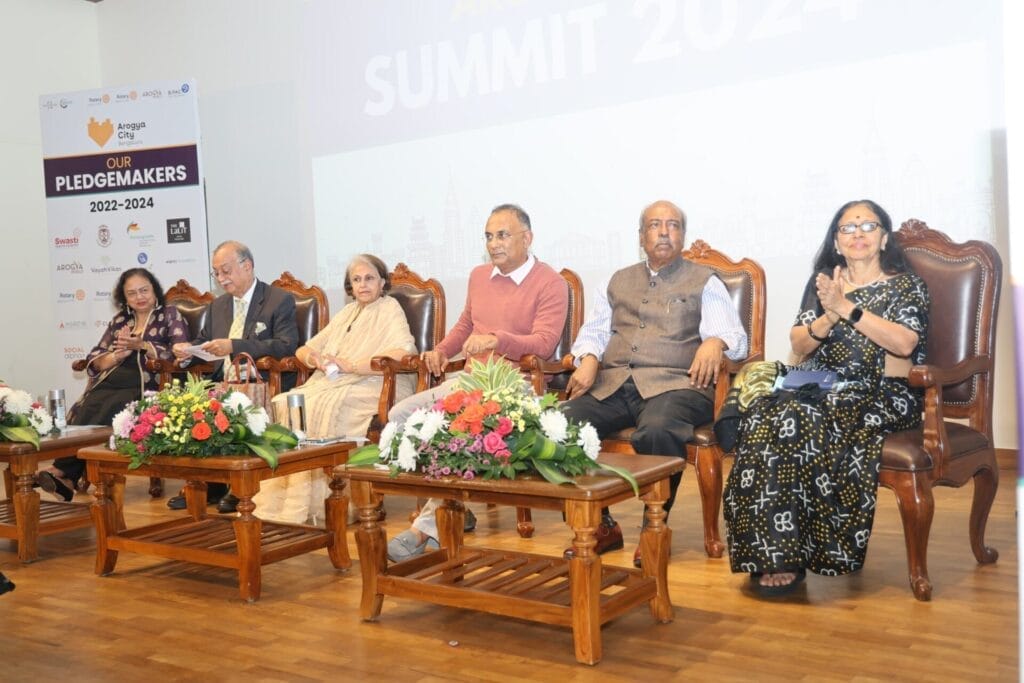
Gruha Arogya, or the government’s door-to-door health screening drive will become part of the Arogya model, to enable the entire population to fight lifestyle diseases. Gundu Rao highlighted the state’s support in making Bengaluru, India’s first Arogya City. About 22 pledge makers were honoured for reaching out with health interventions, educational material and preventive screening in the last two years.
To prevent non-communicable diseases, lifestyle modifications include reducing sugar, smoking, alcohol, and salt intake, decreasing sedentary behaviour, and improving sleep and social skills. The BBMP is also submitting a proposal for a separate Bengaluru Health Commissioner, said Chief Commissioner Tushar Girinath.
Source: UNIIndia, The New Indian Express, X, Deccan Herald
Read more: Have suggested a health survey to check effects of industrial pollution: Kalanidhi Veerasamy
One million unsold housing units in top Indian cities
Eight Indian cities — Mumbai Metropolitan Region (MMR), Delhi National Capital Region (NCR), Bengaluru, Chennai, Hyderabad, Kolkata, Ahmedabad and Pune — have recorded high inventory levels, with one million unsold housing units in the third quarter of 2024, according to Liases Foras and Colliers.
This is mainly due to the record-high sales in the residential market over the last two years. Developers have launched projects across affordable, mid, luxury and ultra-luxury segments. The combined sales of the top seven cities reached 4,76,000 units, as against 3,64,000 lakh units in the previous year, showing an annual growth of 31%.
The new housing supply shows a 19% year-on-year (Y-o-Y) drop, below the 1,00,000 mark for the first time since Q1 2023. Sales also reduced by 11% Y-o-Y.
While NCR, Chennai, and Tier-II cities show a deficient supply level, they may see a surge in new launches. MMR, Pune and Hyderabad are approaching a plateau in sales and supply. Of the one million unsold units, affordable and middle-income categories accounted for almost two-thirds of the unsold inventory, whose levels roughly mimic the overall residential market in the country.
Source: Business Standard
[Compiled by Revathi Siva Kumar]