COVID: Second serosurvey to be done by September end | 12 doctors from Chennai succumb to COVID | GCC steps up surveillance in 13,000 streets
The Greater Chennai Corporation (GCC) announced that the second serosurvey will be conducted by the end of September. This time, the T-cells of recovered COVID-19 patients will be analysed for academic research. The T-cells and antibodies have a huge role in immune response in patients affected by the virus. GCC Commissioner Prakash expects the seroprevalence in the second survey to be around 40%. The first survey saw a seroprevalence of 20%.
According to the bulletin, Chennai recorded 992 fresh COVID cases on September 18th. There are 9,874 active cases in the city.
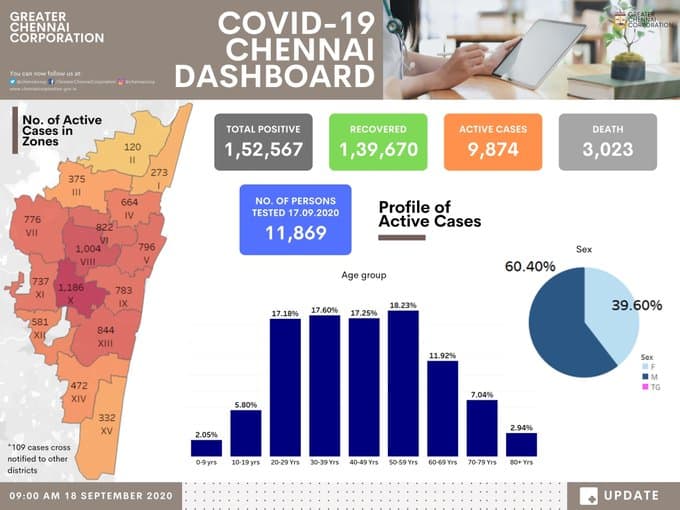
According to the civic body, over 60% of Chennai’s 39,000 have registered COVID-19 cases so far. Surveillance, number of fever clinics and number of samples tested will be increased in the remaining 15,000 streets. GCC is also planning to carry out a disinfection drive in congested areas to limit the spread of the virus .
Data from the Indian Medical Association shows that 12 doctors from Chennai have succumbed to COVID-19 so far. Tamil Nadu State Branch President Dr CN Raja stated that the medical body released the data in order to seek solatium for the families of the deceased from the government. However, he feels that the issue is being given a political colour in the state.
The civic body has collected Rs 1.9 crore as penalty from March till September for flouting COVID safety norms. Royapuram topped the 15 zones where a whopping Rs 44 lakh has been collected for violation of the rules in place to prevent spread of COVID-19.
Source: The Hindu | The New Indian Express | The Times of India
Chief Minister to head CUMTA
The Chennai Unified Metropolitan Transport Authority (CUMTA) Act, 2010 has been amended to make Tamil Nadu Chief Minister Edappadi K Palaniswami the chairman of the government agency. The amendment was passed in the ongoing assembly session. With this move, the other transport bodies will also be brought under the same umbrella.
The board will consist of the Transport Minister, Chief Secretary and Vice-Chairman of the Chennai Metropolitan Development Authority (CMDA) and Housing and Urban Development Minister.
The Act is aimed at integrating all transport modes including the Metropolitan Transport Corporation, Chennai Metro Rail Limited and Southern Railway by introducing one ticketing procedure and better connectivity. The committee will propose an action plan to all the transport departments for implementation. The new committee will oversee, coordinate and assess the implementation of the plan.
Source: The Hindu
Report within 24 hrs for resolving cybercrimes
In a bid to create awareness on cybercrimes, the special wing of Crime against Women and Children, Chennai City Police has started a door-to-door campaign. As teaching has also moved online, cops are advising children not to engage with strangers and give away personal details on the Internet. The campaigns are being organised at apartments and residential areas.
The downsides of the Internet such as cyberbullying, cyber grooming and harassment are explained as part of the awareness programme. Cyber complaints can be registered with the Cyber Crime Cell or the National Cyber Crime Reporting portal.
Recently, the Mylapore Cyber Crime wing recovered Rs 1.50 lakh linked with seven different complaints. Officials from the department state that the lost money can be easily recovered if cybercrimes are reported within 24 hours of occurrence.
Source: The Hindu | The New Indian Express
New harbour for tuna
The National Green Tribunal (NGT) has given clearance for the construction of a harbour for tuna after the fisheries department obtained clearance from State Environment Impact Assessment Authority (SEIAA). NGT ordered a temporary stay after the Meenavar Nala Sangam from Thiruvottiyur Kuppam village in Ennore filed a petition stating that the project was being undertaken without seeking mandatory environmental clearance.
To assess the project’s impact on the coastal area and calculate the compensation, a committee, comprising members from SEIAA, Tamil Nadu Pollution Control Board (TNPCB) and the Tiruvallur Collector has sought aid from Institute of Remote Sensing, Anna University.
According to Fisheries Commissioner G S Sameeran, an additional facility is required to free up the Chennai fishing harbour as it lacks space to land the boats. The new facility is proposed to have fish handling halls, an auction hall, cold storage, ice factory, fuelling station, power backup centres and dormitory for workers.
Source: The New Indian Express
(Compiled by Bhavani Prabhakar)