Corporation website for vaccine slots
In a bid to boost the vaccination campaign, the Greater Chennai Corporation (GCC) has rolled out a website for Chennaiites to book vaccination slots. People may choose one of the centres in the zone they belong to and pick a time slot for their jab.
The website has also clarified that this does not bypass the CoWin booking. The site is only to secure slots in the vaccination centre. A separate CoWin booking will be done in the vaccination centre by the officials.
Besides the website, residents can also register by dialling 044-4612 2300 or WhatsApp 94999 33644. One-third of the doses allotted to a particular centre will be available for online or telephonic booking and the remainder will be reserved for walk-ins at the centres.
Source: The New Indian Express | The Times of India
CAG report reveals only 52% of sewage collected in 2019
A report by the Comptroller and Auditor General of India (CAG), tabled in the Tamil Nadu Assembly during the ongoing session, stated that only 52% of the sewage generated in Chennai Metropolitan Area (CMA) is collected by the existing sewerage system, leaving the rest uncollected as of March 2019.
The report also further added that only 88% of the collected sewage was treated before letting being let out. Responding to the audit, the state government noted that the calculation was based on a theoretical estimation.
In 2017, the state government had initiated Tamil Nadu Vision 2023 under which 100% safe sewage disposal was a key project. The CAG report has noted that the possibility of completion of this achievement was “bleak”. It also pointed out flaws in execution of the underground sewerage system, sewage treatment plants and lines.
The remaining uncollected raw sewage, an estimate of 242.73 MLD, was being drained into the Adyar river, Buckingham Canal, Cooum and other water bodies through stormwater drains.
Source: The Times of India | The New Indian Express
Read more: Thoraipakkam: Never-ending wait for piped water and sewerage system
Suburban trains back on track
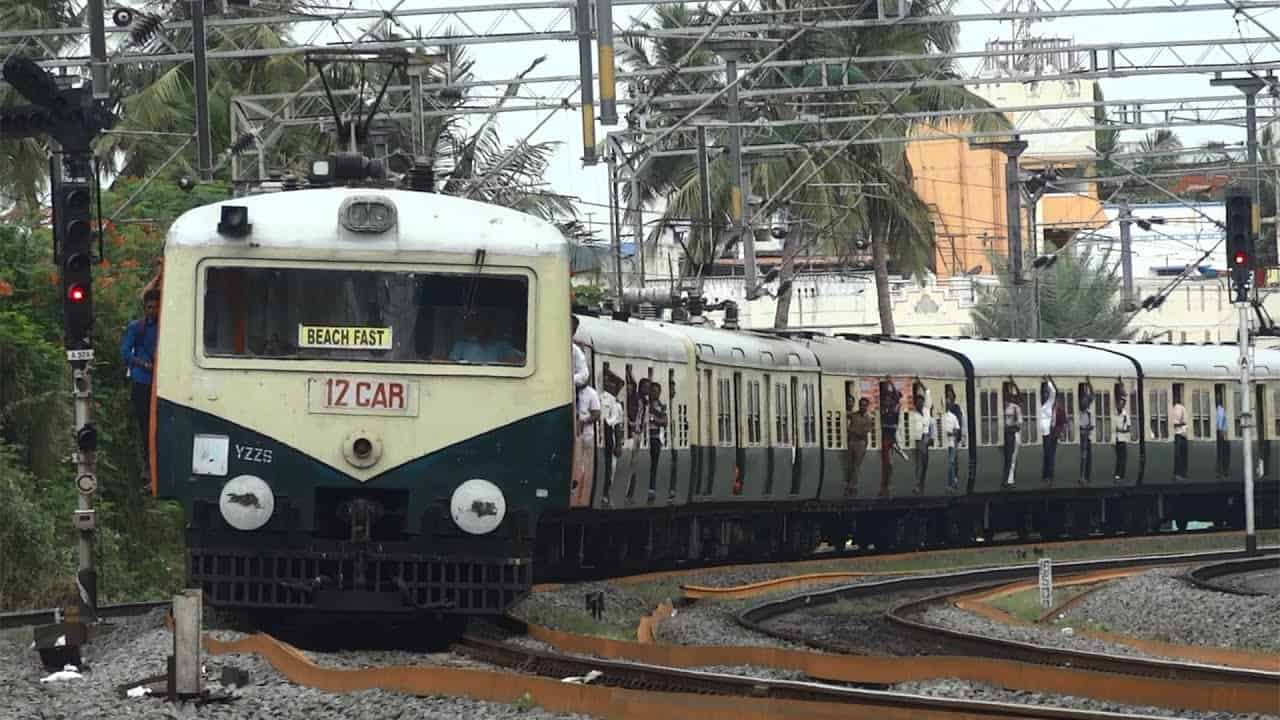
As Chennai has entered the unlock phase, the transport services have been permitted to operate with 50% capacity. Starting June 25th, suburban trains are allowed to transport passengers. While women are allowed to travel in trains without time restrictions, men working in non-essential sectors are allowed to travel during non-peak hours from 7.30 am to 9.30 am and from 4.30 pm to 7.30 pm.
State and Union government employees, and those working at Public Sector Undertakings (PSUs), Courts, and the private sector will be allowed to travel for duty with a permission letter from the higher authorities and a valid identity card.
To ensure COVID-19 safety norms are being adhered to, the Southern Railway is also imposing Rs 500 as penalty on people at railway stations or in the trains without a face mask.
Source: DT Next
Flood management committee to be set up under ‘Singara Chennai 2.0’
Under the Singara Chennai 2.0 initiative, the state government will form a Chennai Metro Flood Management Committee to work out flood control mechanisms and design stormwater drains to reduce the impact of floods. The committee will have experts from the environment, urban planning and disaster management fields.
In his address at the Assembly, TN Governor Banwarilal Purohit also mentioned that a new model for enhancing urban governance, citizen-focused service delivery in key areas, mobility and water supply will be established.
The 42 local bodies which were merged with the city corporation lack facilities in terms of basic infrastructure. Considering this, the Governor added that the new initiative would amp up the infrastructure and services within the expanded city limits.
Source: The Hindu | DT Next
Read more: Singara Chennai 2.0 plans raise citizen hopes
24% COVID patients reported symptoms after recovery
An assessment among 1001 patients by the city corporation revealed that 24% of COVID patients in the city continued to have symptoms even after recovering from the illness. To help patients with long COVID, a tele-counselling service has been initiated.
The symptoms shown by those surveyed included coughing, breathlessness, tiredness and sleeplessness. Weight loss and hair loss were some of the other commonly reported symptoms.
Long COVID was particularly observed among patients who were hospitalised with severe symptoms and with oxygen support. 41% of those who received oxygen treatment reported one of these symptoms post recovery.
Source: The Hindu | The Times of India
[Compiled by Bhavani Prabhakar]