Pushing a rickety tricycle and making multiple stops to collect waste from households is a Herculean task for conservancy workers. As the day progresses, the vehicle gets progressively heavier with heaps of garbage but the worker still pushes it, going door to door to collect the waste.
“Every part of my body aches, literally,” said a conservancy worker, who has been in the job for over 15 years. The long term health effects of their work on these blue-collared workers include persistent shoulder and back pain.
But there is some good news for them. This troublesome situation could soon become a thing of the past, thanks to efforts by the Greater Chennai Corporation to make their jobs easy. The civic body has collaborated with Pi Beam Electric, a company incubated at the IIT-Madras research park, to introduce a batch of Electric Trikes (Tricycles sold as Pi Beam E03) for garbage collection. State Bank of India (SBI) has funded the vehicles under their Corporate Social Responsibility (CSR) project. The GCC will own and maintain the vehicles, while Pi Beam will be assisting with scheduled services.
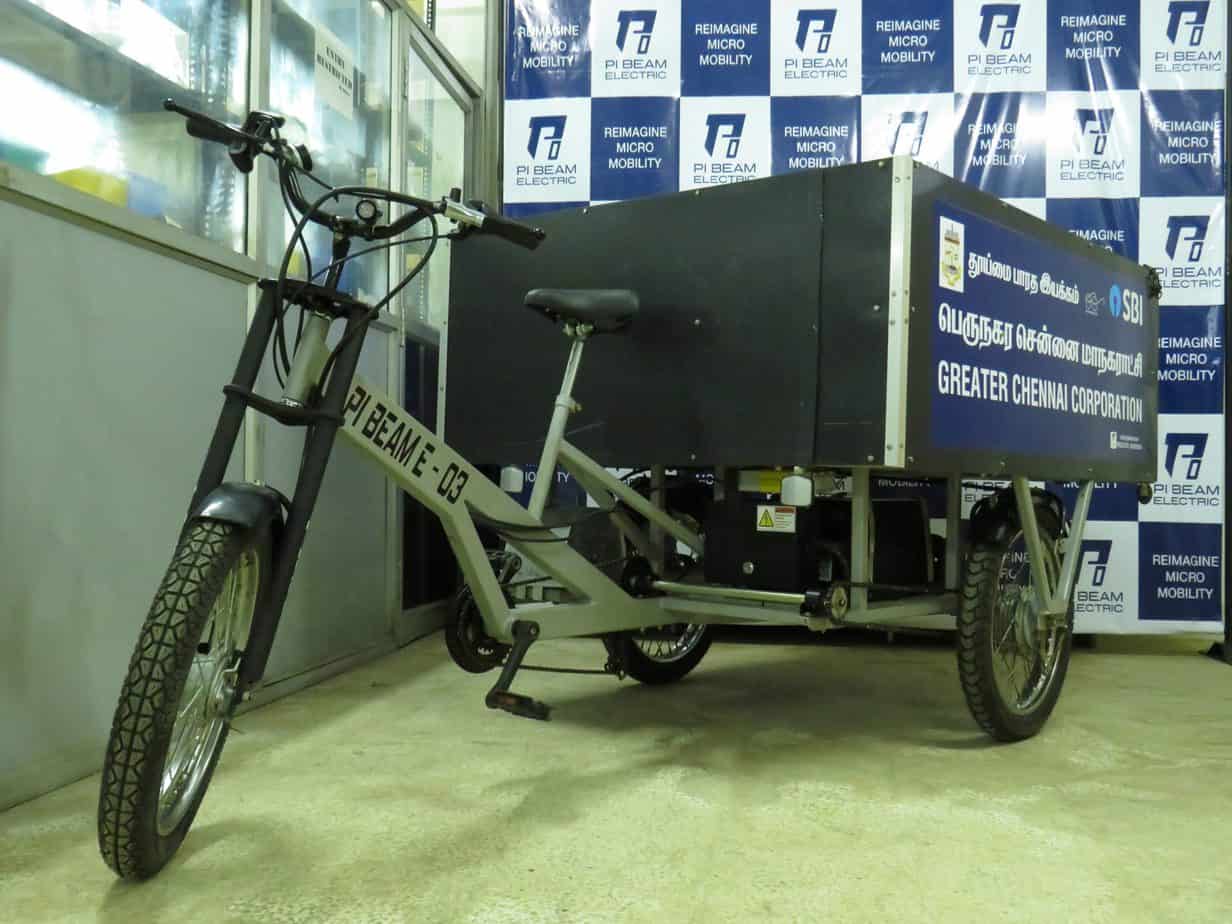
The electric tricycle can cover 45kms on one full charge. Pic: Arun Joy
As per the Solid Waste Management rules 2016, it is mandatory to segregate the solid waste at source and to process wet and dry waste separately. Chennai Corporation has achieved around 42% source segregation so far. To implement segregation at source more effectively, more battery operated vehicles are required. “We recently conducted trial runs with the Pi Beam electric tricycle in Zone 14 and found the vehicles to be suited for the application,” said G Prakash, Commissioner, Greater Chennai Corporation. The trial focussed mostly on vehicle performance with heavy loads and manual effort required to ride the vehicles.
|
Features
|
During the trial run conducted at Perungudi (Zone 14), the various difficulties faced by workers while using the traditional tricycle became evident. The inherent weight and presence of crossbar in a manual tricycle makes it unfriendly for any female worker. Most of the conservancy workers toil for more than eight hours a day, going home with a breaking back and heavy shoulders. Pi Beam’s electric trikes addressed both these issues with an easy riding mechanism and a gender-friendly frame design. Workers of both genders were found to be able to ride the vehicles comfortably.

Dr Alby John IAS, the Regional Deputy Commissioner (South) inspected the electric tricycles. Pic: Arun Joy
“The tricycle design enables easy climbing and getting down; I look forward to using these tricycles to cover more areas without much hassle,” said a woman conservancy worker at Perungudi.
The trikes were finally rolled out on November 26th in Zone 5. Based on findings during the trial run, it is expected that these vehicles will operate at 50% higher capacity, at half the price compared to existing electric vehicles available for the GCC.