COVID-19: Hostels for quarantining, 1973 residents report symptoms, camp for migrant workers
As the number of COVID-19 patients is increasing in Chennai, the Greater Chennai Corporation (GCC) has sent notices to 41 educational institutions like IIT-M and Anna University to hand over the hostel facilities for quarantining purposes. Besides hostel buildings, the institutions have also been asked to hand over a few other structures for use by the authorities in their efforts to prevent COVID-19. Of the 834 COVID-19 patients in Tamil Nadu, 81 are from Chennai.
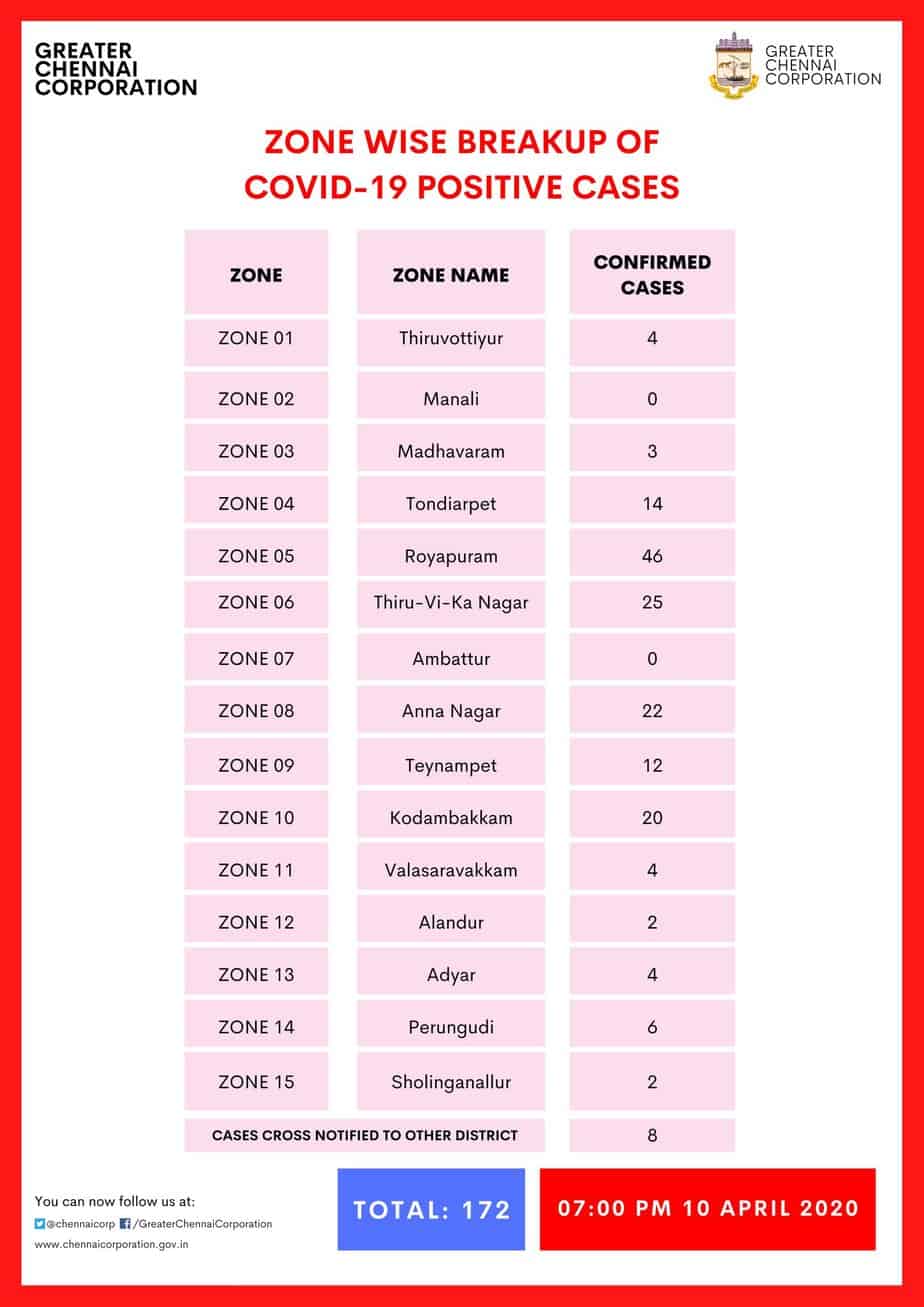
Zone-wise break up of COVID-19 patients in Chennai. Pic: GCC
1,973 residents from the containment blocks in Chennai have reported COVID-19 symptoms to GCC. The local body has set apart 12,204 containment blocks, with 100 houses each.
The number of residents with symptoms is higher in areas such as Anna Nagar, Teynampet, Tiruvottiyur, Tondiarpet and Royapuram, as per the list the Corporation generated. Of the 10.7 lakh houses in the 15 zones of the city, 9.18 lakh houses have been covered by the workers, collecting data from residents.
Chennai Metropolitan Water Supply and Sewerage Board (CMWSSB) has established 32 camps in the city to provide shelter to 572 migrant workers. They are engaged in various water supply and sewerage projects and are being provided essentials by the agency. N-95 masks will be given for people who are into sewage management.
Owing to the lockdown, metro rail travellers who own trip cards and monthly passes were unable to access the service. In a bid to compensate for the same, passengers can get their passes renewed, after which they can use the same for the leftover days in the card.
Source: Deccan Herald | The Times of India | The Hindu
‘Sufficient water that lasts a year’
With citizens following the health advisory to wash hands frequently to keep COVID-19 at bay, many have begun to fear shortage of water. However, CMWSSB has stated that the city has sufficient water that could last for another year.
According to CMWSSB Executive Director Dr T Prabhushankar, Chennai had a more or less normal north-east monsoon last year. It also received Krishna water. So far, the city is reported to have received around 7.7 tmc (thousand million cubic feet) — the second largest volume in the last 25 years. That has kept the reservoirs going.
Prabhushankar said that the groundwater is also quite good compared to last year. CMWSSB is currently supplying 650 MLD (million litres per day) now and might increase it further.
The two tertiary treatment reverse osmosis (TTRO) plants has helped with the supply of water to industries which were heavily relying on groundwater. Another factor is that with several companies being shut, the groundwater has not dipped.
Source: News18
Veggies at your doorstep
In a bid to ease the process of shopping essentials, the Chennai Metropolitan Development Area (CMDA) has introduced door delivery of fruits and vegetables from the Koyambedu wholesale market. It can be ordered through food delivery apps (Zomato, Swiggy or Dunzo) or on CMDA’s website (http://www.cmdachennai.gov.in.).
The officials have also acquired vehicles to deliver fruits and vegetables in bulk to flats/apartments where the need is more, catering to more than 25 families. Three different combo packs are introduced starting from Rs 220. The CMDA, which maintains the market, has launched phone numbers for the purpose. The numbers are: 7305050541, 7305050542, 7305050543, 7305050544, 9025653376 and 044-24791133.
GCC has planned to rope in 7,000 mobile grocery units that will reach supplies to citizens. Commissioner G Prakash has stated that the sellers would be provided safety equipment. Vegetable markets in the city limits have already been shifted to playgrounds.
Source: The New Indian Express | The Times of India
Disinfection tunnels in Chennai
Following GCC’s introduction of a disinfection tunnel in Thiruvanmiyur, Avadi Corporation has introduced two disinfectant tunnels to spray disinfectants as people pass through them. The corporation plans for a few more such tunnels to be introduced in its limit. The tunnels have been erected at a cost of 1 lakh each and uses Lysol as the disinfectant. Tambaram Municipality has set up one in West Tambaram, opposite to Sevasadan school.
Source: The Times of India
[Compiled by Bhavani Prabhakar]