Chennai is one among the many urban civic bodies in Tamil Nadu that has not had local body elections in the last 10 years. The state government has been administering the cities and towns by appointing special officers in place of the Mayor and councillors. There has been a lot of hue and cry over the absence of an elected local government, but with little effect. Now with the State Assembly elections around the corner, will it pave the way for conduct of municipal elections? Can we expect to see concrete reforms in urban governance? Will Chennai and other cities in Tamil Nadu adopt the participatory budgeting system and shall we see greater devolution of funds and power to local bodies?
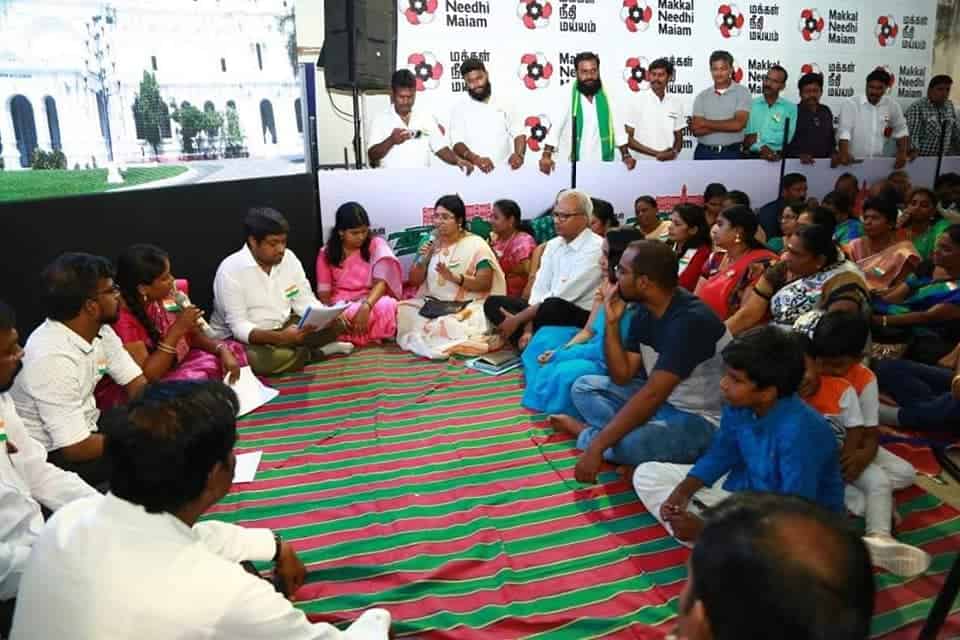
At a web panel conducted last Friday by Janaagraha, an advocacy group based in Bengaluru, experts came together to discuss strategies to improve the urban governance system in Tamil Nadu.
Prashanth Gowtham, a volunteer with Arappor Iyakkam, Charu Govindan, founder member of Voice of People, Yuvaraj, Joint Secretary – research wing of Satta Panchayat Iyakkam and Manuraj Shunmugasundaram – spokesperson, DMK were the panel members.
State of urban governance
Tamil Nadu is a state known for its progressive welfare schemes such as 50% reservation for women in municipal tenure as well as enactment of a public disclosure law (a mandate that makes it statutory on the municipalities to publish information periodically on its own). A notable achievement in terms of city governance is the appointment of a local body ombudsman empowered to conduct an enquiry on allegations against city governments.
Read more: What can Chennai learn from Kerala and Bengaluru on citizen participation in urban governance?
However, Charu pointed out that the state is backward when it comes to local governance, or enabling citizen participation and devolving power to the local bodies. “It has been 25 years since the 73rd and 74th amendments came into being, but the participation of various stakeholders in the democratic state is still abysmally low, especially in the urban areas. Power devolution and empowerment are lacking,” she said.
Speaking of how the DMK and AIADMK have approached the issue of urban decentralisation, Yuvaraj pointed out that DMK had mentioned state autonomy in its 2016 elections manifesto. “There was no mention of local bodies in DMK’s manifesto. On the other hand, AIADMK was not even ready to conduct local body elections anytime in the last 10 years,” he pointed out, adding that even when they do talk about local bodies, there is no mention of wards. “Considering past records, elections may happen but true empowerment of local bodies is a distant dream,” said Yuvaraj.
Responses from DMK
Agreeing to the points raised by Charu and Yuvaraj, the DMK spokesperson, Manuraj, promised that the local body elections would be conducted within three to six months of assuming power if DMK wins in the legislative polls.
“There is no doubt that whichever party comes to power in Tamil Nadu, decentralization, devolution and more autonomy for grassroots democracy will be in focus,” Manuraj added. He felt that active participation of various stakeholders, through civic and advocacy groups, could make that happen.
In addition, Manuraj made a couple of important promises for cities, to be implemented if the party wins a majority.
- A functional Solid Waste Management system across cities in Tamil Nadu
- Providing close to 10 lakh additional low-cost housing in urban areas. The scheme would be targeted at reduction of the slum population from 16.66% to 5% in a 10-year timespan
Read more: As India steps into her 73rd year, let’s ask for area sabhas in our city
Empowering local body and citizens
There is strong anticipation that local body polls will be conducted soon after the assembly elections, but how can one empower citizens and ward-level bodies?
Charu called for a bottom-up approach for this: “ The voices of citizens need to be heard in grama sabhas/area sabhas. It should go to the central government through ward committees, city council and the state government. That is how a unified city or state can flourish in democracy.”
Arappor Iyakkam wants a Citizens’ Participation Social Audit Act, where citizens will have the power to audit government projects. “If they create the law and bring about a framework, it would help make the local bodies transparent,” said Prashanth.
But even as these measures were suggested, Prashanth and Yuvaraj unanimously agreed that most of them would likely remain a pipe dream.
Read more: We need our Ward Committees and Area Sabhas
No elected representatives: What does it mean for Chennai?
With no local body representatives, special officers are the executive authority in the city. Chennai has several examples to showcase how administration and decision making suffer in the absence of elected councillors.
To cite just one instance, the Greater Chennai Corporation (GCC) had proposed a Rs 270-crore project funded by the German development bank KfW for constructing a stormwater drain network to cover the areas between Kottivakkam and Uthandi.
“The locality did not see flooding even during the devastating December 2015 floods, which indicates that there is no need for a stormwater drain network in that area at all. However, the residents of ECR have been requesting the civic body for a sewage system for several years and that still remains unfulfilled,” pointed out Prashanth. Having an elected body of local representatives is crucial to ensure that funds are spent on the right projects to develop the locality.
Watch the full panel discussion here.
Also read: