As of September 2nd, 2025, Bengaluru transitioned into a new urban governance system based on the Greater Bengaluru Governance Act, 2024. This Act implements a three-tier structure:
- The Greater Bengaluru Authority (GBA): It is chaired by the Chief Minister and comprises all Karnataka ministers and Members of Parliament, Members of the Legislative Assembly and Council from Bengaluru, as well as the mayors of the five newly formed City Corporations. Its primary role is to harmonise planning, development, and service delivery by all the departments and agencies across the five City Corporations.
- Five City Corporations: The city is divided into five smaller City Corporations (named East, West, Central, North, South), each with its own Council and Mayor and managed by a Commissioner. These corporations will have smaller wards (to be announced post delimitation) and are granted significant autonomy over their affairs, including financial matters, taxation, and local elections, consistent with constitutional mandates.
- Ward Committees: These are designed to facilitate active citizen engagement at the ward level. Chaired by elected Councillors, the ward committees provide a platform for participation in local governance and help bring accountability closer to citizens.
Important disclaimer:
This summary is provided to help clarify recent changes to Bengaluru’s governance system. The information herein is not official. It reflects my interpretation of the Greater Bengaluru Governance Act, 2024 and compilation from news sources. The presented details are subject to change as more official communications and legal clarifications arise. All opinions expressed and interpretations are strictly individual and do not represent any organisation or institution.
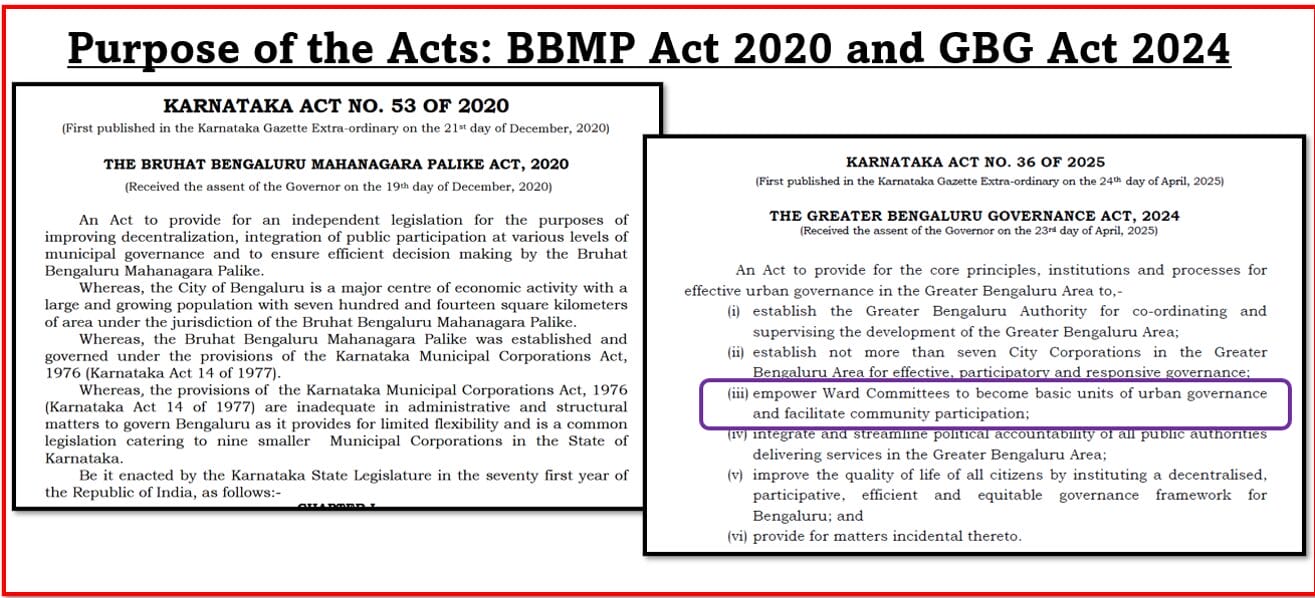
Let’s look at the introduction of the GBG Act 2024. It highlights,
- Establishment of the Greater Bengaluru Authority
- Establishment of up to seven City Corporations
- Empowerment of Ward Committees (Ward Committees are part of BBMP Act 2020 but not mentioned in the Introduction of the Act)
- Political accountability of all public services.
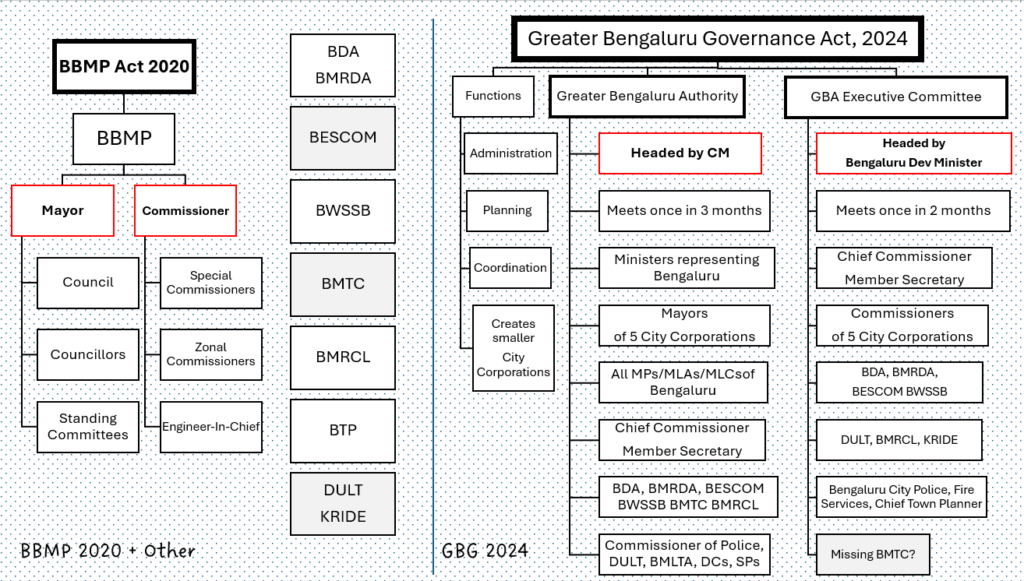
The big change in GBA 2024 is the attempt to bring all parastatal agencies like BESCOM, BWSSB, BMTC, and BMRCL under one umbrella called the Greater Bengaluru Authority (GBA). This is an entirely new tier of local governance, not seen in any other city. The GBA is headed by the Chief Minister, and the GBA Executive Committee is chaired by the Bengaluru Development Minister — bringing the city governance under State government control. This move has been challenged in the courts.
Read more: Greater Bengaluru Governance Act: Urban reform or recipe for inequality?
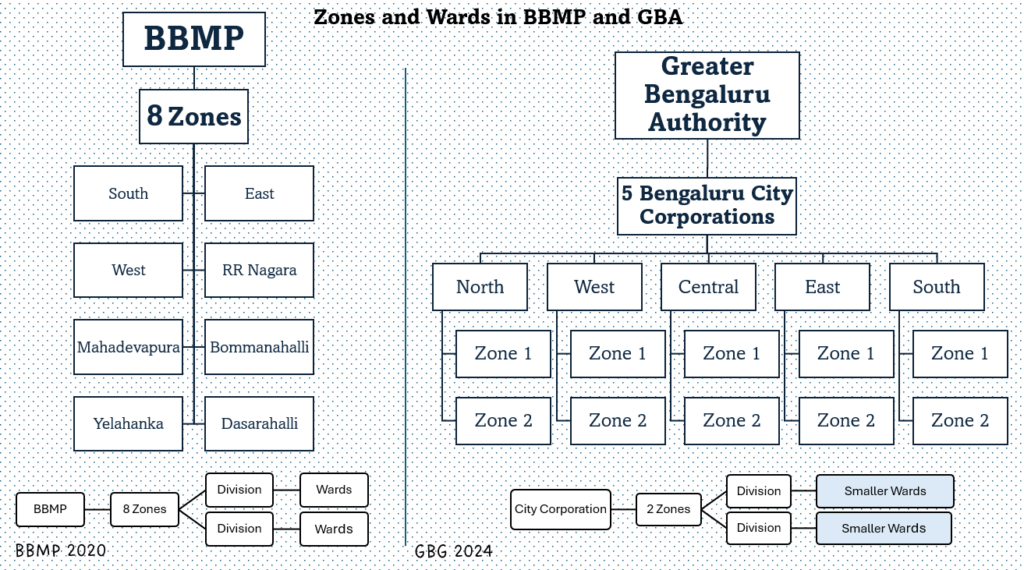
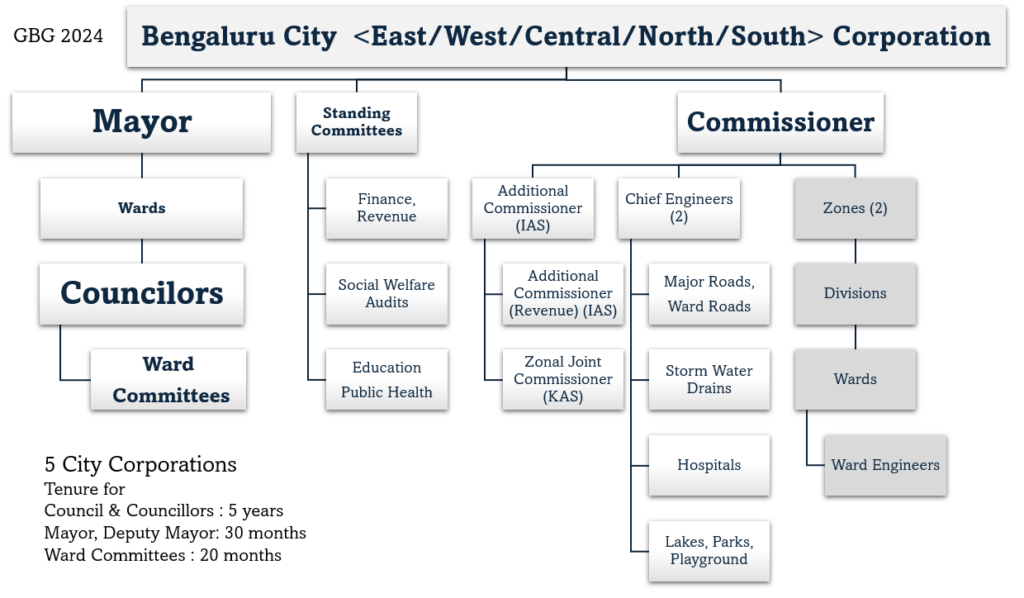
The erstwhile BBMP had eight zones, but now there are two zones for each of the (smaller) City Corporations. Zones are further organised as divisions, which are indicative of Assembly Constituencies of the city (28 of them). The big change coming to our city is smaller wards. From large wards that are as big as small towns, we are going to have a lot more wards that are smaller.
There is no Mayor for Bengaluru, but five Mayors for each of the corporations. Instead of Zonal Commissioners, there are Corporation Commissioners.
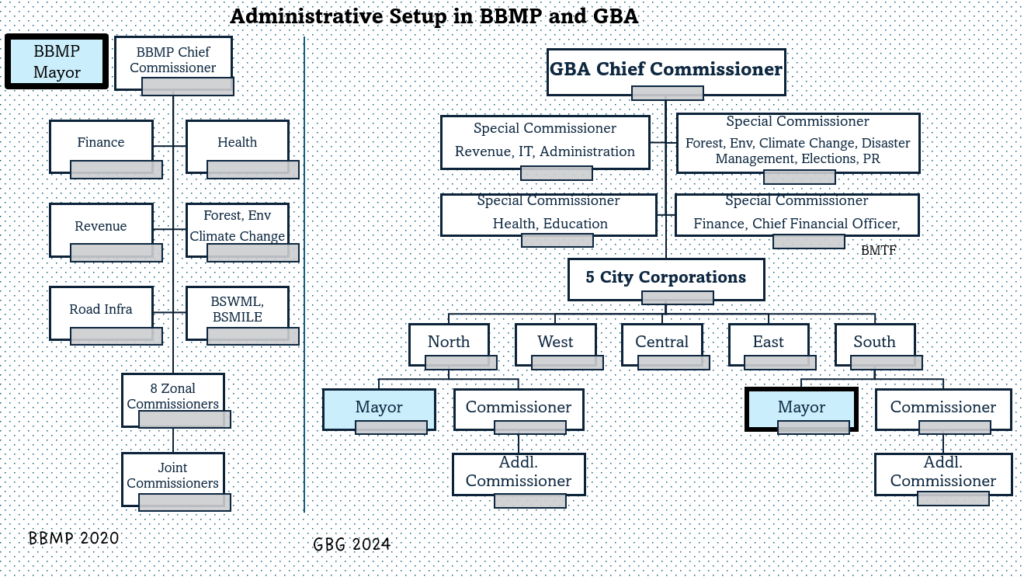
How are the City Corporations organised? Like BBMP, there will be a Mayor and a Council, much closer to citizens than Hudson Circle, apart from Standing Committees and Ward Committees, but there are changes in how the administrative setup looks. For example, each Corporation has two Chief Engineers responsible for everything, including roads, drains, lakes, parks, playgrounds, and hospitals.
Read more: How the Greater Bengaluru Governance Act undermines urban local self-government
Ward committees
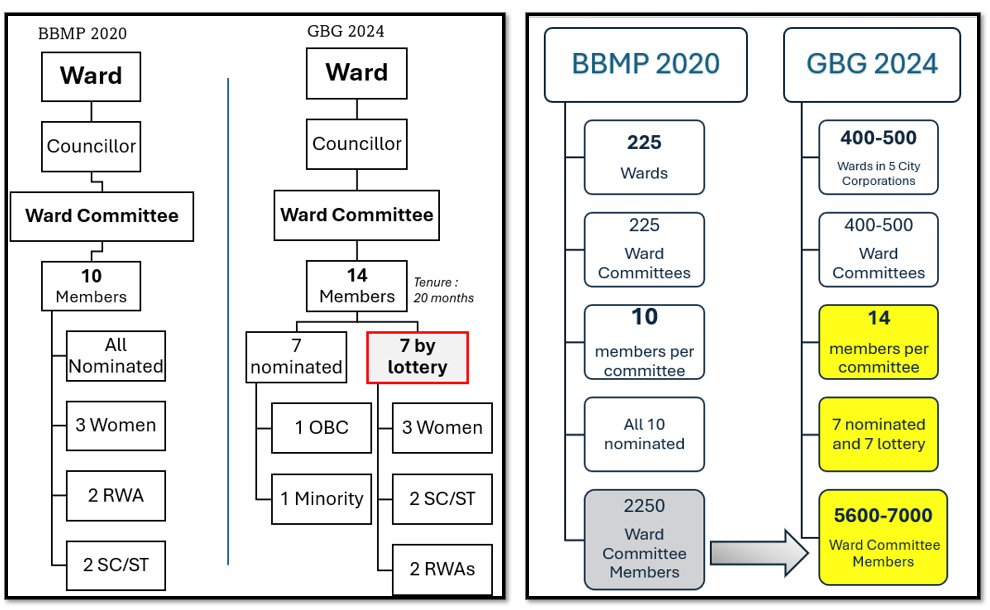
Under the Greater Bengaluru Governance Act, significant changes are coming to Ward Committees, both in size and selection of members, which have been a major obstacle in the past. Bengaluru has active citizens in every ward with a deep interest in matters of public interest and who engage with the system.
Karnataka always had a good law for citizen participation in the form of ward committees that meet once a month, with all concerned departments. But in many wards, the Councillors were not keen to nominate active citizens but chose to nominate their friends and family who did not contribute. Each Ward Committee now has 14 instead of 10 members.
Earlier, all ten members were nominated by the Councillor, thereby denying the opportunity for active citizens to become members. Now, seven of these 14 will be chosen using a lottery system. All interested citizens who are registered voters of a ward can enter. As the number of wards is set to dramatically increase, the total number of ward committee members will also rise significantly, giving more voice to citizens.
What this means for Bengaluru
The existing governance setup that runs Bengaluru is fragmented and doesn’t lend itself to alignment of planning and execution. GBG Act 2024, for the first time, brings them all under the GBA. The size of wards in Bengaluru is bigger than many small towns — smaller wards are likely to help with local accountability. Ward Committees have a chance to truly engage active citizens. How the GBG Act 2024 plays out in the real world is yet to be seen.
The biggest problem with BBMP was rampant corruption. How is the govt going to address corruption? The GBA is planning to hire 500 new Engineers for various positions in these new corporations. How are they going to be hired? Are they going to be nominees like they have for the Guarantees committee?
Yes, one of the biggest problems with BBMP in the past has been rampant corruption, and citizens have consistently demanded greater transparency and accountability. The government is aware of this and has taken certain steps such as digitization of approvals, e-procurement systems, and the introduction of citizen charters to reduce middlemen.
Regarding the hiring of 500 new engineers for the newly formed corporations under GBA, the government has clarified that these will not be political nominees like the Guarantees Committee. Instead, they are expected to be recruited through standard government recruitment processes – either via the Karnataka Public Service Commission (KPSC) or through an open, merit-based competitive examination process.
The intent is to ensure that these engineers are professionally qualified and recruited on merit, so that they can provide technical expertise and strengthen civic infrastructure delivery. However, the government will need to also ensure:
1. Transparent recruitment with no room for political favoritism.
2. Fixed accountability mechanisms so that engineers are directly responsible for the quality of work.
3. Independent oversight – perhaps by Lokayukta or a third-party audit – to monitor corruption risks.
Only with these checks will the new system avoid repeating the mistakes of the BBMP era.
Bengaluru Residents have been suffering corrupt practices of the bbmp Revenye Insoectors and AROs After new Act coming into Force the corrupt practices continue and the rate of corruption has also doubled The order of the commissioner of bbmp classifying properties as A and B was found to BAD IN LAW by Honourable Karnataka High court also all properties before BBMP Act 2020 cane into Force on 10 June 2022 should be given A khatha butit is not being done and whoever pats TIPS gets whatever they want The Karnataka Loj Ayukta should nomine one Inspector with staff exclusively to initiate action as per law