Testing sewage to detect clusters
Karnataka will begin testing sewage water to identify potential coronavirus clusters and mutant variants of the virus. The surveillance teams which will be in 45 wards, will cover over 75% of 90 lakh residents by generating over 90 data points per week, the Urban Development Department reportedly revealed. This could be a cost-effective early warning system to assess the increase in cases before the number of official cases actually go up.
Officials hope it will avoid city-wide lockdowns by focusing on micro-containment zones. Samples would be pulled from 45 wards every day for the next year. Sources hope to check for traces of the virus and also do genome sequencing. The project would involve tracing the origin point. The platform is launched by Restore Health and Wellness, in collaboration with United States Agency for International Development, Skoll Foundation, WHO and the State Government.
Source: Deccan Herald, The New Indian Express
20,000 daily jabs
The vaccination drive for frontline workers and priority groups appears to be picking up pace. An average of 20,000 from across 25 categories were inoculated everyday. The BBMP (Bruhat Bengaluru Mahanagara Palike) has appointed nodal officers to identify and ensure vaccine availability to eligible beneficiaries in each category. Officials say they were able to inoculate as many as 2,000 differently abled persons, along with their caretakers, on Wednesday alone. In case of the destitute or people in old-age homes, NGOs were the primary points of contact.
Meanwhile, for street vendors, the BBMP is validating data based on their ID cards. It is collecting data for construction workers. Over 3,000 such workers, including migrant labourers, have been listed by the BBMP. It is planning to inoculate staff at banks next.
As many as 53,000 street vendors have been identified for vaccination. About 7,500 workers at four metro stations, considered as front-line workers, will be inoculated in a two-day drive. At least 3,128 Metro construction workers got inoculated on the first day.
Source: Deccan Herald, The Hindu, The New Indian Express
Read More: COVID lessons Bengaluru must learn from second wave
Cases decline, not fatalities
Even though the number of fresh infections and the positivity rate has begun showing a marked decline in the last few days, there appears to be no such respite in case the fatality rate (CFR). Experts say that there is always a lag of two to three weeks after decline in daily infections and positivity rate, before the CFR comes down.
Of the fresh cases reported Thursday, 5,949 were from Bengaluru Urban, as the city saw 6,643 discharges and 273 deaths.
Source: The Hindu, Indian Express
Curative steps
The BBMP has trained and deployed 11 women marshals on an experimental basis to enforce COVID-19 norms and help out at care centres. The women marshals will be deployed at select maternity homes, COVID care centres, triaging and stabilisation centres. Meanwhile, another Oxygen Express train arrived in Bengaluru on Thursday night, carrying 120 MT of oxygen.
With the number of patients infected with mucormycosis (black fungus) rising, the state government has advised doctors not to administer steroids to patients during the first week of COVID infection.
Source: The Hindu, Indian Express, The New Indian Express, Deccan Herald
Read more: Where do Bengaluru hospitals get their oxygen supply from?
Blocking streets, sealing homes
After the lockdown was extended till June 7, roads in several residential neighbourhoods are now being blocked. While shopkeepers complain that the blockades are hampering business, patients say that marking their homes is causing stigma.
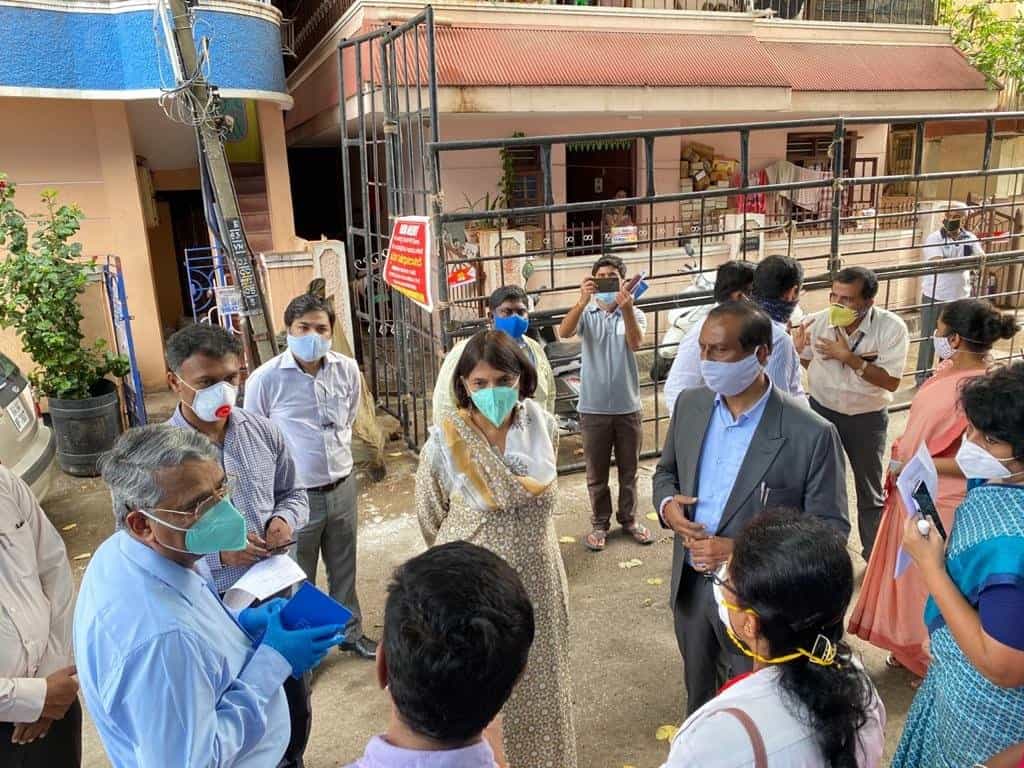
Several houses were sealed with red tape to indicate they contained patients in home isolation and also had a notice of 14-day home quarantine pasted on their gates. BBMP admitted that some houses in the West and South zones were fixed with red tape.
Authorities also stamped seals on the arms of COVID positive patients besides deploying civic workers to sanitise their buildings and surroundings. Teams have been formed at ward levels and data of Covid positive patients is being shared for tracking. Revenue officers, doctors and ASHA workers are also contacting patients for information.
Meanwhile, there has been a slow but steady rise in prices of edible oils and a fall in sales and business. On a positive note, restrictions on the movement of vehicles and construction activities has brought down air pollution by 60 per cent. And while most businesses have taken a beating, bicycle business is booming. Public bike-sharing service, Yulu, which aims at offering micro-mobility services, has clearly seen a surge in demand for its electric bikes ‘Miracle’.
Source: Bangalore Mirror, Deccan Herald, The New Indian Express
HC: Don’t alter Hesaraghatta
The High Court of Karnataka on Wednesday ordered the State government not to alter the nature of land at Hesaraghatta, while hearing a public interest litigation petition filed by a member of the BBMP Biodiversity Committee. The petitioner argued that the ecosystem is home to more than 40 different species of birds and animals, and highlighted the need to declare the area as a conservation reserve.
Source: Deccan Herald
[Compiled by Revathi Siva Kumar]