Bangalore Political Action Committee (B.PAC) in association with BBMP on December 21st organised a workshop, Women Leaders for a Better Tomorrow – the imprint of women leaders in political leadership.
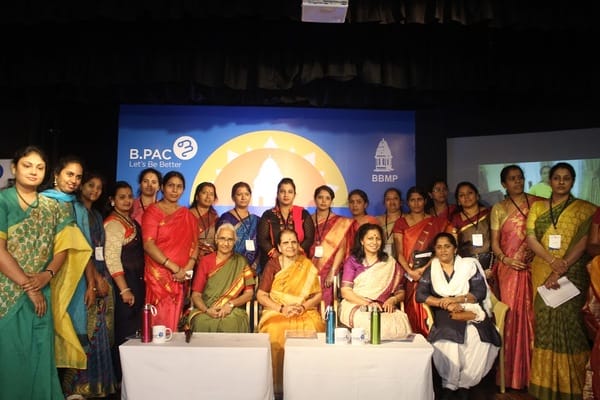
Leading ladies of the BBMP Council. Pic: B.PAC
“This is a historic moment in Bengaluru’s history”, said Revathy Ashok, CEO and Managing Trustee, B.PAC. “BBMP has more than 52% of women elected members and we thought this is the right moment to celebrate this win and to inspire our corporators with mind-blowing stories of several women political luminaries of Karnataka such as Leeladevi R Prasad and BT Lalita Nayak, she said.
Speaking during the inaugural session Dr Kiran Mazumdar Shaw, President, B.PAC said, “We have trained over 150 passionate citizens, aspiring corporators through our B.CLIP programs, across three batches. Last month, B.PAC organised a program for all newly elected corporators on critical issues facing the city. This program is the beginning of series of conversations we want to have with our women corporators. We want to see them emerge as strong successful leaders who will transform their respective wards through their passion, commitment and good governance. “
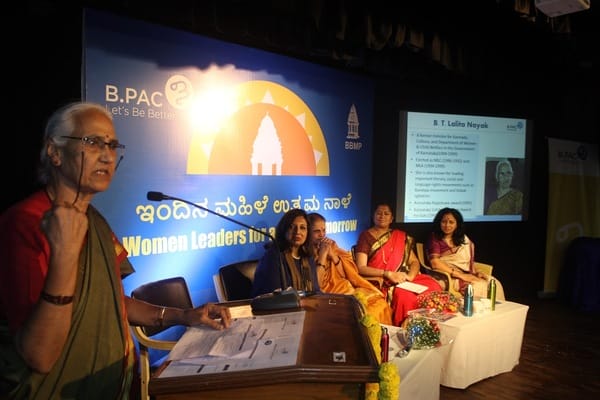
Lalitha Nayak addressing the women corporators. Pic: B.PAC
Leeladevi R Prasad, former Minister, GoK, and BT Lalitha Nayak, former Minister, GoK, addressed the young women corporators, and shared inspirational insights of their humble beginnings and their political journey in a very tough environment. Their deep commitment to public service and engagement with the city, high standards of governance, integrity, and humility, were the key take aways for the partcipants to emulate.
SP Hemalatha, Deputy Mayor, BBMP spoke about the huge opportunities for women corporators to make a mark; and spoke of the initiatives on waste management and health related programs and initiatives in her ward that could be succesfully replicated by other corporators.
Suresh Moona, eminent historian of Bengaluru took the audience through the need to connect the generations with a sense of place, by recording the history of each ward and its uniqueness and requested each corporator to install a ‘Green Plaque’ as a symbol of heritage in their respective wards. Moona summed it beautifully by saying, “When a woman gets educated, the whole family benefits; when women corporators get educated, the entire ward and city will benefit”
Nitin Pai, Founder of The Takshashila Institute explained to the participants the need to develop a comprehensive vision for the ward, prioritise, plan and execute on the vision with a well documented and standardised process, so that corporators can leave behind a strong legacy of positive action in their respective wards. The video below documents some ideas for transformation.
There was a video message from the Mayor and from the former Minister Rani Satish exhorting the corporators to bring about positive change in the city.
C Manjula, former Chairperson, Karnataka State Women Commisison, while addressing the corporators spoke about the delicate balance that a corporator has to exercise between party priorities and greater public good and asked the corporators to be solid and fearless in their service to their respective wards.
K Latha Narashima Murthy, former corporator, HSR Layout took the partcipants through the best practices to emulate in the wards by showing how she developed a vision for the ward and the learnings she had during her journey as a corporator.
The program was well received by the women corporators and they were keen to work in a collaborative manner along with local citizen groups to solve pressing problems and get their voices heard.
The uniform refrain from all leaders, past and present was that the Mayor and Deputy Mayor’s role currently was only recommendatory, and should be given greater powers for effective governance of the city.
B.PAC, through this endeavour has reached out to all women corporators of Bengaluru city to realise their full potential and capability and to lead important transformational change in city’s developments – making the city a pride of place for every citizen.
About B.PAC
Bangalore Political Action Committee (B.PAC; www.bpac.in) is a citizen’s group that aims to improve governance in Bangalore and to enhance the quality of life of every citizen.
B.PAC is specifically targeting good governance practices, integrity and transparency in all arms of the government, improving the quality of infrastructure in the city, identification and support of strong candidates for public office at all levels of governance in Bangalore city and the creation of a safer city where the rule of law is ensured for all citizens of Bangalore.
Related Articles
Women are a majority in BBMP council: will they shine this time?
BBMP corporators and their contact numbers – 2015