The Takshashila Institution, on May 3rd, launched India’s first post-graduate programme in public policy for working professionals. The 48-week programme is delivered using Takshashila’s networked learning platform that allows people from any academic background to take the course from anywhere at their own pace. Students will learn and interact with some of the foremost policy thinkers, analysts and practitioners and be eligible for careers with top industry, NGO, politician and media partners. The course starts in September 2016 and admissions open in the first week of May.
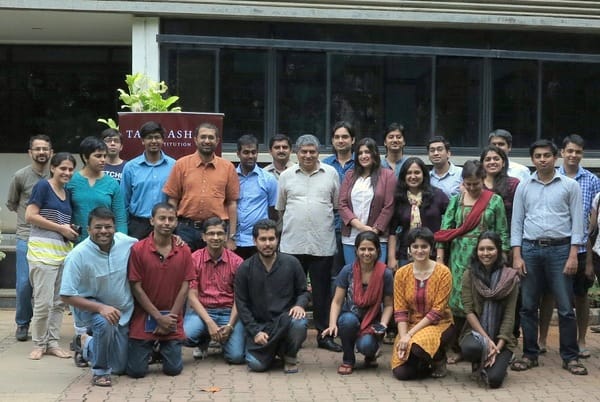
Nandan Nilekani with the students and staff of the Graduate Certificate in Public Policy programme. Pic: Takshashila Institution
The faculty includes prominent policy experts such as Dr M Govinda Rao, (Member of the Fourteenth Finance Commission and former Member of the Prime Minister’s Economic Advisory Council), Dr Pratap Bhanu Mehta (President, Centre for Policy Research), Dr Sanjaya Baru (former media advisor to the Prime Minister), Dr C Raja Mohan (head of Carnegie India), Dr Srinath Raghavan (Senior Fellow, Centre for Policy Research), Dr Daveed Gartenstein-Ross (FDD, Washington DC), Mr Rahul Sharma, (MD, Rediffusion), Mr Rakesh Thukral (MD, Edelman India), Mr M R Madhavan (CEO, PRS Legislative Research), Dr Rajan Govil (IMF). Takshashila will continue to bring on board the top minds to teach at the programme.
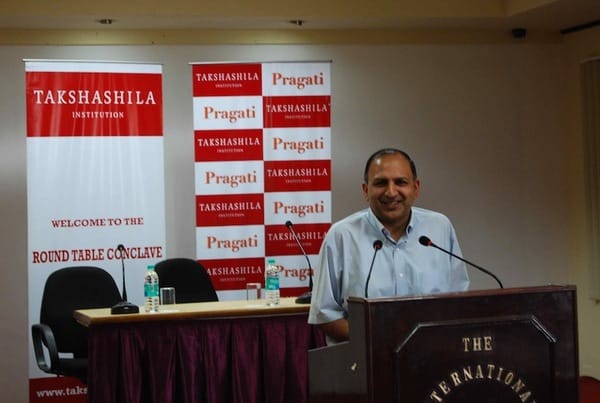
Dr Pratap Bhanu Mehta giving a guest lecture to Takshashila students in Goa. Pic: Takshashila Institution
To build professional career streams in public policy, Takshashila is partnering with a number of reputable companies, politicians, think tanks, NGOs and media houses to create employable graduates. Among the initial partners are the Tata Group, Biocon, United Way Bengaluru, Prof Rajeev Gowda (Congress), Dr C N Ashwathnarayan (BJP) and Dr Ashwin Mahesh (Lok Satta).
Nitin Pai, co-founder and director of the institution said, “Takshashila intends to create the right people, with the right knowledge, connected to the right networks, in order to transform India. We are excited because we are creating the best programme in public policy in the country — you now have fewer reasons to go to master’s programmes abroad.”
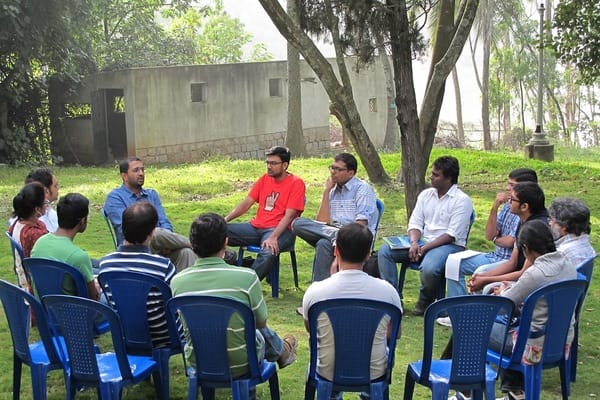
Nitin Pai teaches Takshashila’s public policy students. Pic: Takshashila Institution
Dr Govinda Rao, a member of the core faculty noted that, “Strong economic reasoning and analytical thinking is essential for a public policy professional. PGP students will hone their skills during the programme.”
Sushant Naik, National Head of Government Affairs at the Tata Motors, stressed the need for trained professionals in the public affairs industry. He said, “Qualified public policy professionals have an important role to play in terms of strategically engaging multiple stakeholders and influencing major decisions.” As a partner, the Tata group will provide inputs on the curriculum and anchor course projects to ensure graduates have market-relevant skill sets and work on live challenges.
“India yearns for policy professionals who can balance politics with economics, empathy with efficiency and equity, vision with practicality, and hope with resilience. One can get there either through decades of experience, where you learn on the job or through immersion in a well-rounded public policy course, where you learn from the insights and experiences of others,” said Prof Rajeev Gowda, Rajya Sabha MP.
For more information contact Nidhi Gupta, Programme Manager, at pgp@takshashila.org.in.
About The Takshashila Institution
The Takshashila Institution is an independent, non-partisan think tank and school of public policy located in Bangalore. It is a non-profit institution. Over the past four years, Takshashila has educated over 500 talented individuals in public policy in shorter courses. It partnered with Bangalore Political Action Committee (B.PAC) in India’s first civic leadership incubator programme (B.CLIP). This year, Takshashila also launched an MA in Public Policy course in collaboration with Mount Carmel College, Bangalore – a two year, full-time programme for fresh graduates and young professionals.
Takshashila brings together a number of domain experts in geopolitics, national security, geoeconomics, technology, cyber strategy and urban policy both online and offline.