Ongoing construction of the Kittur Rani Chennamma flyover at what is popularly known as Devegowda Petrol Bunk junction in Bengaluru has turned the area into a war-zone. Many beautiful trees have been brought down, footpaths are broken, streetlights have been removed and the fence between the pavement and the massive Rajakaluve (now a drain really) has been opened up. Pedestrians have to endlessly battle bulldozers, open drains and ditches, cement blocks with metal rods jutting out, no street lights (thus absolute darkness in the night) and a never-ending stream of heavy vehicular traffic, day and night.
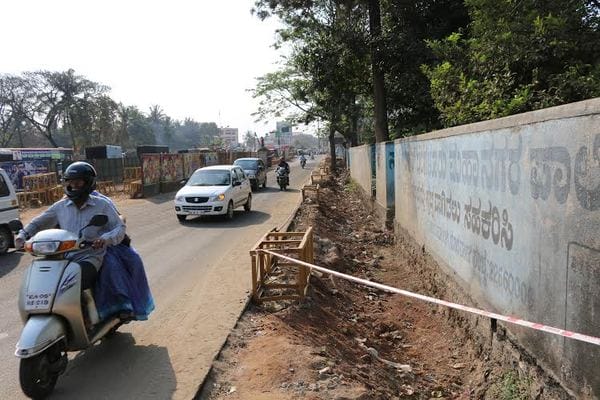
Footpath has been dug leaving no space for pedestrians to walk, near Devegowda Petrol Bunk on Outer Ring Road. Pic: Bhargavi S Rao
Vehicle drivers frustrated by long delays flout traffic discipline exposing school-going children, senior citizens, differently abled, women with infants, pregnant women, pourakarmikas, and construction labourers to near-death experiences almost all the time. An elderly woman pourakarmika who was sweeping the street was hit by a vehicle and have been grievously injured – she had just lost her husband, and was working without any pay for six months now.
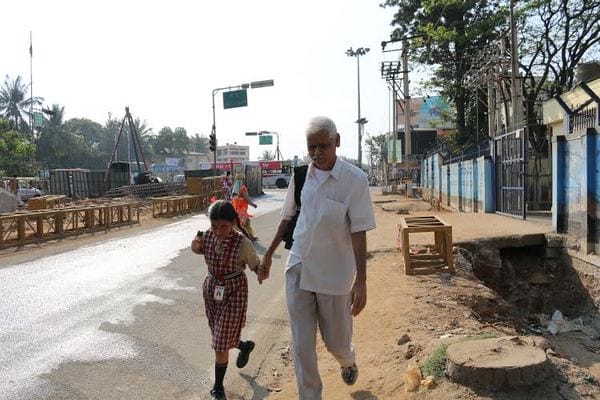
School-going children and pedestrians face a nightmare on this road everyday, with no safe area to walk on. Pic: Bhargavi S Rao
Authorities remain blind to the conditions that expose us to such high risk – including a threat to our lives. Such mega projects have no provisions and safeguards. Safe passages and pathways with clear signage don’t exist, and there is no priority for non-motorised traffic, to ensure everyone can walk safely.
In addition to handling heavy passenger vehicular traffic at all times, this location witnesses movement of heavy construction equipment and machinery. This is because, besides the construction of the flyover, massive high-rises are coming up in anticipation of “better infrastructure”.
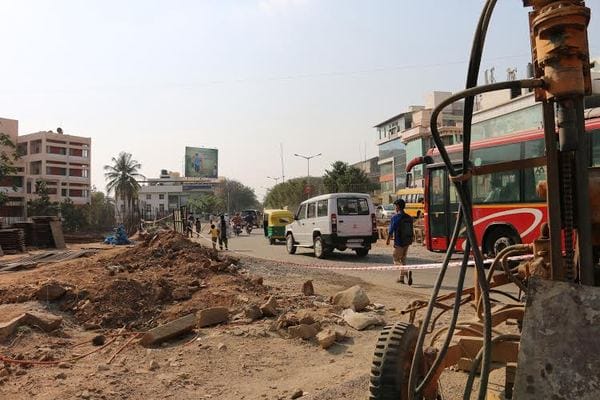
The flyover construction project does not take into consideration the pedestrians and non-motorised transport. Pic: Bhargavi S Rao
Material movement for massive apartment complexes coming up around the junction involve an endless stream of soil, sand, cement mixers and trucks constantly plying on the roads. All equipment are moved around so carelessly that this place is a veritable nightmare for pedestrians and motorists – especially two wheeler riders. Dust levels are intolerably high leaving the local population perpetually coughing and sneezing and running to pharmacies for quick remedies. Yet nothing at all is being done to contain the dust and ensure that construction activities are regulated per norms.
It should have occurred to BBMP, the planners and executioners of this mega project that this junction is also a major thoroughfare for students, residents and office goers. Neighbourhoods around have a very high density of primary and secondary schools, several higher educational institutes, major hospitals, banks, shopping malls and centres, besides being intensely residential. The roads everywhere are almost always filled with pedestrian and motorized traffic.
Such multi-crore mega development projects make their way into the city without any provisions to safeguard the rights of pedestrians and other non-motorised transport. It is a shame that such prodigious engineering projects of flyovers, road expansions, construction of expressways, laying metro-lines, etc. have absolutely no conception or comprehension of the simple needs of pedestrians, cyclists, etc. It is as though the decision makers and the contractors have no family member who walks or probably do not care for their lives!
The least that implementers of such projects can do is to ensure these construction zones are forced to become “low speed zones” with simple traffic-calming methods and without any excuse ensure there are clear and safe pathways for pedestrians. This does not cost anything, but demonstrates a quality of humaneness rarely evident today in public project development.
Such simple and required methods would be the most significant step in improving pedestrian safety. They would also create sufficient spatial separation between pedestrian and traffic movements and regulate driver/rider behavior. A simple rule to remember is that the pedestrian has a greater right to safe passage than a motorist, and this should inform project planners that pedestrian pathways cannot be taken for granted, just as they do not take for granted the right of a motorist to move.
Related Articles
BTM wants flyover, BBMP says no money
BDA flyover path hijacked by Metro
Citizens victory: High Court stays Agara-Sirsi flyover
Sprucing up ORR with another flyover
One can argue that a flyover was sorely needed at the D.G signal junction. Having lived in the locality for over 20 years, I’ve witnessed the exponential growth in population and subsequently traffic in this part of town. Still, areas like BSK 2nd stage, 3rd stage and Padmanabhanagar, much like most of South Bangalore are lucky to be relatively better planned and much greener than the rest of the city. BBMP missed a great opportunity to re-imagine public project development – signboards, walkways, safety features, eco-friendly design were all low-hanging fruits. But as it turns out, residents/commuters are dreading yet another long-drawn, dusty, disruptive affair.