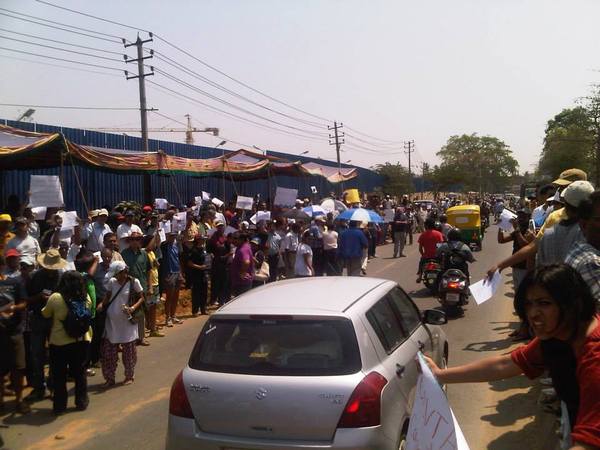
Hundreds of residents took to streets in protest against the multicrore project coming up on Bellandur wetlands.
“Mall beda, Neer beku! Go back Mantri!” shouted hundreds of residents — not just the adults but also the young children — assembled beside Srjapur Road, near the biggest lake of Bengaluru, Bellandur lake. They had come from HSR Layout, Koramangala and Bellandur. When government failed to take action and justice was slow in coming, citizens decided to protest, and this was the result.
At 10.30 am on March 23rd, 2014, men and women from all ages wearing caps and holding umbrellas, marched towards the Mantri project in a bid to save Bellandur lake. Even though it is the exam season, children aged 12 to 15 years, held hand-written banners and raised slogans that asked stopping the construction. The crowd included residents of all nearby apartments, members of Save Bangalore Lakes group, Save Koramangala groups, Citizen Action Forum etc.
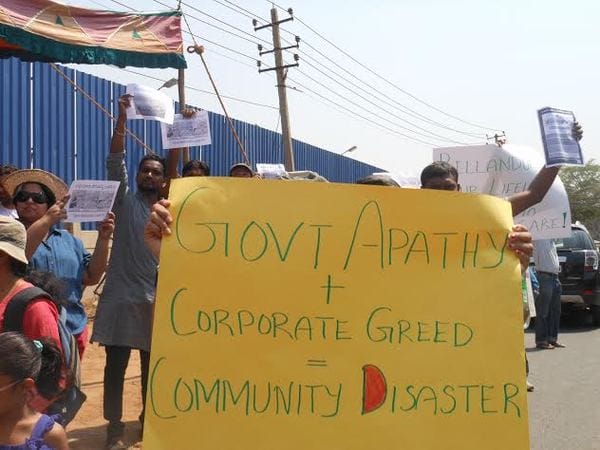
Pic: Nikita Malusare
It is never easy to protest against such a big project. It was evident when barricades were placed to block the traffic heading towards Sarjapur road from Koramangala. The barricades said BWSSB construction work is going on. 30 meters from the signal, one could see the corner of the road was dug, and a JCB was placed horizontally to stop the traffic.
However, when a president of Koramangala S T BED Layout Residents’ Welfare Association, Rajendra Babu argued about the need to block the entire the road, the barricades were removed and the traffic was left immediately.
Residents were caught in conversation among themselves on how Mantri allegedly tried to force the police officials to revoke the permission to stage protest. The previous night, HSR Layout police asked the residents to call off the protest. However the determination of residents was too strong to pull them back. A resident who didn’t want to be named said that the SP warned them saying “protest at your own cost, we won’t be there.”
However, the police were seen at the site during the protest. Nearly 1500 citizens were seen almost everywhere – in the tent, on both sides of the road, and even on the divider.
Why massive protest?
N S Mukunda, President of Citizen Action Forum (CAF) said, “Government is waiting for citizens to come on street and protest. When we don’t get proper recourse either in terms of time or justice, we have to come on to the streets and force the politicians to understand and realise, force them to act. It is the only way left.”
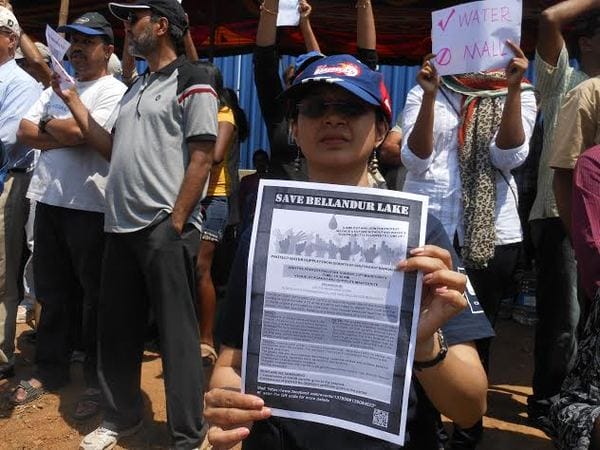
Pic: Nikita Malusare
He continued, “We are trying to save our lakes which are an important part of water ecosystem in Bangalore. We cannot afford to lose even a single lake. 40 years ago, we had 940 lakes, today we have only 94 lakes. If developments continue in such a manner, in another ten years there will be no lake.”
However he added, “We are not against development. Development shouldn’t happen at the cost of environment or at the cost of basic requirements like water and good liveable city. We can’t let it happen.”
No water for nearby areas
Residents of Bellandur say that close to 20,000 people in surrounding areas do not have borewell or BWSSB for water. They completely rely on tanker waters. Krishna R S, an independent consultant, said, “We rely on tankers 100%. We pay Rs 450 per tanker for 6000 litres.”
S Subramaniam, a resident of Bellandur, pointed that Mantri has promised BWSSB that will not dig any borewells for the construction of the project. He said, “if they do not dig borewells here, how will they get water for their construction? By tanker. From where does the tanker water come? From someone else’s right to water.”
Residents want the government to listen
A software engineer, Swati Hegde said, “I think the government is just ignoring us. They will have to pay attention, when all of us come together on the road, including children and senior citizens. They have to pay attention.”
Harini, a resident of Bellandur says, “I don’t think it is the apathy of government but there are powerful vested interests involved.”
Nitin Seshadri, resident of Koramangala, addressed the crowd stating that, “This is just the beginning of the fight. We will have to stage many such protests until the project is called off.” Residents clapped showing their support. After thanking the police officials, the protest ended with National Anthem.
When contacted, Gudagi, Secretary of KIADB, said, “The decision is in the hands of the High Level Clearance Committee now. The case is also pending in the High Court and Lokayukta’s office, we cannot do anything now.”
BBMP Commissioner Lakshminarayan and H S Ramesh, Head of the State Environment Impact Assessment Authority were unavailable for comments.
To read more stories on the issue, click here.
I sincerely hope the right message has been received by powers that be to listen to citizens. .Well done Commander. and good coverage by Citizen Matters