BTM playground turns into dumping ground

The only open space in BTM is fast becoming a dumping yard. Residents blame the lack of fencing for this.

The only large playground on 19th Main, BTM layout, 1st stage has become dumping yard, for construction debris, owing to the broken fence all around. This playground comes under BBMP ward 176 and is a major open lung space for the neighbourhood.

The residents feel that if the fencing is not done, the entire playground will soon become a dumping yard. Some contractors have started to illegally dump construction debris at night. Subramaniyam Sheshadari, a resident who stays opposite the playground says that at the least, the fence should be repaired to avoid the situation from getting worse.
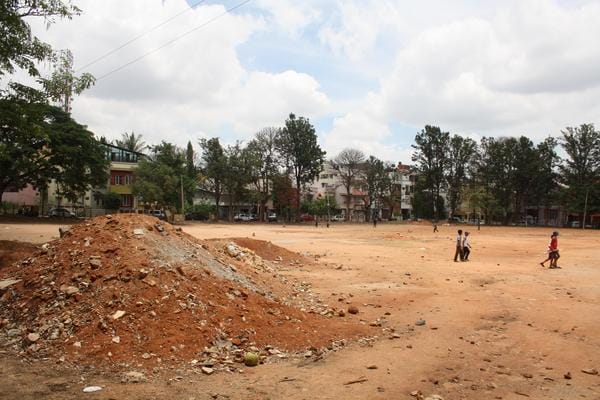
Debris in the playground due to illegal dumping

The residents feel that ward Corporator GNR Babu, has done his bit to keep the playground in good shape. Recently Babu took the initiative to install street lights around the playground and levelled one part of the ground to make a badminton court. Residents claim that the street lights have brought down the instances of chain snatching in the vicinity.

However when it comes to fencing, BBMP’s lack of funds seems to be an issue. Babu though now says that the project to overhaul the ground has been finally approved and will be completed in 3-4 months. Babu says, "Around 25-30 lakh rupees budget has been approved by BBMP. It includes re-fencing, building toilets as well as a provision for a security guard to safeguard the area." ⊕

Leave a Reply

Your email address will not be published. Required fields are marked *

Similar Story

Heatwaves are now a natural disaster in India. What changes for funding?  

While heatwaves now come under the Disaster Management Act, making relief and mitigation funds accessible, States must fix planning gaps.

In August 2026, the Ministry of Home Affairs recognised heatwaves as a natural disaster eligible for relief under the National Disaster Management (NDM) Act 2005. It’s a decision climate and policy experts have advocated for over the years. So, what are the implications of that change on heat financing in India?  But first, why heat is an urgent policy issue  Earlier this year, 95 out of the world’s 100 hottest cities were located in India. With 75% of the country’s population residing in districts prone to high or extreme heat, it is no coincidence that India has the largest share…

Similar Story

Bengaluru’s GBA and Hyderabad’s CURE: What they have in common and where they differ

While the mega-cities have split up into smaller corporations, both have put state leadership in control of city governance.

With the Core Urban Region (Integrated Governance) Bill 2026, better known as the CURE Bill passing in the Telangana Legislative Assembly, India's two fastest-growing mega-cities—both having crossed the 1.3-crore population mark—now operate under brand-new urban governance laws enacted within roughly two years of each other.  Both states confronted the exact same structural challenge: a single, overstretched corporation, fractured inter-agency coordination, and an urgent need for hyper-local administrative units capable of  delivering civic services efficiently. In an earlier article, we broke down how local governance would change with the Greater Bengaluru Governance Act. Read it here. Two mega-cities, one playbook The…