Mayor and Deputy Mayor’s wards get highest allocation

Even as the opposition cried hoarse about the revenue plans for the budget, the Palike budget has shot up by 184 crores at the final count.

When the BBMP budget was passed on Saturday, September 3rd, 171 corporators had got additional grants for ward works. While the allocation was Rs 1-4 crore for most wards, the highest allocation was for Mayor Sharadamma’s ward Shettihalli (ward number 12). Mayor’s ward received Rs 15 cr.

The second highest allocation was Rs 8 cr, for Deputy Mayor S Harish’s ward Nagapura (67).
Rs 5 cr were allocated to Shanthinagar (117) and BTM layout (176), both of which are represented by Congress.

The additional ward grants have taken the budget outlay from the earlier Rs 9196 cr to Rs 9380 cr. This addition of Rs 184 cr was given even as opposition was arguing that the budget was unrealistic and that funds cannot be mobilised this year.
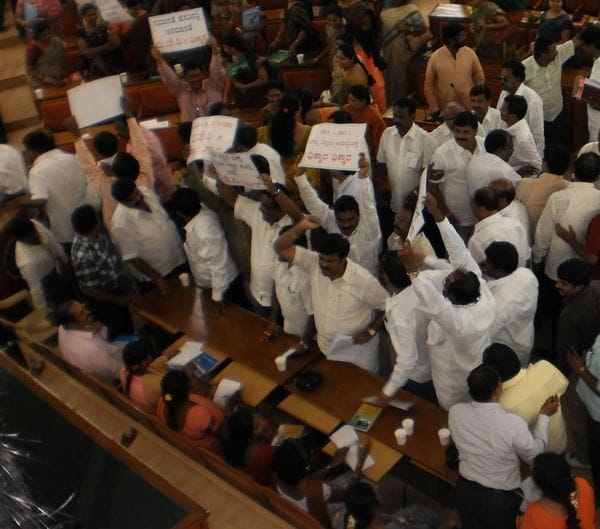
Opposition councillors voicing their protest. Pic: Navya P K

BJP has no clear answers on how Rs 184 cr will be mobilised. BJP leader B R Nanjundappa says that this amount will be channelised from MLA funds and by cutting down on unnecessary spending.

The budget was passed on Saturday even as the opposition was protesting. Congress and JD(S) corporators had raised several questions on the budget during the four-day discussion from August 23 – 26. On September 3rd, Taxation and Finance Committee Chairman Manjunath Raju and BBMP Commissioner H Siddaiah responded to these questions.

The response however was mainly a reiteration of the promises made in the budget. As opposition continued its protest, Mayor Sharadamma read out a speech saying that the budget was approved, putting an end to the discussion. As the budget was passed, opposition members protested, moving into the well of the House with placards and slogans.

The Council does not have a process of counting corporators’ votes for budget approval; the approval process is completed as soon as the Mayor declares so.⊕

Comments:

  1. Divya Harave says:

    What a shame!

Leave a Reply

Your email address will not be published. Required fields are marked *

Similar Story

Heatwaves are now a natural disaster in India. What changes for funding?  

While heatwaves now come under the Disaster Management Act, making relief and mitigation funds accessible, States must fix planning gaps.

In August 2026, the Ministry of Home Affairs recognised heatwaves as a natural disaster eligible for relief under the National Disaster Management (NDM) Act 2005. It’s a decision climate and policy experts have advocated for over the years. So, what are the implications of that change on heat financing in India?  But first, why heat is an urgent policy issue  Earlier this year, 95 out of the world’s 100 hottest cities were located in India. With 75% of the country’s population residing in districts prone to high or extreme heat, it is no coincidence that India has the largest share…

Similar Story

Bengaluru’s GBA and Hyderabad’s CURE: What they have in common and where they differ

While the mega-cities have split up into smaller corporations, both have put state leadership in control of city governance.

With the Core Urban Region (Integrated Governance) Bill 2026, better known as the CURE Bill passing in the Telangana Legislative Assembly, India's two fastest-growing mega-cities—both having crossed the 1.3-crore population mark—now operate under brand-new urban governance laws enacted within roughly two years of each other.  Both states confronted the exact same structural challenge: a single, overstretched corporation, fractured inter-agency coordination, and an urgent need for hyper-local administrative units capable of  delivering civic services efficiently. In an earlier article, we broke down how local governance would change with the Greater Bengaluru Governance Act. Read it here. Two mega-cities, one playbook The…