Bengaluru MLAs are long timers: 16 of 28 have been legislators from 2008

Bengaluru MLAs have been voted again and again by citizens and have now gained decades of experience representing our city.

A lot has changed in Bengaluru in the last 20 years. Millions of people moved in and made the city their home in the last decade. Lakhs of jobs have been added. Infrastructure too has been added to keep pace with the growing population. Municipal wards went from 100 to 198 to now 243.

A new BBMP Act has been enacted that extended the Mayor’s term from one year to 2.5 years. The BBMP Act also brought in Zonal level Commissioners and Zonal Councils. We saw so many Chief Ministers, Bengaluru Ministers, Commissioners, and Mayors but one thing remained more or less constant–our 28 City MLAs. Most of them have been elected again and again by citizens and have now gained decades of experience representing our city in the state legislature. Many of them have been Cabinet Ministers and even Bengaluru Development Ministers in the past.


Read more: Voting on May 10th? Here’s what you need to know


Some interesting statistics

16 of the 28 MLAs have been elected for more than 3 terms (15 years), giving them a combined experience of 240 years as city MLAs!
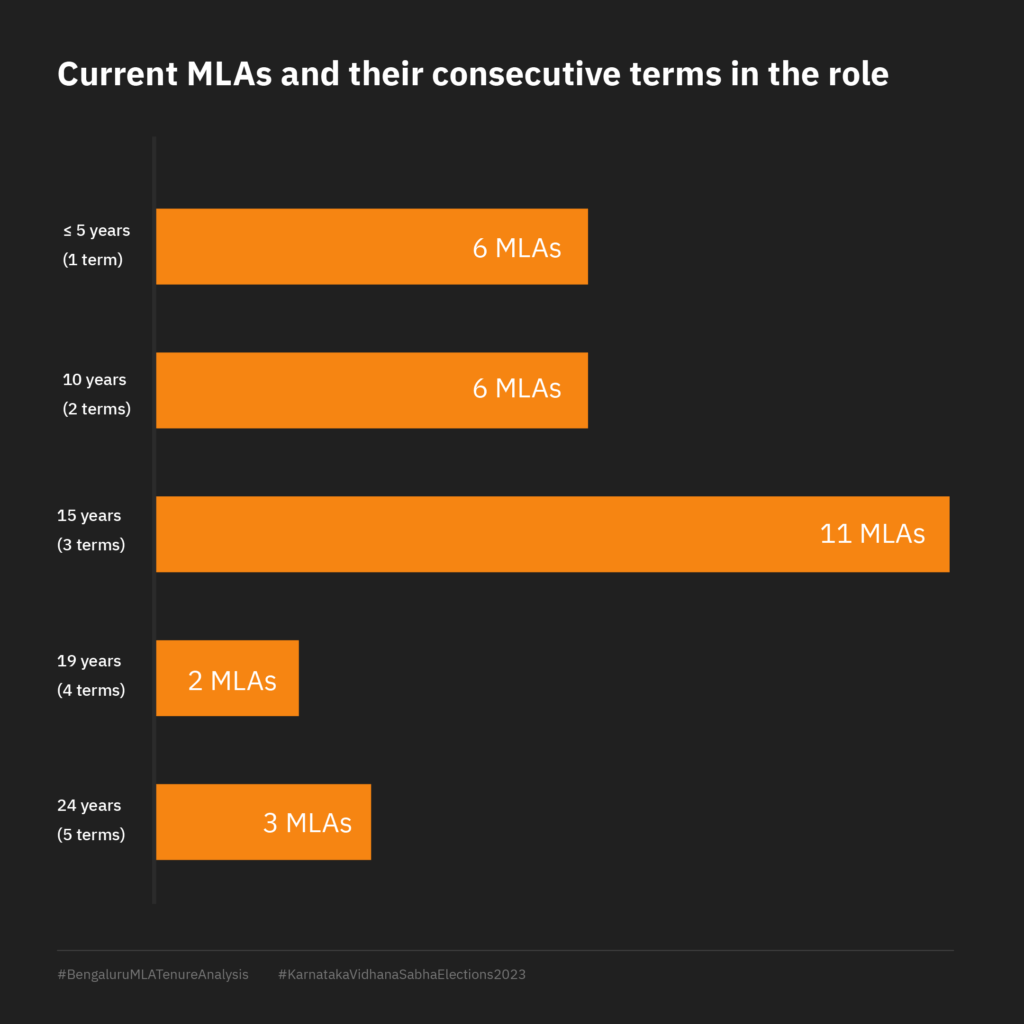
Current MLAs and their consecutive terms in the role
Graphics courtesy: Deep Chaitanya

Dinesh Gundu Rao, Ramalinga Reddy, and R Ashoka are the longest-serving MLAs in our city. They have been MLAs for almost 25 years!
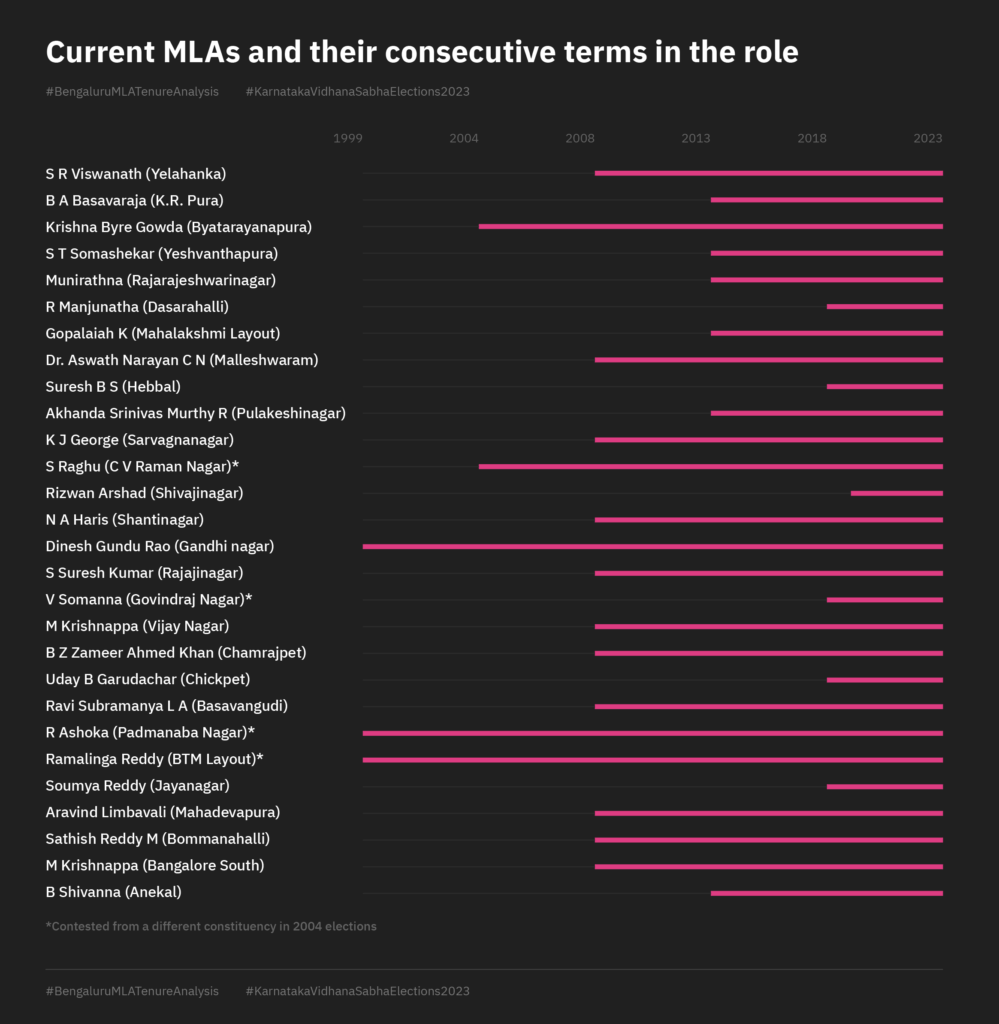
Current MLAs and their consecutive terms in the role
Graphics courtesy: Deep Chaitanya

Just six of the 28 are first-time MLAs. 22 of 28 have been MLAs for ten years!
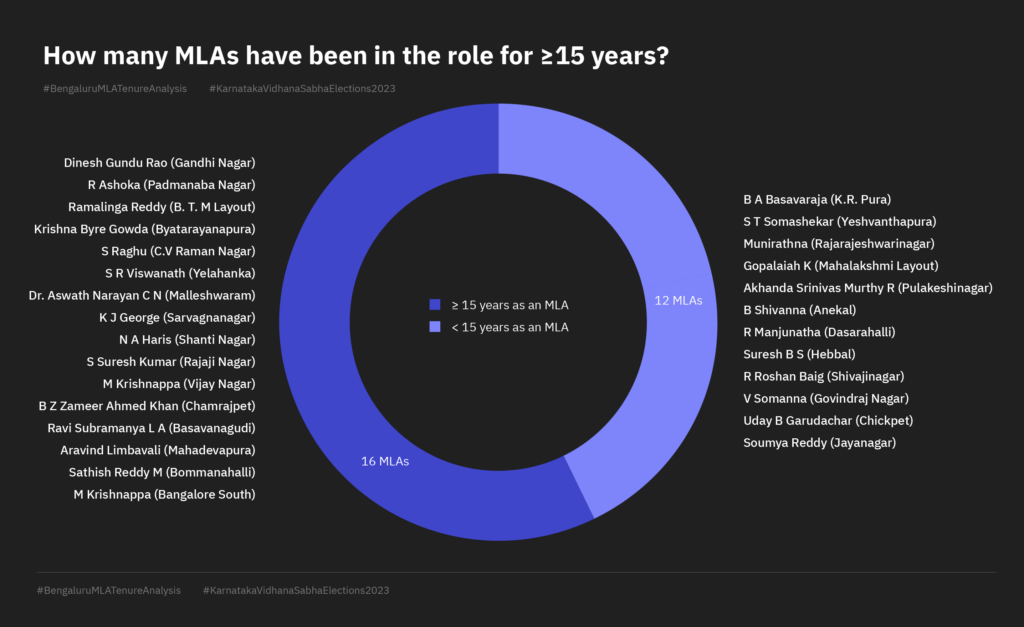
How many MLAs have been in the role for above 15 years?
Graphics courtesy: Deep Chaitanya

We deliberately did not get into the political affiliation to convey that the party seems to be a lot less important than the candidate as the electoral record shows. A few MLAs switched their party and still won!
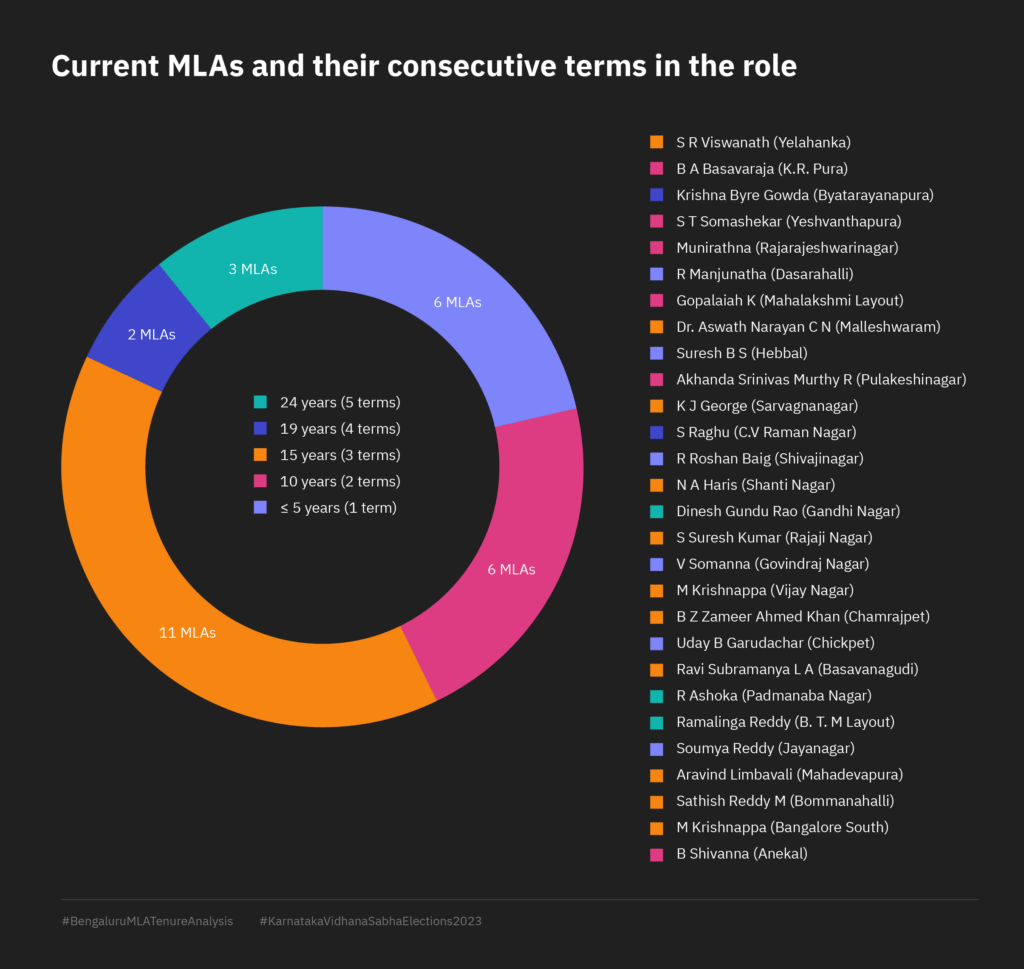
Current MLAs and their consecutive terms in the role
Graphics courtesy: Deep Chaitanya

There is just one woman MLA representing our city – Sowmya Reddy from Jayanagar. For a dynamic city like Bengaluru with so many women CEOs, business leaders, educationists, entrepreneurs, activists, and even IAS officers, this is a matter of concern. Women are taking Bengaluru forward, but they are not at all represented adequately in the political ecosystem.

  • Only two MLAs in Bengaluru figure in the under 50 list – Sowmya Reddy and Rizwan Arshad
  • Sowmya Reddy is also the youngest MLA at 40 years
  • The average age of MLAs is 59 years

Here is hoping that in the next five years, the newly elected 28 MLAs will come together and work on bringing positive transformation to our city using the powers given to them by us, the voters of Bengaluru.

More information on MLAs and Candidates for 2023 election can be found here.

Also read:

Leave a Reply

Your email address will not be published. Required fields are marked *

Similar Story

Left off the list: How SIR is costing transgender voters their rights

Mismatched documents, hostile families, and no dedicated support leave many trans citizens at risk of being removed from electoral rolls.

For Rayyan Monkey, a transgender voter from Mumbai, the SIR does not just threaten her right to vote. It also risks her ability to travel freely and exist as a woman in the country. Raised abroad before moving to Mumbai, Rayyan was left unmapped on the voter lists because her parents did not vote in 2002. The only way for her to complete her progeny mapping is to provide either her grandfather’s Brihanmumbai Municipal Corporation (BMC) card or her father’s birth certificate. However, after coming out to her family, Rayyan has been estranged from her extended relatives. Her father’s documents,…

Similar Story

Karnataka Apartment Management Bill: The proposed law needs one critical correction

A flaw in the Karnataka Apartment Bill, 2026 could derail apartment governance in Bengaluru and beyond. Why the 50% allotment rule must be amended.

The proposed Karnataka Apartment Management Bill, 2026 is an important step towards simplifying apartment governance in the state. By replacing the overlapping provisions of the Karnataka Ownership Flats Act (KOFA) and the Karnataka Apartment Ownership Act (KAOA) with a single legislation, the government has an opportunity to create a more transparent and efficient legal framework for apartment communities. Many of the proposed provisions are likely to benefit homebuyers, apartment associations and developers alike, by reducing legal ambiguity and providing a common framework for the management of residential communities. However, one provision deserves urgent reconsideration before the Bill becomes law. Formation…