Bengaluru MLAs are long timers: 16 of 28 have been legislators from 2008

Bengaluru MLAs have been voted again and again by citizens and have now gained decades of experience representing our city.

A lot has changed in Bengaluru in the last 20 years. Millions of people moved in and made the city their home in the last decade. Lakhs of jobs have been added. Infrastructure too has been added to keep pace with the growing population. Municipal wards went from 100 to 198 to now 243.

A new BBMP Act has been enacted that extended the Mayor’s term from one year to 2.5 years. The BBMP Act also brought in Zonal level Commissioners and Zonal Councils. We saw so many Chief Ministers, Bengaluru Ministers, Commissioners, and Mayors but one thing remained more or less constant–our 28 City MLAs. Most of them have been elected again and again by citizens and have now gained decades of experience representing our city in the state legislature. Many of them have been Cabinet Ministers and even Bengaluru Development Ministers in the past.


Read more: Voting on May 10th? Here’s what you need to know


Some interesting statistics

16 of the 28 MLAs have been elected for more than 3 terms (15 years), giving them a combined experience of 240 years as city MLAs!
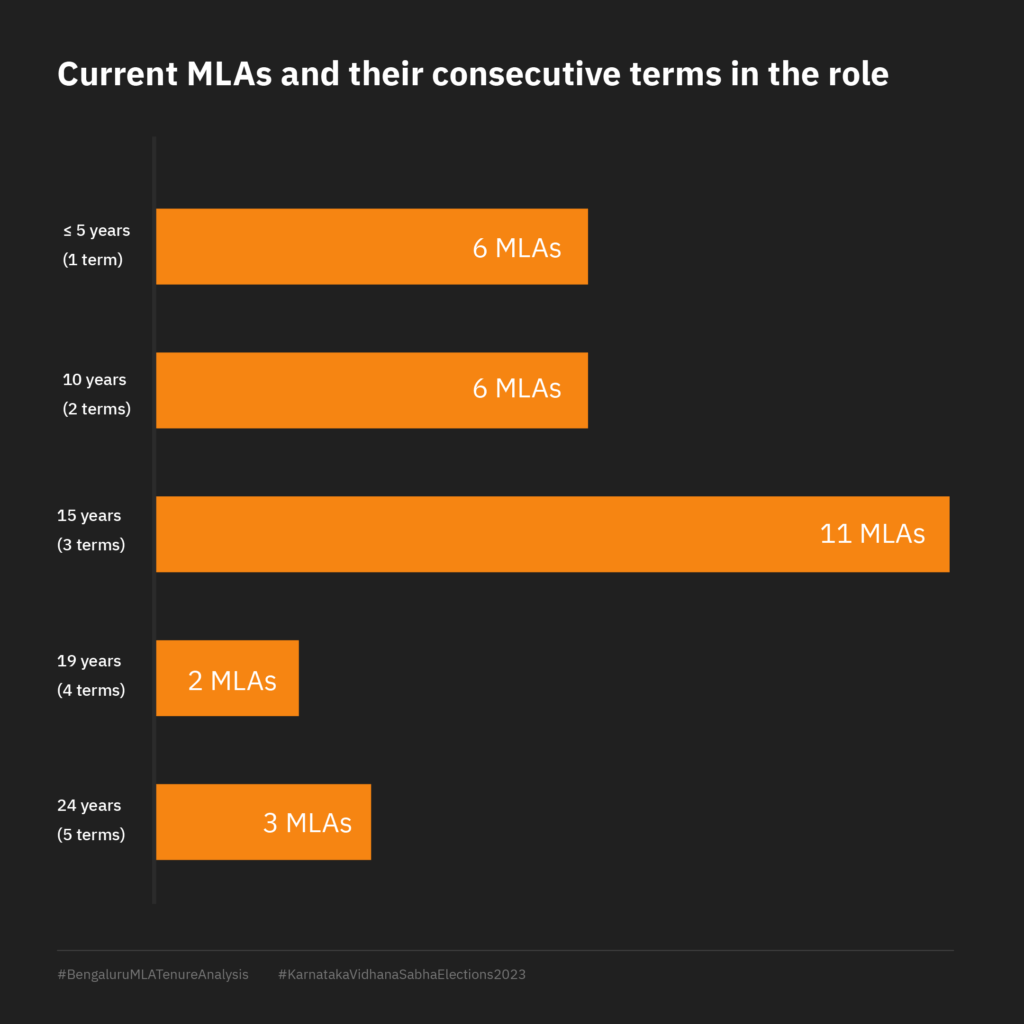
Current MLAs and their consecutive terms in the role
Graphics courtesy: Deep Chaitanya

Dinesh Gundu Rao, Ramalinga Reddy, and R Ashoka are the longest-serving MLAs in our city. They have been MLAs for almost 25 years!
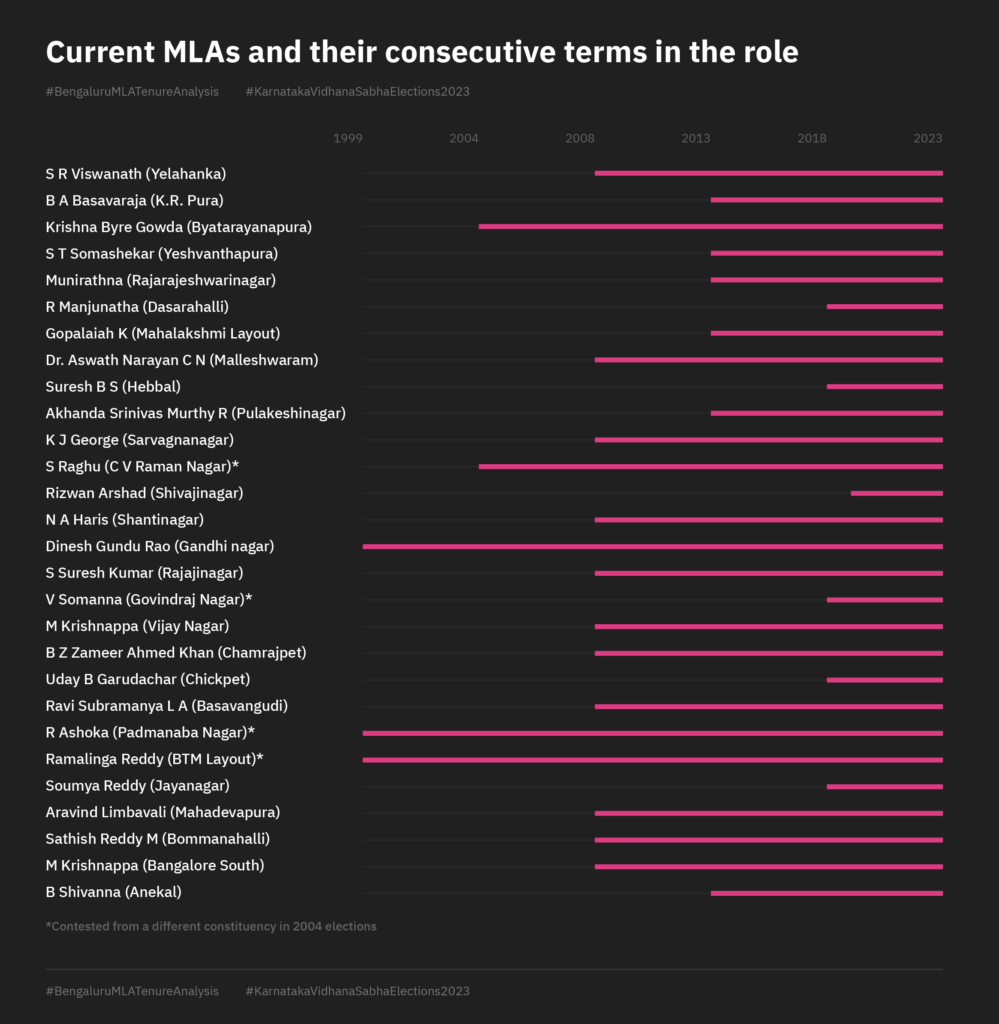
Current MLAs and their consecutive terms in the role
Graphics courtesy: Deep Chaitanya

Just six of the 28 are first-time MLAs. 22 of 28 have been MLAs for ten years!
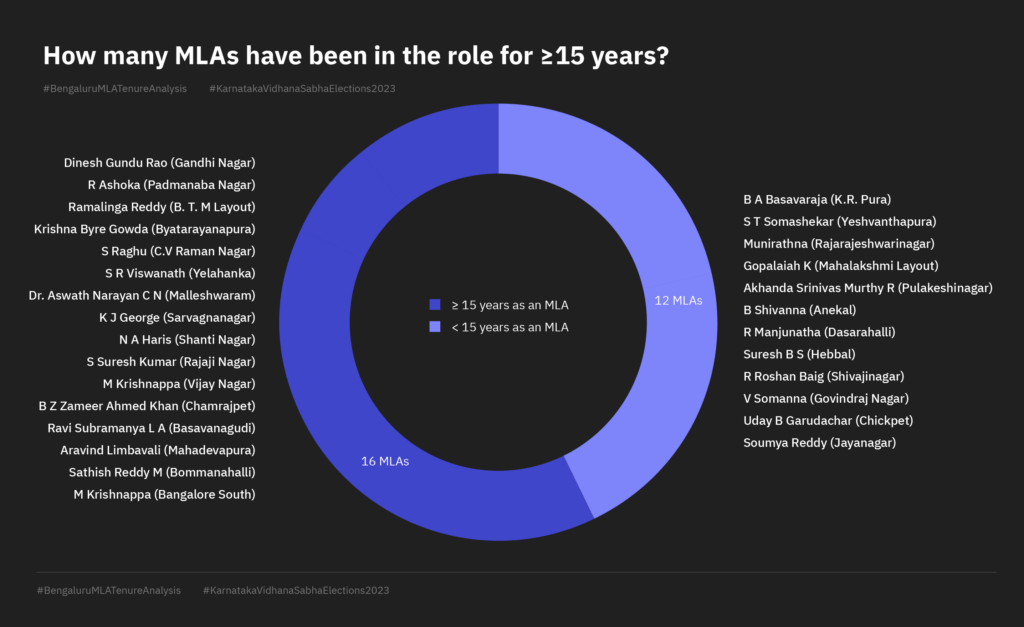
How many MLAs have been in the role for above 15 years?
Graphics courtesy: Deep Chaitanya

We deliberately did not get into the political affiliation to convey that the party seems to be a lot less important than the candidate as the electoral record shows. A few MLAs switched their party and still won!
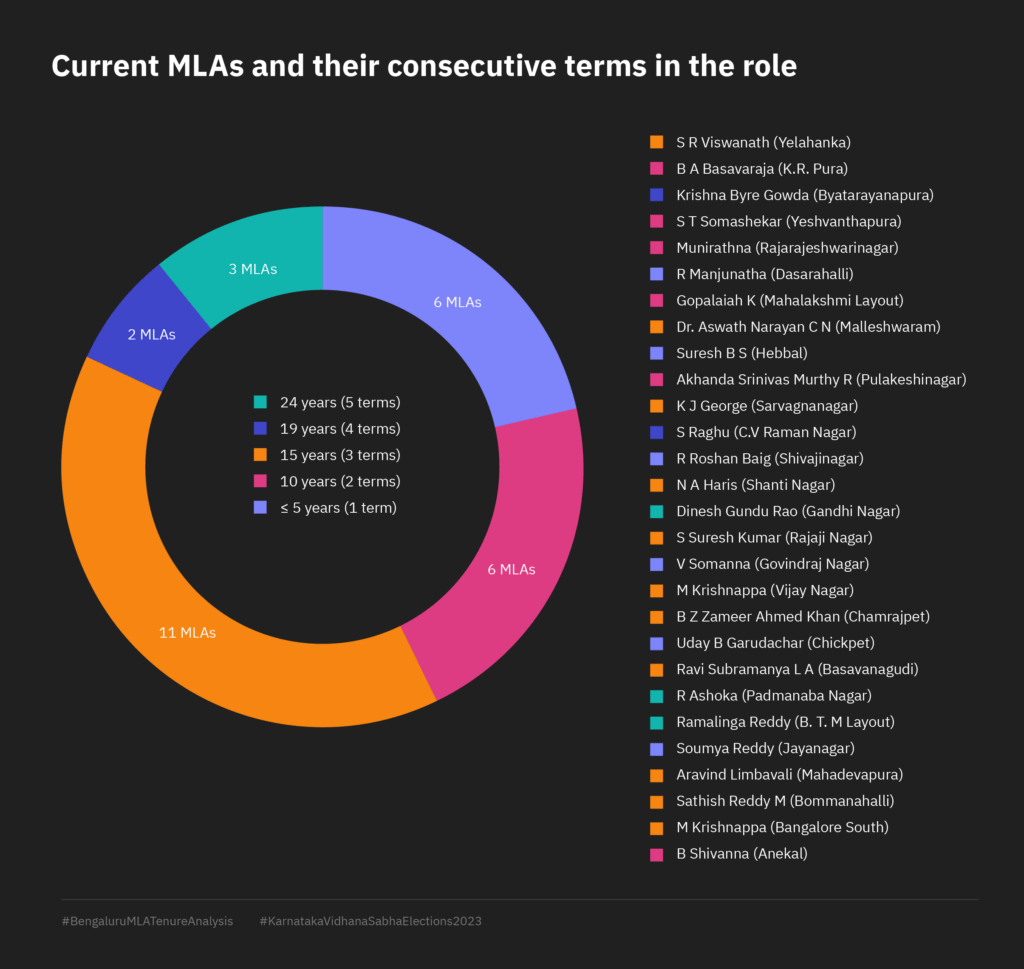
Current MLAs and their consecutive terms in the role
Graphics courtesy: Deep Chaitanya

There is just one woman MLA representing our city – Sowmya Reddy from Jayanagar. For a dynamic city like Bengaluru with so many women CEOs, business leaders, educationists, entrepreneurs, activists, and even IAS officers, this is a matter of concern. Women are taking Bengaluru forward, but they are not at all represented adequately in the political ecosystem.

  • Only two MLAs in Bengaluru figure in the under 50 list – Sowmya Reddy and Rizwan Arshad
  • Sowmya Reddy is also the youngest MLA at 40 years
  • The average age of MLAs is 59 years

Here is hoping that in the next five years, the newly elected 28 MLAs will come together and work on bringing positive transformation to our city using the powers given to them by us, the voters of Bengaluru.

More information on MLAs and Candidates for 2023 election can be found here.

Also read:

Leave a Reply

Your email address will not be published. Required fields are marked *

Similar Story

Bengaluru’s GBA and Hyderabad’s CURE: What they have in common and where they differ

While the mega-cities have split up into smaller corporations, both have put state leadership in control of city governance.

With the Core Urban Region (Integrated Governance) Bill 2026, better known as the CURE Bill passing in the Telangana Legislative Assembly, India's two fastest-growing mega-cities—both having crossed the 1.3-crore population mark—now operate under brand-new urban governance laws enacted within roughly two years of each other.  Both states confronted the exact same structural challenge: a single, overstretched corporation, fractured inter-agency coordination, and an urgent need for hyper-local administrative units capable of  delivering civic services efficiently. In an earlier article, we broke down how local governance would change with the Greater Bengaluru Governance Act. Read it here. Two mega-cities, one playbook The…

Similar Story

SIR in Bengaluru: Disenfranchisement at a grand scale

With Bengaluru Urban seeing a 42 per cent reduction in the voter rolls, is the SIR an update or a denial of electors' rights?

The CEO Karnataka recently published the final rolls for Karnataka after finishing their hurried and stressful Special Intensive Revision (SIR). People were asked to prove that they live where they do, and map themselves or their parents/ancestors to the 2002 voter roll. The final roll published now has 4.54 Crore electors in Karnataka as against the 5.54 Cr as per the 2025 Special Summary Review; a reduction of almost one crore electors or 18% of the earlier rolls. However, the numbers in the 28 constituencies in Bengaluru Urban paint a more drastic picture. The 1.026 crore electors as per the…