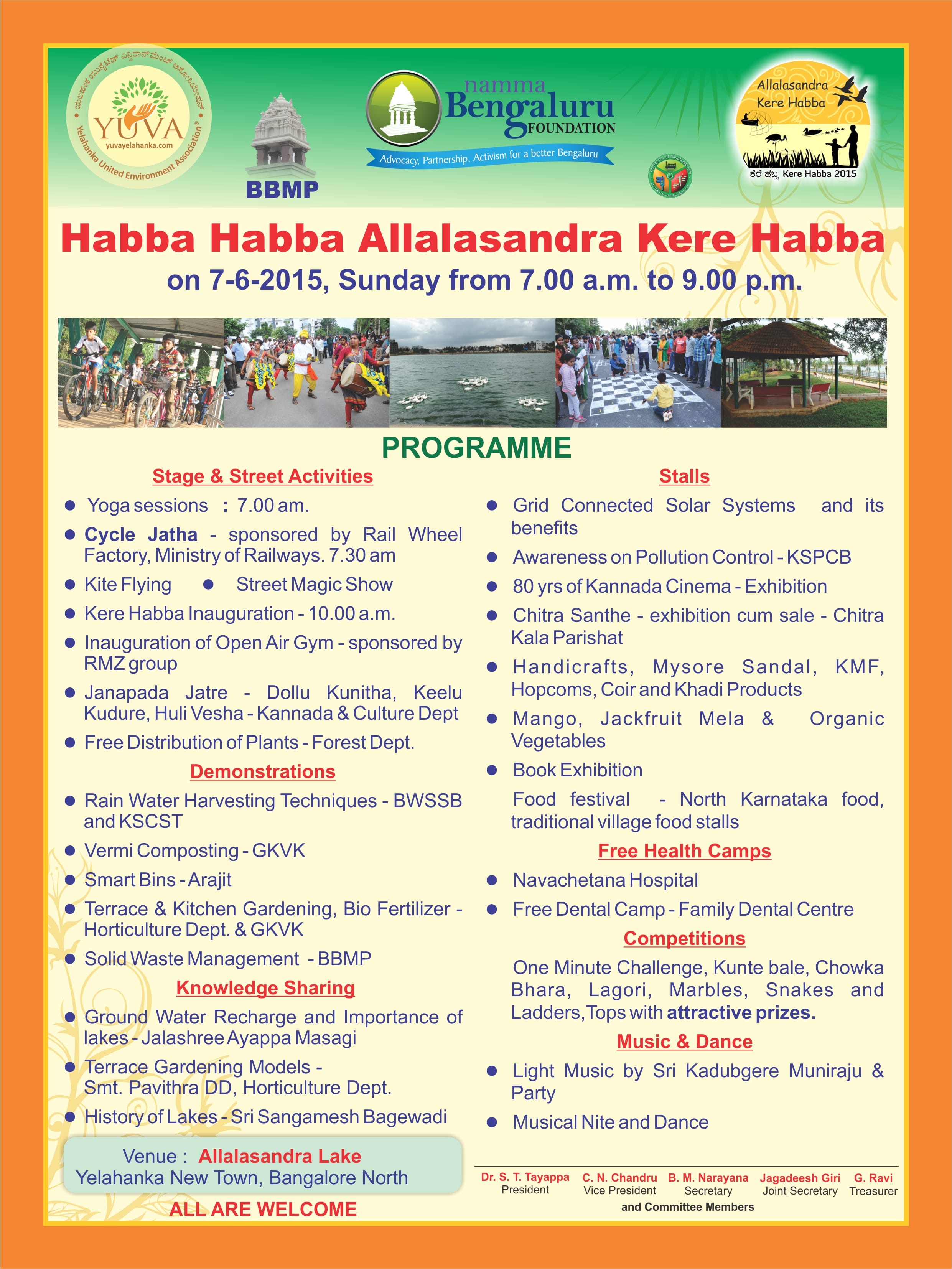
Allalasandra Lake, Yelahanka will host Bangalore’s fifth Kere Habba on Sunday 7th June 2015.
Since January this year, the Namma Bengaluru Foundation has been regularly collaborating with local lake groups to organise Kere Habbas (lake festivals) across the city. The earlier four habbas were held at Kaikondrahalli, Puttenahalli JP Nagar, Madiwala and Chellakere.
The Allalasandra Kere Habba is being held in collaboration with Yelahanka United Environment Association (YUVA).
About YUVA: YUVA has been in the forefront of the rejuvenation of the 44-acre Allalasandra Lake, with support from the Upa Lokayukta, local MLA, Corporator, BBMP, BWSSB, police officials and citizens. It has also been conducting various activities in the neighbourhood to spread awareness about environmental issues such as preserving lakes and parks, water conservation, garbage segregation at source, wet waste management, kitchen gardening, reducing pollution, increasing non-motorized traffic (Cycle Day), increasing public transport (Bus Day). YUVA was on of the finalist nominees for the prestigious Namma Bengaluru Award 2014, for its contribution to Bangalore city.
At the Allalasandra Kere Habba, visitors can be sure that they would find some fun activity that would not only entertain but also educate. The inauguration function will be at 10:00 a.m., while the valedictory function will be at 5:30 p.m.
Expected at the event are Upa Lokayukta Justice S.B.Majage, Karnataka Legislative Assembly Speaker Mr Kagodu Thimmappa, Bangalore District in-charge Minister Mr Ramalinga Reddy, MPs Mr Rajeev Chandrashekar and Mr Veerappa Moily, MLA Mr S.R.Vishwanath, Central Law Minister Mr Sadanand Gowda, BBMP Commissioner Mr Kumar Naik, Yelahanka BBMP Joint Commissioner Mr Sarfraz Khan, KSTDC MD Mr Harsha, KSPCB Chairman Dr Vaman Acharya, Environment & Ecology Secretary Mr Ramachandra, UDD Addln Chief Secretary Mr D Satyamurthy, Former Commissioner of BBMP Dr S.Subramanya, BWSSB Chairman Mr Anjum Parvez, DC Bangalore Mr Shankar V, Vice Chancellor of GKVK Mr Shivanna, President of Chalana Chitra Academy Mr Rajendra Singh Babu, Secretary of Sheshadripuram Educational Trust Mr Woodey P Krishna, Chairman of RMZ Corp Mr Arjun Menda, DCPs Mr Vikas Kumar and Mr Girish, BBMP Administrator Mr Vijay Bhaskar, and other officials from Govt of Karnataka, BBMP, BWSSB and the Police Department.
Arathi is a market researcher who loves to run and write. She has been actively involved in issues that affect citizens, including apartment management, waste management and lakes. She used to live in Mumbai and is now based in Bengaluru, working as a Community Anchor with Citizen Matters.
Mumbai's landscape is changing with big infra projects. Experts suggest better use of government plots and improved street design to retain green cover.
Long before Mumbai’s relentless summer even began this year, the city was already simmering. In March, Mumbai was hit by a severe heatwave, with the temperature reaching a five-year high of 40° Celsius. As rapid urbanisation and a flurry of infrastructure projects replace dense tree cover with steel and mortar, heatwaves seem to have gone from being rare occurrences to an annual threat. The Mumbai Metro Rail Corporation Limited (MMRCL) cut a whopping 3,093 trees in Aarey Colony to make way for Mumbai’s Aqua Line ( Metro 3). For environmentalist Stalin Dayanand, this is not just a temporary problem.…
71% of waterbirds at Begur Lake are declining. A visit to one of Bengaluru’s rapidly deteriorating lakes shows what's causing the collapse.
During the Open City biodiversity datajam held in December 2025, our group examined the ecological trends around Bengaluru’s lakes. Our analysis suggests a majority of waterbirds are declining across the city's lakes. Earlier, we addressed crucial questions on how migrant and resident waterbirds are surviving across 14 of Bengaluru’s lakes, how the shape of the lakes influence microhabitats, and how a scoring system can be used to record the decline in lake quality and bird populations. The last of our four-part series turns its attention to an individual site. As part of this study of waterbirds in 14 city lakes,…