A ‘hummingbird’ in Lalbagh!

You might confuse this creature with Hummingbird - but it’s not! Meet the unique species that has helped in enriching the fauna in Lalbagh.

Dhiraj Gaurh was astounded by a very large creature, which, he felt, might be a Hummingbird. Here are the excellent shots he got, of the creature drinking nectar from Aster flowers:

He posted the link to the photos in the egroup of the Bird Watchers’ Field Club (contrary to its name, this is a group of enthusiasts of all forms of wildlife and nature.) Several people (Rachna Shetty, Gautam Krishnan, Vijay Krishna, Ravi Vaidyanathan, Anubhav Vanamamalai, Nandhu Sridhar)  promptly responded to him,  identifying this, not as a Hummingbird (we do not have them in India), but as the Hummingbird Hawk Moth
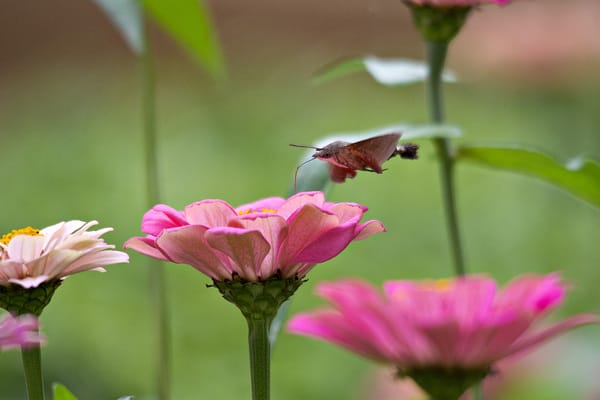
Its hovering behaviour, accompanied by an audible humming noise, makes it look remarkably like a hummingbird while feeding on flowers.

So…the next time you see something which might be a bird…it might not, actually, be one!

Comments:

  1. Amruta says:

    nice clicks of hummingbird

  2. ridhima says:

    nice photographs and thanks for bringing this to attention.

  3. Roli Srivastava says:

    Thanks for the information. I saw exact same creature in my terrace garden and took it for a humming bird

Leave a Reply

Your email address will not be published. Required fields are marked *

Similar Story

Encroachment and drainage woes: Lessons to prevent flooding in Porur Lake

A study investigates the causes of flooding in Porur, flags the underutilised potential of the nearby sponge park and suggests connecting missing links.

When the northeast monsoon hits Chennai, a foreseeable result of the heavy downpour is severe flooding in several areas, including Porur Lake. As residents living near this 200-acre water body battle inundation every year, our team set out to investigate the root causes of flooding using available data. Environmental issues have often been dealt with a one-size-fits-all approach, but our study aimed to provide specific solutions tailored to the Porur catchment area. For this, we mapped inundation patterns, land gradient, land use change and the outlay of stormwater drains (SWDs).   At a recent datajam organised by the Oorvani Foundation…

Similar Story

From slums to skyscrapers: How Mumbai’s L Ward faces climate stress

Crowded lanes, shrinking green cover and increased construction make L Ward vulnerable to extreme heat.

Mumbai’s L Ward, covering Kurla, Chandivali, Saki Naka, and Powai, has been quietly heating up, and not just metaphorically. It is a ward of extremes: dense slums on one side, luxury high-rises and malls on the other. But when the mercury rises, the contrasts fade, and everyone feels the burn. With urban heat on the rise across the city, L Ward is emerging as one of Mumbai’s hotspots where everyday life is increasingly being shaped by climate stress. The heat problem Spread across 15.6 sq km, L Ward is home to more than nine lakh people, packed into one of…