On September 19th, the Brihanmumbai Municipal Corporation (BMC) announced a three-month demolition drive targeting approximately 39,111 informal structures measuring 14 feet or more in height. The campaign was scheduled to run from October 1 to December 31, 2026, using guidelines dating back to 2002 to identify structures for demolition.
The eastern suburbs were to bear much of the impact. Of the structures identified by the BMC, 31,227 were located in the eastern suburbs, with a large concentration in Govandi’s M-East Ward.
The announcement caused considerable anxiety among residents. Following opposition, the BMC shelved the proposed special drive. However, it has not formally withdrawn the proposal. Families are still unsure whether the campaign could return or whether the 14-foot criterion will continue to be used against their homes.
For people who have lived on the same land for decades, this uncertainty is nothing new. They build their homes, raise their children and establish their lives in these neighbourhoods, yet remain vulnerable to the next demolition announcement. Many have no clear idea of what they can do to secure the land they occupy.
The response to such threats has usually been to oppose the particular demolition or redevelopment project. This is understandable. Residents have to protect their homes when they are threatened. But stopping one project only provides temporary relief. The next proposal can bring the same anxiety and the same fight all over again. Protests may delay a demolition, but they do not change the policies that leave people vulnerable in the first place.
The government and the BMC need to address those policies. Residents should have a genuine opportunity to regularise their homes and obtain land titles, rather than having to fight every new demolition proposal as it comes along.
Read more: Interview with Slum Redevelopment Authority (SRA): Where does the slum-free Mumbai goal stand?
Labelling residents as encroachers
Calling people encroachers is easy. It is much harder to acknowledge that families have lived on the same land for generations and built their homes through years of work and savings. These are people who have made Mumbai their home. They should not have to live with the constant fear that everything they have built can be taken away.
The humiliation is particularly severe for poorer and Muslim communities. Residents are called Bangladeshi, threatened with demolition when they raise their voices and made to feel like criminals in their own neighbourhoods. Their citizenship and their right to live in their homes are questioned even as their families have spent decades here.
There is also a glaring sense of unequal treatment. A small home belonging to a poor family is quickly labelled illegal, while violations by more powerful property owners can find ways to be regularised. Why should the opportunity to secure property rights depend on who has the money or influence to negotiate with the authorities?
We need to give residents and tenants a genuine opportunity to regularise their homes. One way to do this would be to allow them to pay a reasonable amount to the government and obtain legitimate land titles. The principle could be similar to the payments private developers make to acquire land rights and permissions.
Families who want ownership and are willing to pay for it should be allowed to do so. They should be able to regularise their structures and continue living on the land. This option must be offered before residents are pushed towards larger redevelopment projects or Slum Rehabilitation Authority (SRA) schemes.
Options other than redevelopment for Govandi
For many residents, entering an SRA scheme is presented as the way forward whenever questions about informal housing arise. But not everyone necessarily wants redevelopment. Some families may prefer to retain their homes and secure ownership of the land they occupy. They should have that option.
The government must work out a policy that makes this possible. Residents should know what they need to pay, how their structures can be regularised and what the process for obtaining land titles involves. Those who prefer redevelopment should also have clear information about eligibility, rehabilitation and their rights under the scheme.
Structural safety is another important consideration. Nobody wants to live in a dangerous building. But a height measurement alone cannot tell us whether a structure is unsafe. Each building needs to be assessed individually by qualified technical personnel. Where a structure poses a genuine risk, the authorities must explain what action is necessary and ensure that residents are not left without adequate rehabilitation.
These are matters that require a consistent policy from the state government and the BMC. Individual administrators should not be left to determine the future of entire settlements through periodic enforcement campaigns. Residents need clear rules and a process they can rely on, whether they seek regularisation or choose redevelopment.
Read more: Govandi residents resolve to push for more change after positive Bombay HC order
Fight for housing security in Govandi
Govandi New Sangam Welfare Society has also taken the concerns over the proposed demolition drive to the United Nations Special Rapporteur on the Right to Adequate Housing. In its submission, the organisation raised concerns about the potential impact on thousands of families and the absence of individual structural assessments, public consultation and assured rehabilitation.
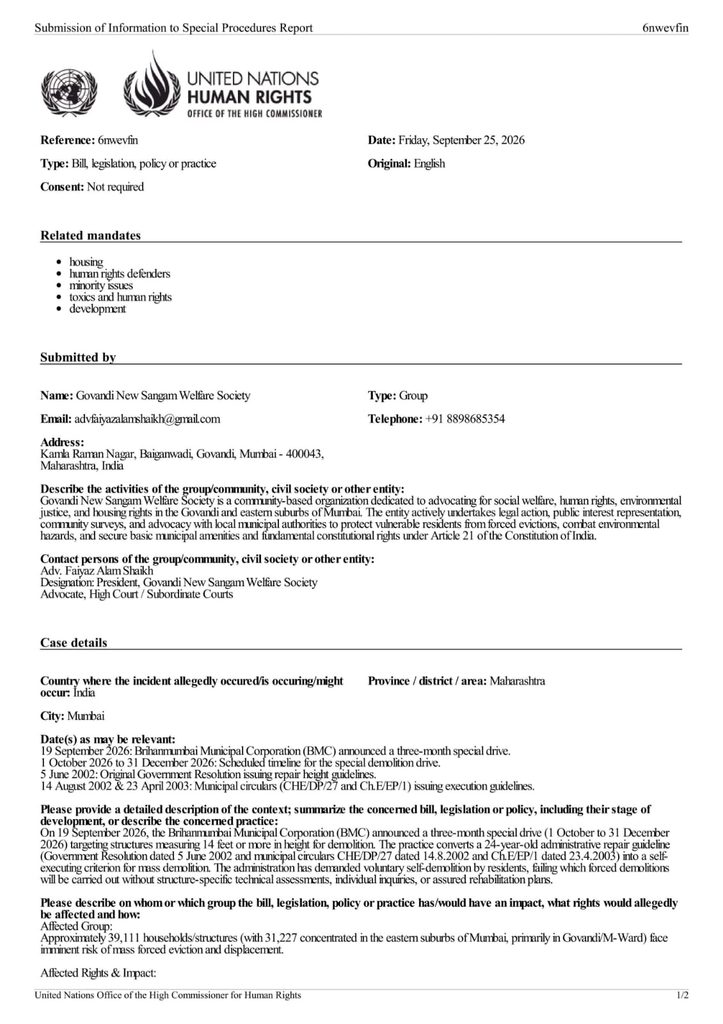
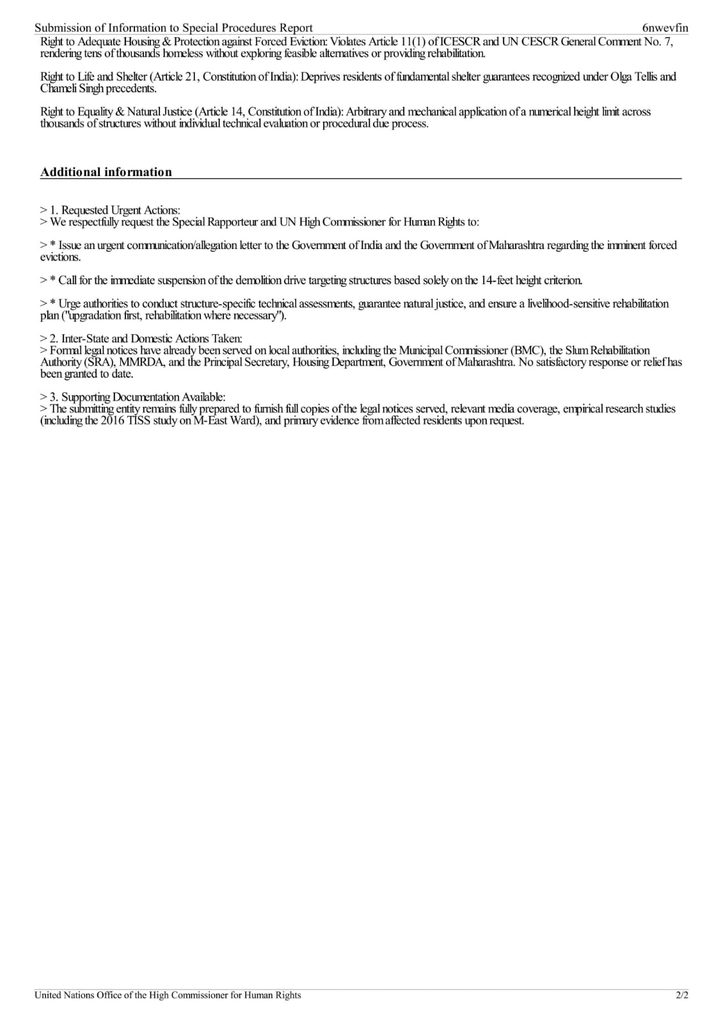
The submission also drew attention to India’s obligations under the International Covenant on Economic, Social and Cultural Rights and constitutional protections relating to the right to life, shelter and equality.
Residents of Govandi, Deonar, and Shivaji Nagar are facing an acute administrative contradiction as civic authorities simultaneously push for long-term Cluster Redevelopment under DCPR 2034 while issuing immediate demolition orders under Section 3Z-2 of the Maharashtra Slum Areas Act, 1971, against structures exceeding the 14-foot residential and 10-foot commercial height limits.
While the cluster tag blocks residents from pursuing self-development or hiring independent builders due to complex de-notification rules and heavy premiums, routine processes like fresh surveys, photopass renewals, and ownership transfers remain stalled—prompting urgent demands for authorities to place cluster notifications, demolition orders, and survey records in the public domain before taking coercive action.
The proposed drive has been shelved for now, but residents are still waiting for clarity from the authorities. Without a formal withdrawal or a change in the underlying policy, the same threat can return.
We cannot keep responding to every demolition announcement with another round of protests and political interventions. Residents need a lasting solution. The government must offer a fair route to regularisation and land ownership before taking up larger redevelopment projects. Families who have lived on this land for generations should be able to decide whether they want to pay for and secure their homes or opt for redevelopment with proper safeguards.
That is the policy change we need to work towards. It is the only way to move beyond the cycle of demolition threats, protests and temporary reprieves that has kept residents insecure for so long.