In August 2026, the Ministry of Home Affairs recognised heatwaves as a natural disaster eligible for relief under the National Disaster Management (NDM) Act 2005. It’s a decision climate and policy experts have advocated for over the years. So, what are the implications of that change on heat financing in India?
But first, why heat is an urgent policy issue
Earlier this year, 95 out of the world’s 100 hottest cities were located in India. With 75% of the country’s population residing in districts prone to high or extreme heat, it is no coincidence that India has the largest share of heatwave-related excess deaths globally. Marginalised groups face the biggest brunt of heat stress. According to the Lancet Countdown, India lost 247 billion potential labour hours in 2024 due to heat exposure, predominantly impacting informal and/or outdoor workers. These labour productivity losses are estimated to be worth about 4% of Indian cities’ GDP annually.
Other vulnerable groups include informal settlement dwellers, low-income women facing indoor heat, migrant workers and the elderly, highlighting the need for a comprehensive approach to tackle the heat crisis.
India aligned with international climate goals through its 2008 National Action Plan for Climate Change to cut carbon emissions. This led to State Action Plans and to Ahmedabad also created South Asia’s first Heat Action Plan (HAP) in 2013, inspiring other cities to follow suit. Today, over 300 HAPs across 23 states, along with city-level Climate Action Plans (CAPs), guide heat interventions like early warning systems, public awareness, and adaptation measures. Beyond the CAPs and HAPs, heatwaves have primarily been managed through government advisories and seasonal warnings.
Read more: Climate laws must enforce heat mitigation measures: Professor Vidhya Venugopal
Such efforts are necessary as heatwaves worsen globally, with South Asia particularly vulnerable. For instance, heatwaves in India have surged annually from about three in 1970 to 25 in the 2010s and 2020s, and are projected to increase further. Nearly 4,000 deaths were reported due to heat or sunstroke in India between 2018 and 2022, what the 16th Finance Commission cites as a major factor in justifying the need for heatwaves to be recognised as a notified disaster.
How is this change significant?
Unlike other disasters such as floods, earthquakes and cyclones, heat-related disasters had not been notified under the NDM Act 2005 until recently. The largest consequence of this omission was how heat mitigation and relief efforts were funded in the country. Prior to 2015, heat risk management was under the discretion of state governments. In its heat wave management booklet, the National Disaster Management Authority (NDMA) in 2019 notes that the approach of both central and state governments thus far “had been response-centric, and due importance to risk reduction was not given,” partially owing to a lack of comprehensive heat financing opportunities.
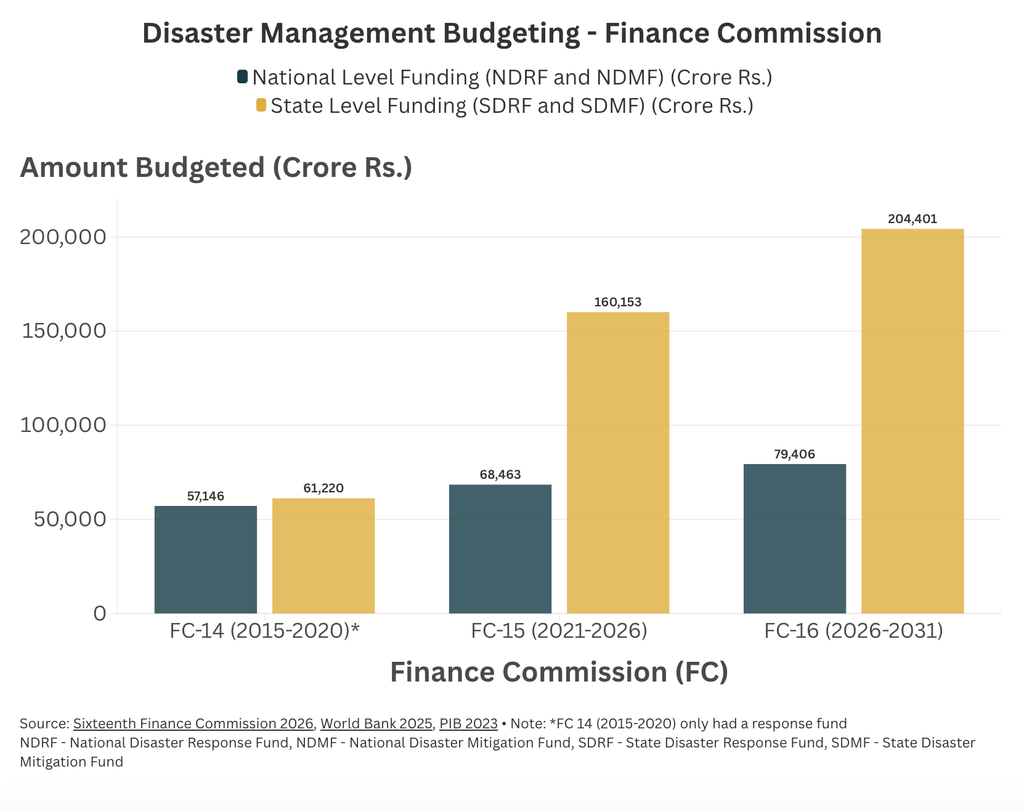
Under the 15th Finance Commission (2021-26), the NDM Act expanded the scope of budgetary allocations for disasters into two windows – one for disaster response and the other for mitigation.
The different types of funds
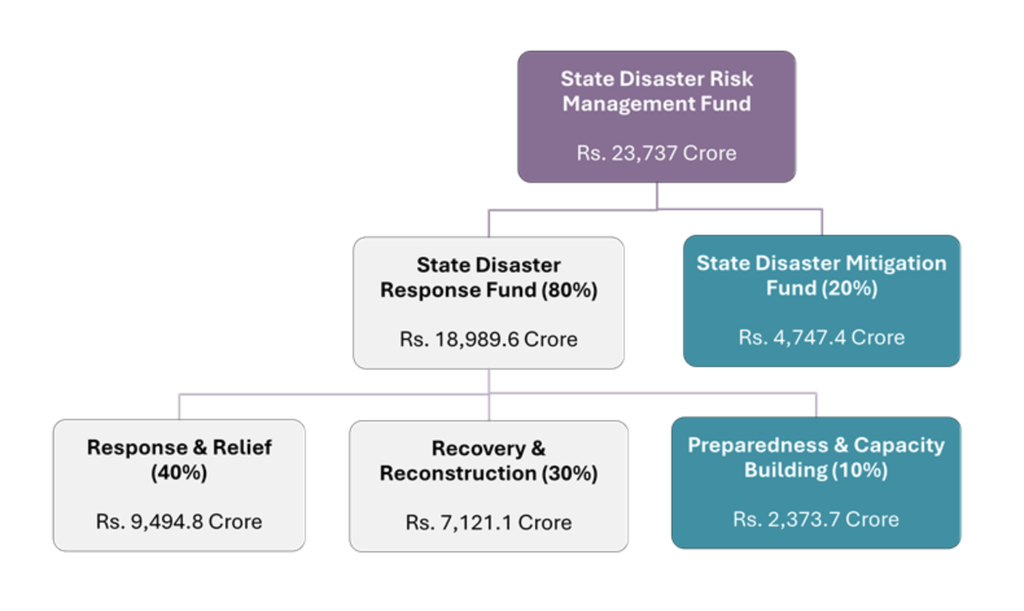
The response funds, namely the State Disaster Response Fund (SDRF) and the National Disaster Response Fund (NDRF) finance immediate relief and recovery after notified disasters, with the NDRF supplementing states when their own funds fall short. The mitigation funds, namely the State Disaster Mitigation Fund (SDMF) and the National Disaster Mitigation Fund (NDMF), were operationalised for the first time, with 20% of each corpus set aside for risk reduction rather than relief.
The Union and state governments also share these costs differently across the two levels: for general category states (i.e. all states other than the North-Eastern and Himalayan states, where the Union’s share is 90% instead), the Central government funds 75% of the total amount while the concerned state government contributes the remaining 25%. At the national level, the NDRF and NDMF are funded 100% by the Centre.
Lack of clarity on spending
Prior to this, 11 states had notified heatwaves as a state-specific disaster: including Telangana, Tamil Nadu, Chhattisgarh, Odisha, Kerala, Rajasthan, Andhra Pradesh, Maharashtra, Karnataka and Madhya Pradesh. Only they were allowed to spend a maximum of 10% of their annual SDRF allocation on managing heatwaves.
This also required the government to lay down clear relief norms approved by their State Executive Committee, sharing the post- disaster 10% window with all other locally notified disasters such as lightning. The other states had to totally rely on their own budgets for heat relief.
Critics also argued that this threshold of 10% was ‘arbitrary,’ and that it limited effective heat responses by restricting relief funds and forcing states to divert money from other development priorities. Identifying how India finances heat management is another major challenge.
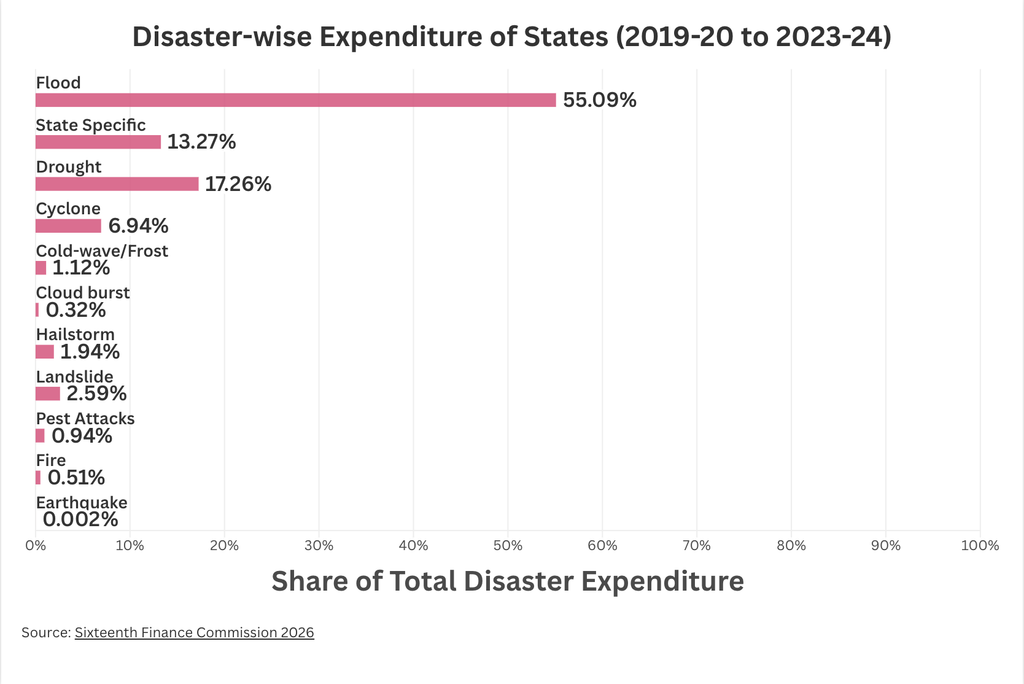
As Bhujabal and Karun (2026) note, despite HAPs serving as the primary policy instrument for heat governance in India, tracking heat-related expenditure is no easy task. HAP or CAP-related actions are frequently, and often confusingly, tucked within multiple departmental budgets and existing schemes. The Sixteenth Finance Commission’s data on state expenditure between 2019 to 2024 (Figure 2) has no separate category for heatwaves; any heat-related spending sits within the broader ‘state-specific’ category for all locally notified disasters. So, the exact amount spent on heat relief cannot be ascertained.
Breaking down the budgets
Relief and long-term resilience
Challenges remain
Heat financing in India: An uncertain future
Recent research indicates that a one-day heatwave scenario would cause approximately 3,400 deaths across the country, significantly higher than the 800 excess mortality deaths per annum cited by the government. It is in this context that developing disaster management systems that reduce preventable deaths from extreme heat is of utmost importance.
The scope of heat financing needs to be more closely aligned with the scale of the issue. While the larger corpus available under the NDM Act 2005 is indeed a major step forward, how much it translates into concrete efforts to support heat-vulnerable groups requires close attention; it will likely shape the climatic futures of millions of Indians.
Also read:
- Reproductive health missing in Heat Action Plans, says climate expert Vidhya Venugopal
- Facing intense heat, children in Chennai’s Ramapuram are becoming the city’s climate stewards
- Heat: The silent killer that threatens both body and mind