By now, you must’ve seen the gut-wrenching pictures of migrant workers walking from cities to their homes. You can imagine what they must be going through.
All of us know that Bengaluru has a large migrant population. Lakhs of people work in the construction industry as daily wage labourers. They build our city – day and night, rain or shine. They sweat it out to create everything from the Metro to your mega apartment.
Large numbers of people are working in the informal sector too. Rag pickers, coolies, microenterprise owners who make a living selling anything from pani puri to roasted peanuts, sex workers, auto and cab drivers, cobblers, pushcart vendors, and so many more. Groups like the transgender community are also more vulnerable.
Most of them do not have proper housing, running water or sanitation. Some have no access to a kitchen, and rely on roadside eateries. During a lockdown, they just do not have the privilege of working from home and of paychecks coming into bank accounts.
‘WithBengaluru‘ is a citizen collective that’s trying to support them. We hope to set up a supply chain by connecting volunteer organisations, individuals and NGOs that are already working with low-income groups, to those that can provide rations, organise transport or donate. We are trying to identify folks who need help (through hyper-local community organisations), estimate their needs, procure supplies, raise funds, and use technology for better planning and execution.
With the funds we raise, ration kits will be distributed to those identified. One kit, costing Rs 1,800, will last 21 days. We have already identified 9000 families.
What’s in the kit?
- Rice – 25 kg
- Lentils – 5 kg
- Cooking oil – 2 litre
- Salt
- Chilli powder
- Jaggery
- Groundnuts
- Soaps
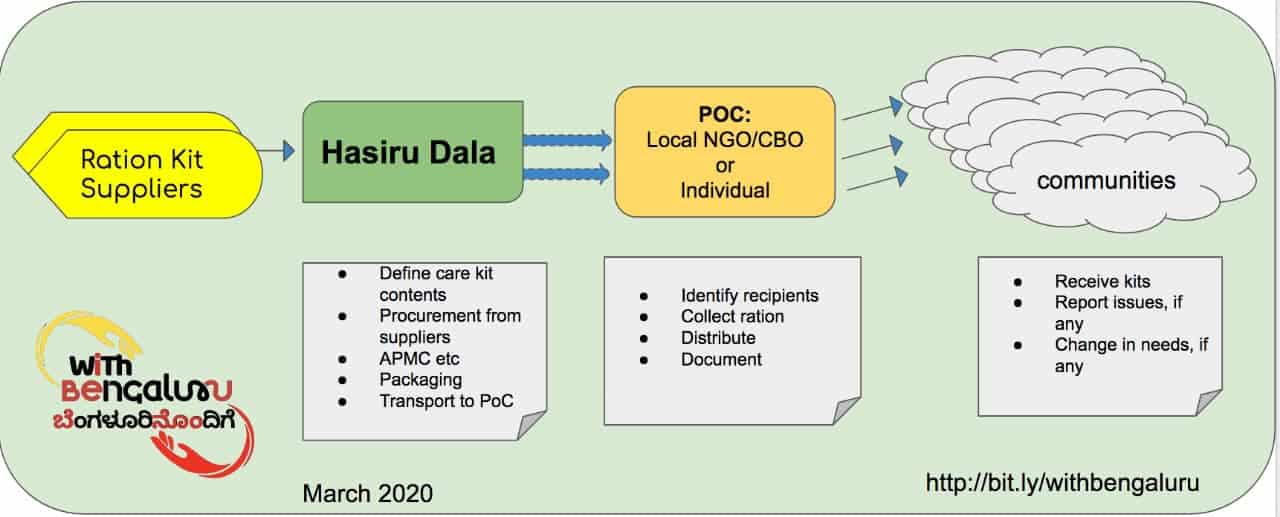
The process being used for supply. If you know of any groups or individuals that need help, you can inform WithBengaluru.
WithBengaluru is also collaborating with government agencies to create food security, leverage Indira Canteens, use the PDS system, ensure prices are in check, etc. Multiple efforts are needed as the scale of the problem is quite large.
This is an earnest appeal to whoever reading this, to make a contribution.
Three things you can do right now
- Make a contribution. No amount is too small. Together, we can make a difference.
Donate now: Time To Be ‘WithBengaluru’ Fundraiser - Tell your friends and encourage them to make a contribution.
- If you know of any group that needs help, tell us. WhatsApp/SMS their contact, location, and count to 98455 37269.
Details for direct bank transfer and UPI
| UPI: rzpy.givetomlpwithben0001@hdfcbank Or Virtual account name: With Bengaluru – Milaap Account number: 2223330039224919 IFSC code: RATN0VAAPIS Bank name: RBL Click here to read the instructions before you make a bank transfer. |
This work started a few days ago and we keep getting more requests everyday. So we realised we needed to reach out to the world!
People associated WithBengaluru are Meera K, Nalini Shekar, Vinay Sreenivasa, Manohar Elavarthi, Aradhana Bhat, Kuldeep Dantewadia, Seema V S, Srinivas Alavilli, Gurumoorthy Mathrubhootam, Manaswini Bhalla, Smitha Kalyani, Gangadhar Sulkunte, Venkatraman Iyer, Gautam Prakash, Rifa Khan, and many more.
For more information, email us at withbengaluru@hasirudala.in or join our Facebook group for regular updates.