Over the past two decades, Chennai has weathered a tsunami, repeated floods, and now, according to a new study, a rapidly worsening mix of heat and rain. Heatwave-preconditioned extreme rainfall events in the Chennai Metropolitan Area have nearly tripled over four decades, rising from an average of 1.2 events a year between 1982 and 1991 to 3.2 events a year between 2012 and 2021.
When a heatwave comes before the rain, the same study finds, the population exposed to flooding rises elevenfold and the number of buildings affected rises seven-fold. A separate assessment projects that heatwave days in the city could double by 2030.
Chennai sits on India’s eastern seaboard, in a belt where the Bay of Bengal generates far more cyclones than the Arabian Sea, a pattern driven by the bay’s warmer, less saline waters, and its flat, low-lying, densely built terrain adds further vulnerability on top of that exposure.
This study, by Habitat Forum (INHAF), is now being shared with around 200 prominent citizens across Chennai, along with an executive summary, as part of a wider consultation. The aim is simple: the master planning process needs broader coverage, a more inclusive agenda, and more effective public participation, and this effort is meant to help build that.
Three plans, one pattern
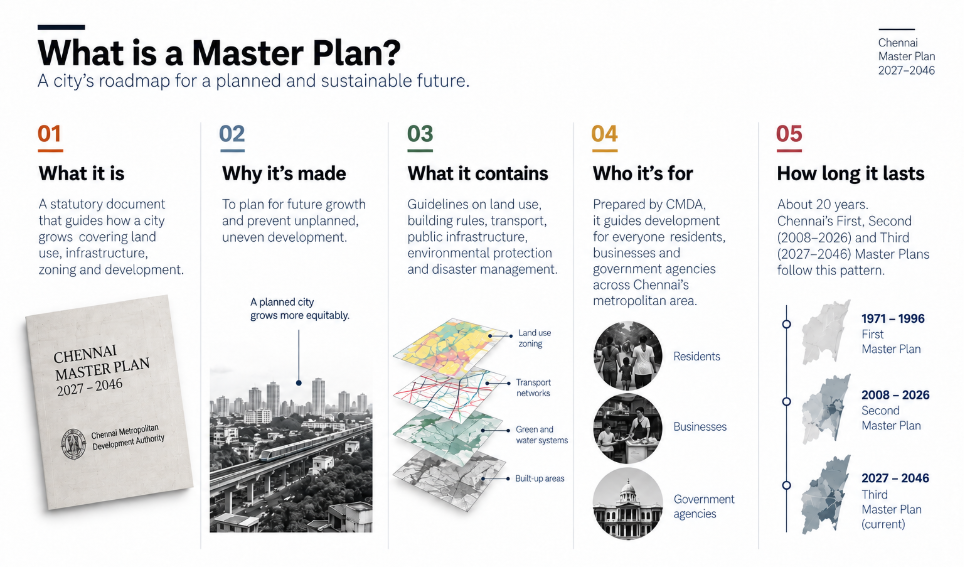
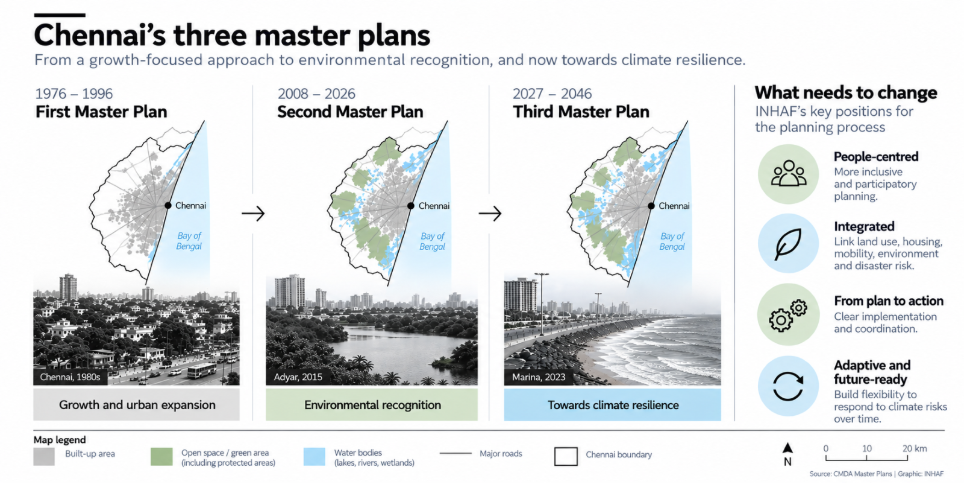
Chennai has written two master plans and is now preparing its third, the statutory documents through which Chennai Metropolitan Development Authority (CMDA) guides the city’s land use, infrastructure and growth over roughly two decades at a time. The study examined the First and Second Master Plans in full to assess how each addressed climate risk and tracked the Third Master Plan’s ongoing preparation through publicly available information, since it has not yet been finalised or opened for public review. The pattern found in the first two plans is one of arriving late.
Read more: Shaping the future of Chennai through the Third Master Plan
The First Master Plan, drawn up decades ago, contained no provisions for climate resilience at all. The Second Master Plan, in force from 2008 to 2026, only began addressing climate risk after the city was hit by the 2004 tsunami and the 2015 floods, and its approach stayed reactive rather than anticipatory. Quarterly review committees meant to keep the plan current sat largely inactive between 2009 and 2012, and new climate science that emerged after 2015 was never systematically folded back in.
The Third Master Plan, covering 2027 to 2046, is now being prepared, at a moment when Chennai has more climate data and more institutional attention on the subject than ever before. Whether it becomes the plan that finally treats climate risk as a foundation rather than an afterthought is still an open question.
What the new plan gets right
Compared with its predecessors, the Third Master Plan does bring real shifts in approach. It moves away from horizontal sprawl toward a compact, vertical growth model, raising the Floor Space Index along transit corridors instead of continually expanding the city’s footprint, a shift meant to hold growth within the existing 1,189 sq km metropolitan area even as CMDA’s own regional planning remit expands to 5,904 sq. km.
It formally maps and protects water bodies and green spaces as blue-green infrastructure, treating them as flood-management assets rather than land available for construction. A Project Management Unit has been set up within CMDA to oversee implementation, staffed in part through the Jameel C40 Urban Planning Climate Lab partnership, and the plan draws on technical studies covering flood mapping and land valuation rather than generic projections.
Climate action is also being mainstreamed through the Jameel C40 Urban Planning Climate Lab, expected to bring in vulnerability mapping and a net-zero emissions roadmap for 2050.
What more could the new plan deliver?
The Third Master Plan has an opportunity to go beyond planning for growth and build stronger systems for managing the risks that Chennai already faces. One of the clearest areas is managed retreat. Despite repeated flood events displacing thousands of residents over the years, Chennai has no mechanism to identify safe relocation areas in advance or define the rights of communities that may need to move.
The plan could establish a clear framework for managed retreat, alongside climate adaptive infrastructure standards and community led risk reduction. These measures would strengthen its stated shift from reactive relief towards proactive risk reduction, in line with the Tamil Nadu State Disaster Management Policy 2023 and the Chennai Disaster Management Plan 2023.
The plan also needs to actively enable Chennai’s role as an economic growth engine. Planning for economic development, not just land use and infrastructure, is essential if the city is to grow while managing its risks.
Equally, the informal economy, which employs a large share of the city’s workforce, must be fully integrated into the plan rather than treated as a peripheral or symbolic concern. This means planning for informal livelihoods and workspaces, not only for informal housing.
There is also an opportunity to make climate risk a more explicit part of development controls, so that decisions on where and how the city grows account for future hazards rather than responding to them after they occur. With Chennai’s population projected to reach around 15 million by 2030, embedding these measures into the master plan now could help ensure that future growth does not deepen existing vulnerabilities.
Gaps in governance
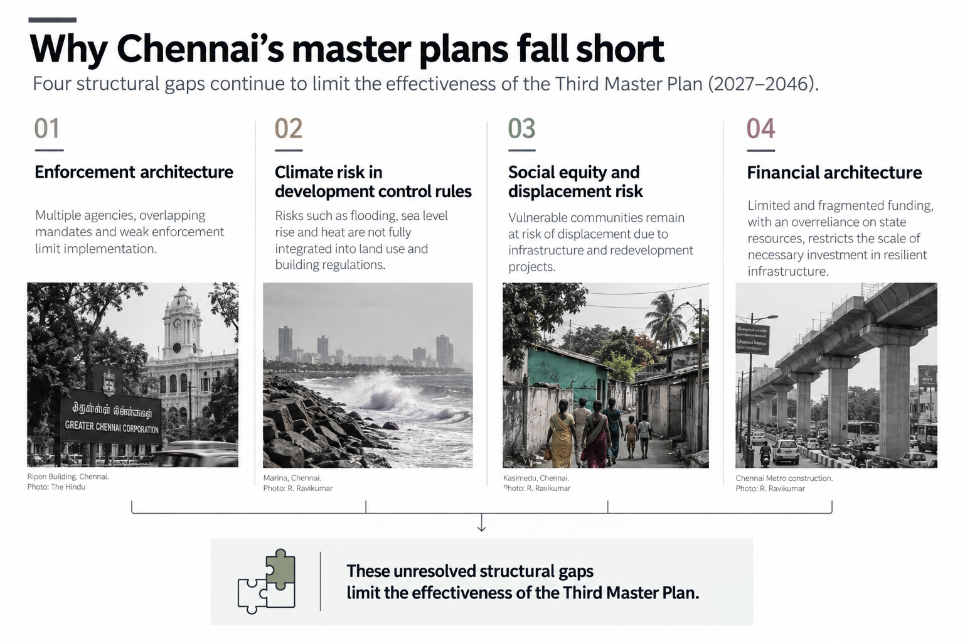
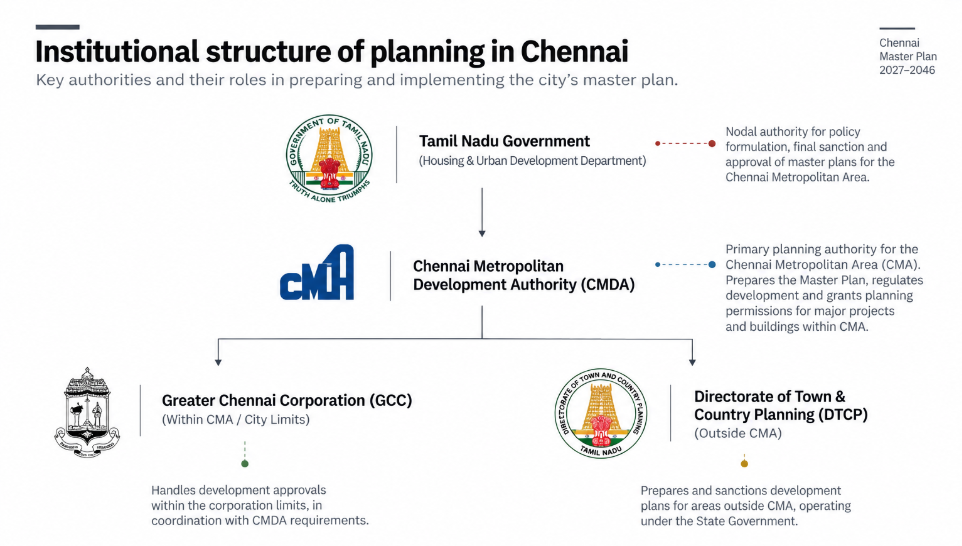
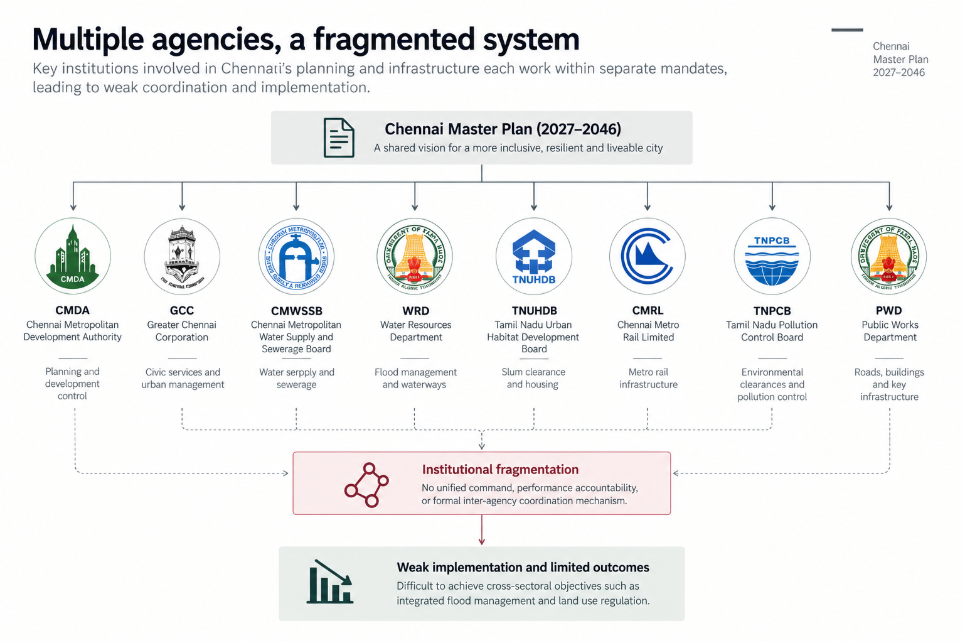
Governance carries a similar story. The city’s earlier plans were undermined less by weak policy design than by weak institutions to carry them out. The CMDA has delivered large projects such as the Metro Rail, but monitoring of land-use violations has often been weak, resulting in unauthorised development and the loss of water bodies that once buffered the city against flooding.
Fixing this requires revamping the master planning machinery itself: better availability and use of data, the involvement of skilled resource persons beyond thematic consultants, and a monitoring system that is actually enforced. A guiding principle should be not to repeat past mistakes, above all the destruction of the city’s natural water system.
Source: CMDA, Government of Tamil Nadu. Graphic: INHAF
How do other cities fare?
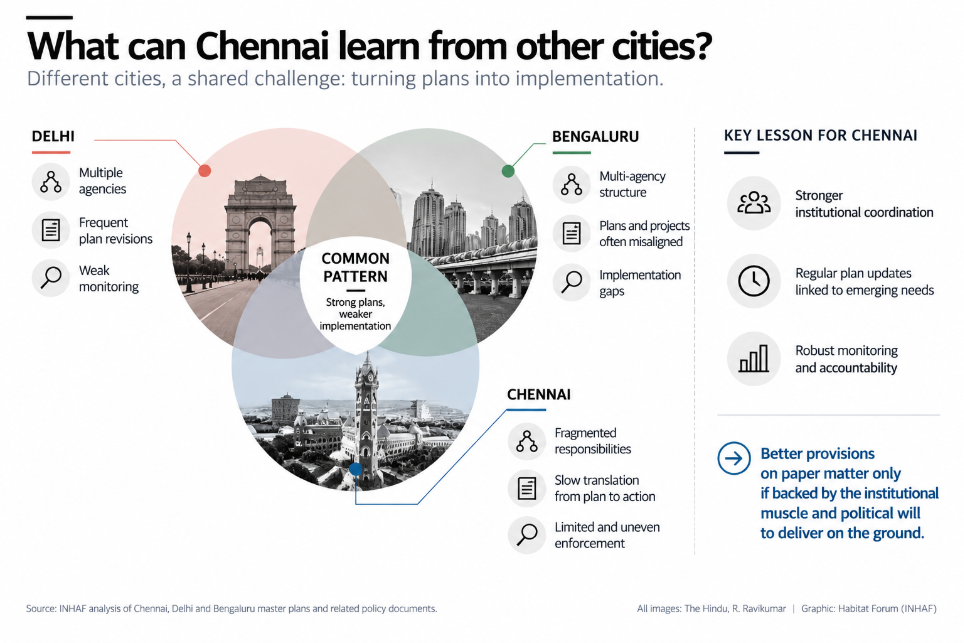
Chennai’s experience is not unique among Indian metropolitan regions. Cities such as Delhi and Bengaluru have faced comparable gaps between what their plans promise and what actually gets delivered, often for similar reasons: responsibilities split across agencies, weak coordination mechanisms, and monitoring systems that exist on paper more than in practice. The lesson for Chennai is that better provisions on paper will count for little without the institutional muscle, and the political will, to enforce them.
What would it take to close the gap
A few shifts, drawn from the INHAF study, would move the Third Master Plan from a well-intentioned document to an enforceable one.
Recommendations:
- Make managed retreat and climate-adaptive infrastructure standards statutory requirements, not aspirations.
- Upgrade informal settlements in place instead of relocating residents to the city’s outskirts.
- Set up regular coordination between the Greater Chennai Corporation, the CMDA, Metro water, the Electricity Board, Traffic Police and Metro Rail at the ward level, so problems get resolved locally instead of escalating upward.
- Give ward-level officials real decision-making authority and budgets to fix problems quickly.
- Enforce rainwater harvesting through law rather than incentives, starting with government buildings.
- Integrate the informal economy into the plan by protecting informal livelihoods and workspaces, not just settlements.
- Build a resource inventory for plan implementation, mapping the funds, assets and capacities needed to actually deliver.
Check out the executive summary of the INHAF study here.